Why does the old man keep resurrecting?
6 min read
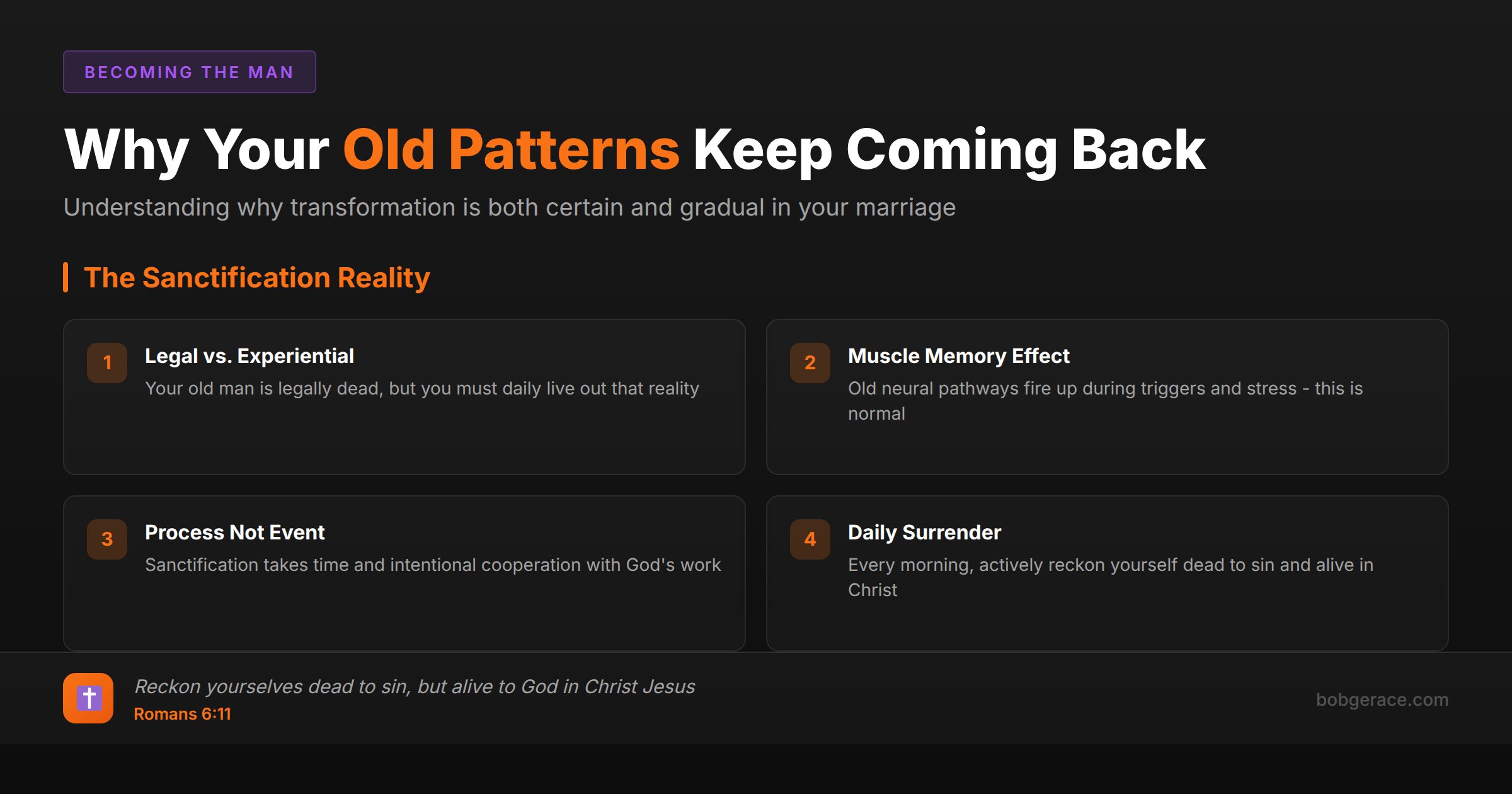
The 'old man' keeps resurrecting because sanctification is a process, not a one-time event. While you've been declared dead to sin positionally through Christ, you must daily choose to live out that reality. Your flesh doesn't automatically disappear at salvation - it requires constant surrender and the Holy Spirit's empowerment to walk in newness of life. Think of it like this: the old man is legally dead, but his influence lingers like muscle memory. Every time you face familiar triggers or stressful situations in your marriage, those old neural pathways want to fire up again. This isn't a sign of spiritual failure - it's the normal Christian experience that requires intentional cooperation with God's transforming work.
The Full Picture
Here's what's really happening when you feel like your 'old man' keeps coming back to life: You're experiencing the tension between your position and your practice.
Positionally, Scripture is clear - you died with Christ and were raised to new life (Romans 6:6-11). That's settled. Done. The old you that was enslaved to sin has been crucified. But practically, you still live in a fallen body with ingrained patterns, in a fallen world with constant temptations.
This creates what theologians call the 'already but not yet' reality. You're already new in Christ, but you're not yet experiencing the fullness of that transformation. It's like being legally freed from prison but still having prison habits.
In your marriage, this shows up as: - Reacting with the same defensiveness you swore you'd overcome - Falling back into criticism patterns you thought you'd buried - Finding yourself in the same arguments with the same toxic dynamics - Feeling like you're two steps forward, three steps back
The key insight: the old man isn't actually resurrecting - you're choosing to put him back on like old clothes. Romans 6:11 says to 'reckon yourselves dead to sin.' That word 'reckon' means to actively consider, calculate, and choose to believe what's true.
Your marriage transformation isn't about trying harder or being more spiritual. It's about consistently choosing to live from your new identity rather than your old patterns. The old man has no real power - only the power you give him through agreement and cooperation.
This is why some days you feel like a completely different person (walking in the Spirit) and other days you feel like the same broken spouse you've always been (walking in the flesh). Both experiences are real, but only one reflects your true identity in Christ.
What's Really Happening
From a clinical perspective, what couples describe as the 'old man resurrecting' aligns perfectly with our understanding of neuroplasticity and behavioral change. Your brain has spent years - maybe decades - wiring specific response patterns in your marriage relationship.
When your spouse triggers you, your brain doesn't pause to consult your theology - it defaults to the most established neural pathway. That's why you can know better, want to do better, and still find yourself reacting the same destructive way. This isn't spiritual immaturity; it's neuroscience.
Here's what makes lasting change possible: Your brain can be rewired, but it requires consistent, intentional practice over time. Every time you choose a new response - even when it feels forced or unnatural - you're literally building new neural pathways. The old pathways don't disappear immediately, but they weaken with disuse.
I see three critical factors in couples who successfully overcome these patterns:
1. They stop interpreting setbacks as spiritual failure. Instead, they see them as data points showing where more work is needed.
2. They create environmental supports - accountability, prayer, practical triggers that remind them of their new identity before they're in the heat of conflict.
3. They practice new responses when they're NOT triggered. You can't build new muscle memory in the middle of an argument.
The theological truth that you're a new creation provides the foundation, but lasting change requires partnering with God through practical, repetitive choices that literally reshape your brain's default responses.
What Scripture Says
Scripture gives us a clear framework for understanding why transformation is both certain and gradual:
Romans 6:6-7 - 'Our old man was crucified with Him, that the body of sin might be done away with, that we should no longer be slaves of sin. For he who has died has been freed from sin.' Your old nature is legally dead - this is your position before God.
Romans 6:11 - 'Reckon yourselves to be dead indeed to sin, but alive to God in Christ Jesus our Lord.' The word 'reckon' is an accounting term meaning to actively consider something true. You must daily choose to live from this reality.
Galatians 5:16-17 - 'Walk in the Spirit, and you shall not fulfill the lust of the flesh. For the flesh lusts against the Spirit, and the Spirit against the flesh; and these are contrary to one another.' This describes the ongoing tension every believer experiences.
Ephesians 4:22-24 - 'Put off, concerning your former conduct, the old man which grows corrupt according to the deceitful lusts, and be renewed in the spirit of your mind, and that you put on the new man which was created according to God.' Notice the active verbs - putting off and putting on are daily choices.
2 Corinthians 5:17 - 'If anyone is in Christ, he is a new creation; old things have passed away; behold, all things have become new.' Your identity is secure, even when your experience doesn't always match.
Philippians 2:12-13 - 'Work out your own salvation with fear and trembling. For it is God who works in you both to will and to do for His good pleasure.' Transformation is both God's work and your responsibility - a divine partnership, not passive waiting.
What To Do Right Now
-
1
Stop condemning yourself for setbacks - they're part of the growth process, not evidence of spiritual failure
-
2
Identify your specific triggers and create a plan for how you'll respond differently next time
-
3
Practice new responses when you're calm - rehearse how you want to handle conflict before it happens
-
4
Develop a daily habit of 'reckoning' - actively reminding yourself who you are in Christ each morning
-
5
Create accountability with your spouse or trusted friend who can speak truth when old patterns emerge
-
6
Celebrate small wins - every time you choose differently, even slightly, you're building new neural pathways
Related Questions
- What does Paul mean by 'what I don't want to do, I do'?
- What is the role of the flesh vs. spirit?
- What does 'renewing of the mind' actually require?
- How do I put off the old man when he keeps showing up?
- What is the relationship between grace and effort?
- What does Scripture say about sanctification timelines?
- Why do I repeat patterns I hate?
- How do I break destructive patterns?
- What are 'neural pathways' and why do patterns persist?
- I keep making the same mistakes
Also find Bob on
Subscribe for weekly videos on Christian marriage.
Your Marriage Isn't a Template Case
The old man resurrects differently in your specific triggers, your history, your wife's actual responses. A coach sees what you can't see alone and calibrates the work to your marriage, not a generic plan.
Talk to Bob →