What emotions are 'allowed' for men?
6 min read
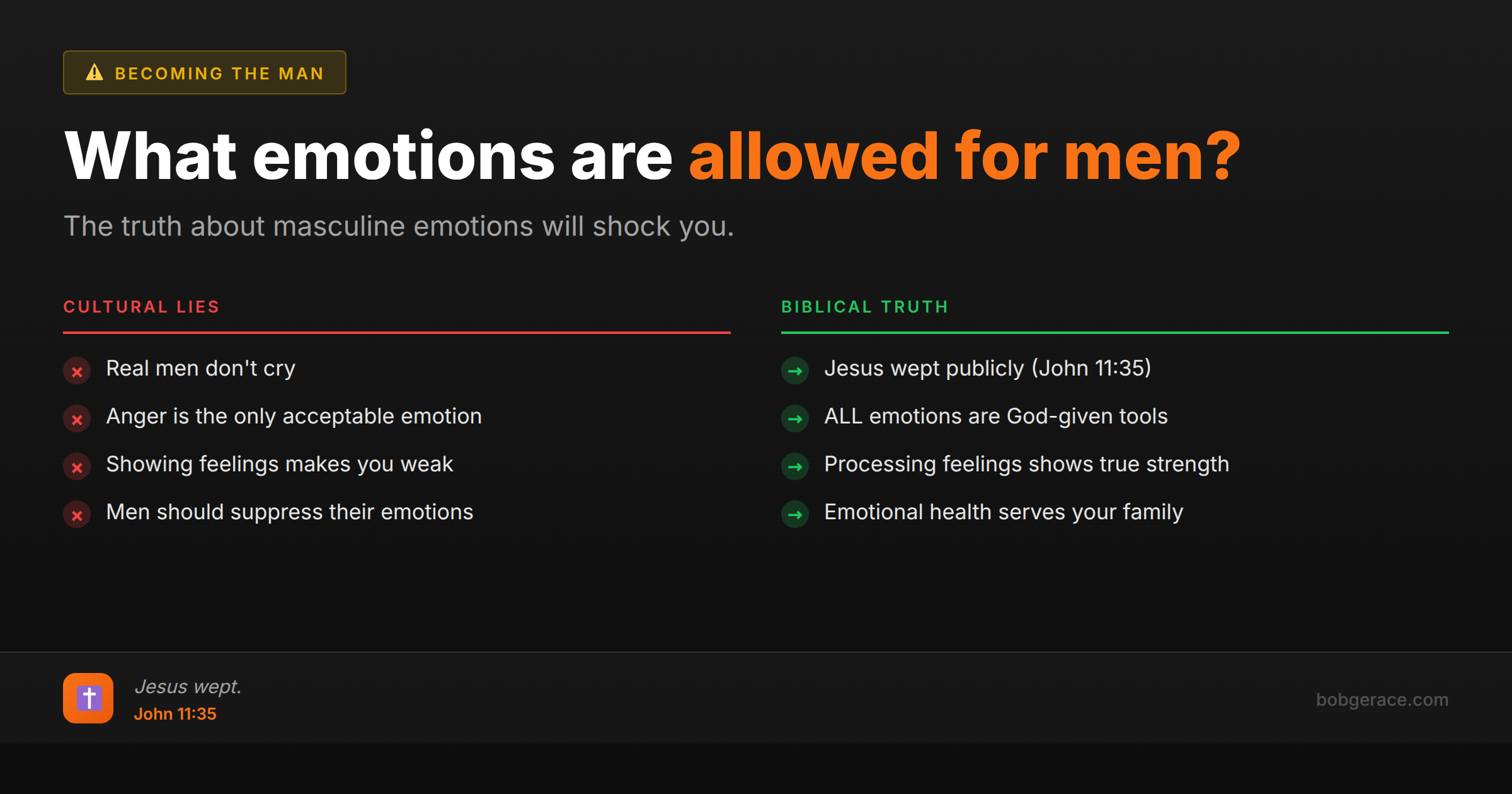
Here's the truth: ALL emotions are allowed for men. The idea that men should only express anger or hide their feelings is cultural garbage, not biblical truth. God created you with the full spectrum of human emotion for a reason - they're information systems that help you navigate life, relationships, and your calling. The problem isn't your emotions; it's what our culture taught you to do with them. Real strength isn't suppressing your feelings - it's learning to process them in healthy ways that honor God and serve your family. When you embrace your emotional reality instead of fighting it, you become the husband, father, and leader God designed you to be.
The Full Picture
Let me be crystal clear: the "strong, silent type" who stuffs his emotions is not biblical masculinity - it's broken masculinity. This lie has destroyed more marriages, families, and men than we can count.
The Cultural Con Job
Somewhere along the way, we bought into the myth that "real men" only feel anger, lust, and maybe hunger. Everything else - sadness, fear, joy, tenderness - got labeled as "weakness" or "feminine." This is absolute nonsense.
What This Actually Creates: - Marriages where your wife feels like she's married to a robot - Children who never see authentic emotional modeling - Internal pressure that eventually explodes in destructive ways - Spiritual disconnection because you can't relate to a God who feels deeply
The Emotional Spectrum Reality
God gave you emotions as a guidance system. They're not the enemy - they're information. Fear tells you about threats. Sadness signals loss. Joy celebrates blessing. Anger identifies injustice. When you shut down this system, you're flying blind.
The Real Problem
It's not that you have emotions - it's that nobody taught you what to do with them. Most men learned to either explode or implode. Neither works. The answer is learning emotional intelligence and regulation, not emotional suppression.
Your wife doesn't need you to be an emotionless machine. She needs you to be a man who can feel deeply, process wisely, and respond with strength and tenderness.
What's Really Happening
From a clinical perspective, emotional suppression in men creates a cascade of problems that impact every area of life. When men are taught that only certain emotions are "acceptable," they often develop what we call emotional alexithymia - an inability to identify and express emotions.
This isn't just about feelings - it's neurological. The brain's emotional processing centers (limbic system) don't shut off just because you ignore them. Instead, suppressed emotions get rerouted through less healthy pathways, often emerging as physical symptoms, explosive anger, or addictive behaviors.
In marriage therapy, I consistently see how emotional suppression creates intimacy barriers. Women report feeling "shut out" or "married to a stranger." This isn't because their husbands don't feel - it's because they've been conditioned to hide those feelings, even from themselves.
The research is clear: men who develop emotional intelligence and expression skills have stronger marriages, better physical health, and more resilient stress responses. Emotional expression isn't weakness - it's actually a sign of advanced emotional regulation and secure attachment.
The goal isn't to become emotionally reactive, but emotionally responsive. This means recognizing what you feel, understanding why you feel it, and choosing how to express it in ways that build connection rather than create distance.
What Scripture Says
Scripture demolishes the myth that godly men are emotionless. Look at the men God calls mighty warriors and faithful servants:
Jesus - The Perfect Man "Jesus wept." (John 11:35) The Son of God cried publicly. He also expressed anger at injustice (Matthew 21:12), felt compassion for crowds (Matthew 9:36), and experienced deep anguish in the garden (Luke 22:44).
David - A Man After God's Heart The Psalms are David's emotional journal. "I am worn out from my groaning. All night long I flood my bed with weeping and drench my couch with tears." (Psalm 6:6) This warrior-king processed his full emotional range before God.
Paul - The Apostle "I have great sorrow and unceasing anguish in my heart." (Romans 9:2) Paul openly shared his emotional struggles with the churches he served.
God's Emotional Reality Scripture reveals God as deeply emotional: "The Lord your God is with you, the Mighty Warrior who saves. He will take great delight in you; in his love he will no longer rebuke you, but will rejoice over you with singing." (Zephaniah 3:17)
The Command to Feel "Rejoice with those who rejoice; mourn with those who mourn." (Romans 12:15) You can't obey this without emotional engagement.
Biblical masculinity isn't about emotional suppression - it's about emotional wisdom and regulation in service of love, justice, and God's kingdom.
What To Do Right Now
-
1
Start an emotion journal - Write down what you feel each day, even if you can only identify "good," "bad," or "angry" at first
-
2
Practice the pause - When you feel something strong, take three deep breaths before reacting or shutting down
-
3
Use feeling words with your wife - Instead of "I'm fine," try "I'm frustrated" or "I'm worried about work"
-
4
Ask for what you need - "I need to process this" or "I need some encouragement" are strength statements, not weakness
-
5
Study Jesus's emotional expressions - Read the Gospels specifically looking for how Christ handled his emotions
-
6
Get professional help if needed - If emotions feel overwhelming or you've stuffed them for years, a counselor can help you develop healthy patterns
Related Questions
- Why do men struggle with emotions?
- What is 'normative male alexithymia'?
- How were boys socialized away from feeling?
- What is the 'man box' and how do I get out?
- What is the cost of emotional suppression?
- Men aren't supposed to feel — is that true?
- I can't control my anger
- What's underneath my anger?
- Why does anger feel like the only accessible emotion?
- What does Scripture say about male emotionality?
Also find Bob on
Subscribe for weekly videos on Christian marriage.
You Don't Have to Figure This Out Alone
Coaching means a human who knows your specific marriage, sees where you're stuck, and helps you process what's actually happening in your relationship. Not theory—your story.
Talk to Bob →