What if God tells me to stay and she still leaves?
6 min read
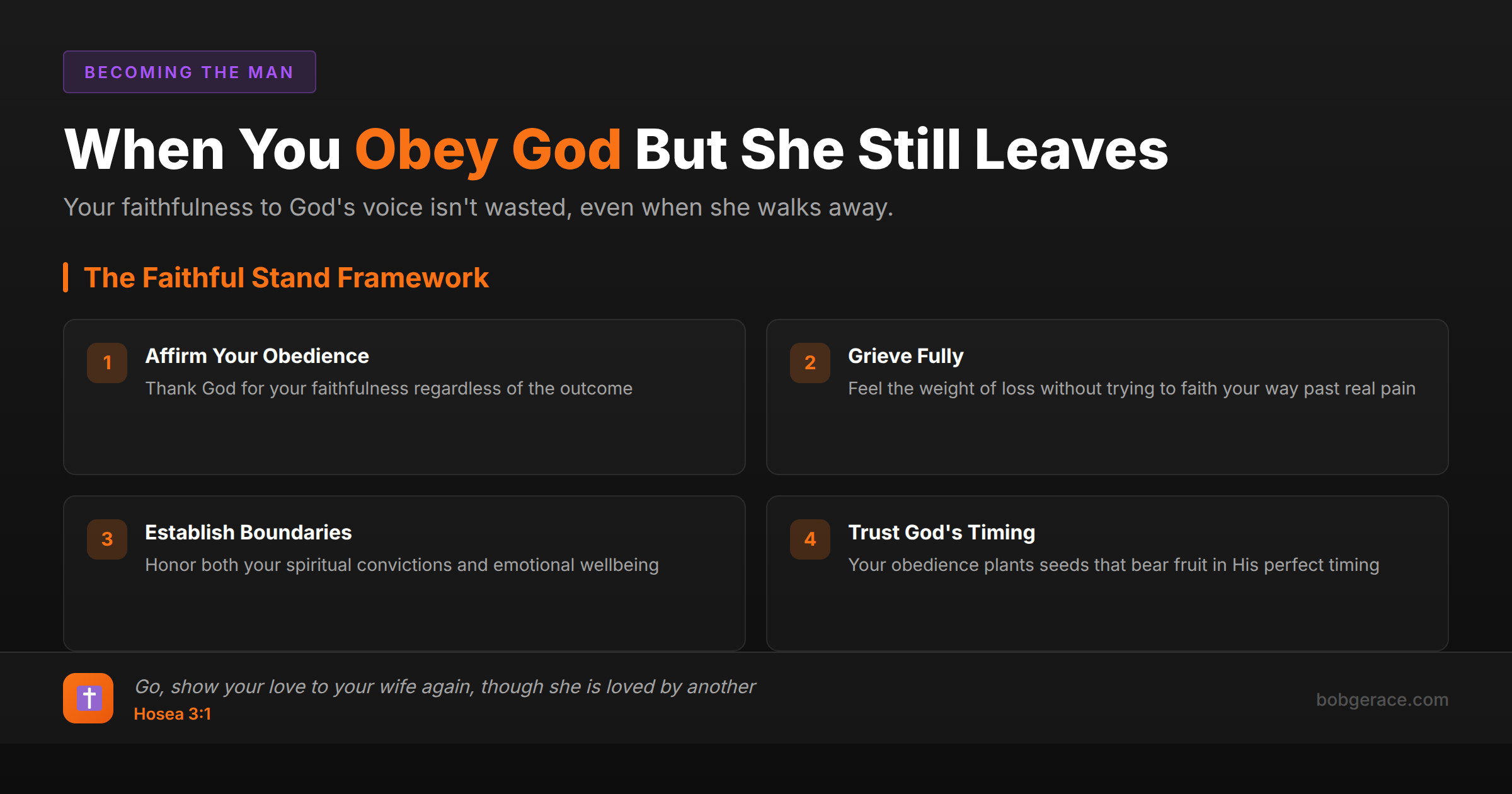
This is one of the most heart-wrenching situations a Christian husband can face - when you sense God calling you to fight for your marriage, but your wife chooses to walk away anyway. First, understand that your obedience to God's leading doesn't guarantee the outcome you desire. God's will often includes allowing others to make their own choices, even destructive ones. Your faithfulness in staying when God told you to stay is not wasted. It demonstrates your character, your commitment to God's voice, and your willingness to love sacrificially even when it costs you everything. Sometimes God calls us to stand in the gap not because it will change the immediate situation, but because it changes us and honors Him. Your obedience plants seeds that may bear fruit in ways and timing you cannot see.
The Full Picture
When God tells you to stay and she leaves anyway, you're experiencing one of faith's most difficult paradoxes - being obedient to God while watching your world fall apart. This isn't a failure of faith or a sign you misheard God. It's often exactly what faithful love looks like in a broken world.
Understanding God's will versus human choice is crucial here. God's will for your marriage may be restoration, but His will also includes respecting the free will He's given your spouse. Your wife has the power to choose separation even when God is calling for reconciliation. This doesn't negate God's plan - it reveals the tension between divine desire and human agency.
Your obedience has purpose beyond the immediate outcome. When God tells you to stay, He's often working on multiple levels: developing your character, demonstrating His love through you, creating opportunities for His power to be displayed, and yes - keeping the door open for restoration if your wife chooses it. Your faithfulness becomes a powerful testimony of God's unchanging love even when human love fails.
The pain you're feeling is valid and expected. God doesn't call you to stay so you can be emotionally numb about the loss. Jesus wept over Jerusalem even knowing God's ultimate plan. Your grief over your wife's choice to leave doesn't contradict your faith - it confirms that you're human and that love always involves risk. Let yourself feel the full weight of this loss while continuing to trust God's bigger picture.
What's Really Happening
From a psychological perspective, you're dealing with what we call 'ambiguous loss' - grief over someone who is physically absent but psychologically present in your daily thoughts and decisions. This creates a unique form of trauma because there's no clear closure or resolution.
Your brain is also processing conflicting information: your faith system says obedience to God leads to blessing, but your lived experience shows obedience leading to pain. This cognitive dissonance can create intense internal stress and even spiritual crisis if not properly understood and processed.
What's happening neurologically is that your attachment system is in overdrive. Even though you chose to stay in obedience to God, your brain interprets your spouse's leaving as rejection and abandonment. This triggers deep survival responses including hypervigilance, rumination, and desperate attempts to understand 'why' this happened despite your faithfulness.
The key to healing is integrating your spiritual understanding with your emotional reality. Your feelings of loss, anger, confusion, and even doubt are normal trauma responses, not signs of weak faith. Processing these emotions fully, while maintaining your spiritual framework, allows for genuine healing rather than spiritual bypassing of real pain.
What Scripture Says
Scripture gives us clear examples of faithful people who obeyed God and still experienced painful outcomes. Hosea 3:1 shows God commanding Hosea to love his unfaithful wife even when she continued pursuing other lovers: *'The Lord said to me, "Go, show your love to your wife again, though she is loved by another lover and is an adulteress. Love her as the Lord loves the Israelites."'* Hosea's obedience didn't immediately change Gomer's heart.
Isaiah 55:11 reminds us that God's word never returns empty: *'So is my word that goes out from my mouth: It will not return to me empty, but will accomplish what I desire and achieve the purpose for which I sent it.'* Your faithfulness in staying when God told you to stay accomplished something significant in the spiritual realm, regardless of your wife's response.
Romans 8:28 doesn't promise easy outcomes but purposeful ones: *'And we know that in all things God works for the good of those who love him, who have been called according to his purpose.'* This includes the good that comes from your character being refined through suffering and your testimony being strengthened through faithfulness under fire.
1 Peter 3:1 specifically addresses loving an unwilling spouse: *'Wives, in the same way submit yourselves to your own husbands so that, if any of them do not believe the word, they may be won over without words by the behavior of their wives.'* While this verse addresses wives, the principle applies - sometimes our faithful behavior becomes the sermon when words fail.
What To Do Right Now
-
1
Affirm your obedience: Write down the ways God led you to stay and thank Him for your faithfulness, regardless of the outcome
-
2
Grieve fully: Allow yourself to feel the full weight of loss without trying to 'faith' your way past real pain
-
3
Establish boundaries: Create healthy boundaries that honor both your spiritual convictions and your emotional wellbeing
-
4
Document God's faithfulness: Keep a record of how God sustains and provides for you during this season of loss
-
5
Stay connected: Maintain relationships with trusted friends and spiritual mentors who can support you through this process
-
6
Prepare for the long game: Recognize this may be a marathon of faith, not a sprint, and pace yourself accordingly
Related Questions
- Does God want me to stay in this marriage?
- How do I know God's will in this?
- Is my suffering redemptive?
- How do I discern God's will for my marriage?
- What does faithfulness require when she won't reciprocate?
- How long should I 'stand' for my marriage?
- How long do I wait before giving up?
- When is it actually over?
- Does the Bible require me to stay after an affair?
Also find Bob on
Subscribe for weekly videos on Christian marriage.
When Obedience Doesn't Change the Outcome
A coach who knows your marriage can help you stay faithful to what God's asking without losing yourself when she still walks away.
Talk to Bob →