What if my leadership was the problem?
6 min read
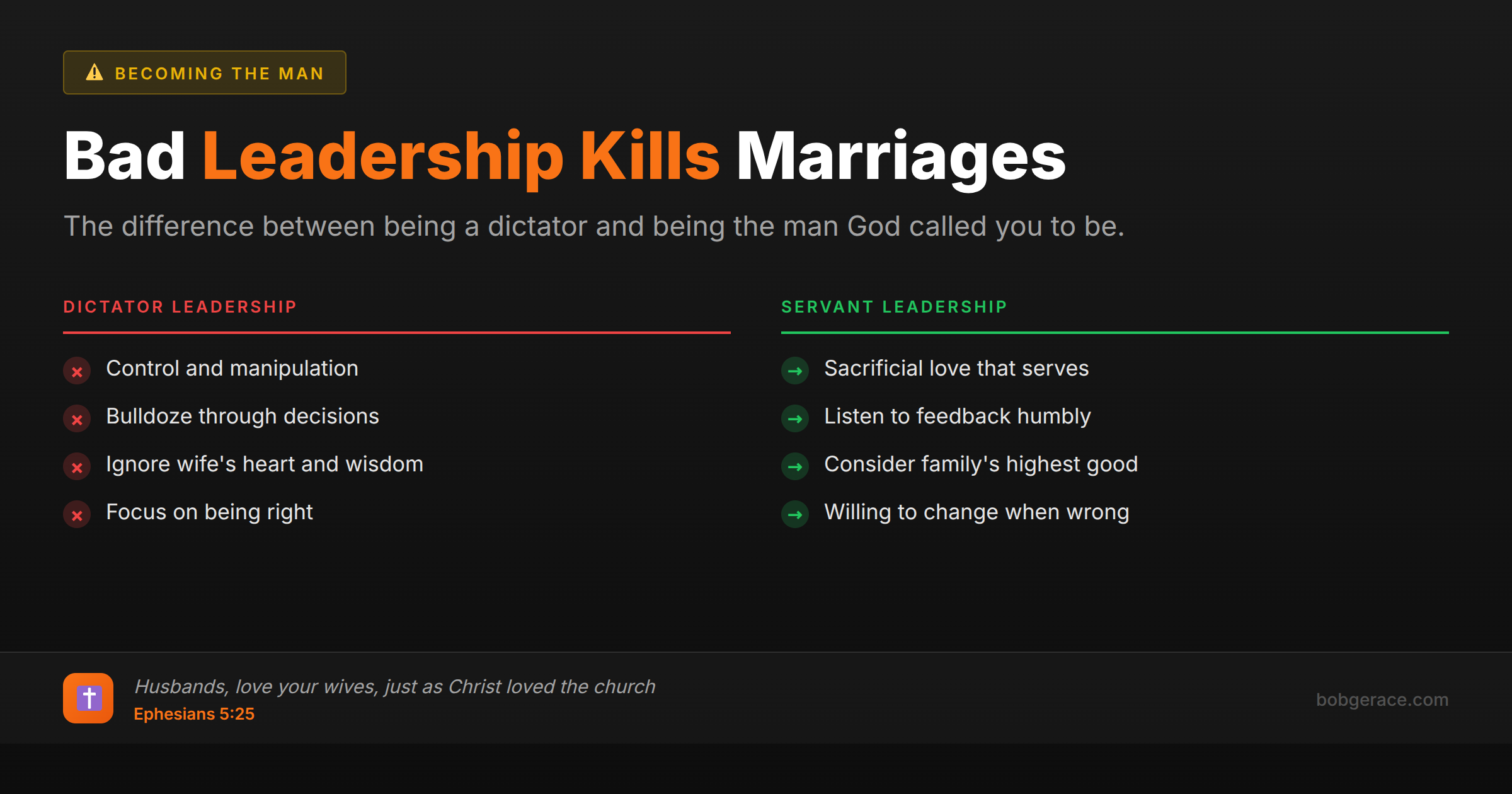
If you're asking this question, you're already showing the humility that true leadership requires. Bad leadership in marriage often looks like control, manipulation, or bulldozing through decisions without considering your wife's heart or wisdom. Maybe you've been a dictator instead of a servant-leader, or perhaps you've abdicated leadership entirely, leaving your wife to carry burdens that aren't hers to bear. The good news is that recognizing poor leadership is the first step toward becoming the man God called you to be. Real leadership isn't about being right or getting your way—it's about sacrificial love that serves your family's highest good. This requires you to examine your motives, listen to feedback, and be willing to change course when you've been wrong.
The Full Picture
The truth about failed leadership hits hard, but it's liberating. Most men who struggle with leadership in marriage fall into one of two camps: the bulldozer or the abdicator. Neither represents biblical masculinity.
The Bulldozer makes decisions unilaterally, dismisses his wife's concerns, and confuses dominance with leadership. He might say things like "I'm the head of this house" while completely missing what headship actually means. This man creates resentment, kills intimacy, and teaches his children that leadership equals control.
The Abdicator swings the opposite direction, avoiding decisions and responsibility altogether. He lets his wife carry the emotional and logistical weight of the family while he disengages. This isn't humility—it's cowardice dressed up as being "easy-going."
Both approaches fail because they're self-focused. The bulldozer protects his ego. The abdicator protects his comfort. Neither serves his family.
True leadership requires you to die to yourself daily. It means making decisions based on what's best for your family, not what's easiest for you. It means listening when your wife has concerns, even when it's inconvenient. It means taking responsibility for outcomes, even when things go wrong.
Here's what healthy leadership actually looks like: You create safety for your family to flourish. You make the hard decisions that others can't or won't make. You serve your wife's highest good, even when she doesn't understand it in the moment. You lead by example, not by demand. You're strong enough to be gentle and secure enough to admit when you're wrong.
The damage from poor leadership doesn't disappear overnight. Your wife may have built walls to protect herself from your control or stepped into roles you abandoned. Rebuilding trust takes time, consistency, and genuine change—not just promises.
What's Really Happening
When leadership becomes problematic in marriage, we often see a pattern of attachment disruption and power imbalances that create lasting relational trauma. The spouse on the receiving end of poor leadership frequently develops hypervigilance—constantly scanning for signs of the next controlling decision or leadership failure.
Neurologically, chronic exposure to domineering or absent leadership triggers the brain's threat detection system. The wife's nervous system learns to stay activated, ready to protect herself or step in when leadership fails. This creates a cycle where trust erodes, emotional intimacy decreases, and both partners become entrenched in adversarial roles.
What's particularly damaging is when leadership problems are justified through spiritual language. When biblical concepts like headship are weaponized to silence feedback or avoid accountability, it creates spiritual trauma alongside relational trauma. The receiving spouse may begin to associate God's design with their pain, complicating both their marriage and their faith.
Recovery requires understanding that healthy leadership is fundamentally about creating safety and fostering growth. Research shows that relationships thrive when there's a balance of influence, where both partners feel heard and valued in decision-making processes. The goal isn't to eliminate masculine leadership but to transform it into something that serves rather than dominates.
Repair work must address both the behavioral patterns and the underlying beliefs driving them. Often, problematic leadership stems from childhood modeling, cultural messages about masculinity, or deep insecurities about worth and competence. Lasting change requires examining these root issues while simultaneously practicing new ways of engaging with family members.
What Scripture Says
Scripture gives us the clearest picture of what leadership should look like, and it's radically different from worldly power structures.
Ephesians 5:25-26 commands: "Husbands, love your wives, just as Christ loved the church and gave himself up for her to make her holy, cleansing her by the washing with water through the word." This isn't about control—it's about sacrifice. Christ's leadership of the church involved dying for her benefit.
Mark 10:42-44 shows Jesus redefining leadership entirely: "You know that those who are regarded as rulers of the Gentiles lord it over them, and their high officials exercise authority over them. Not so with you. Instead, whoever wants to become great among you must be your servant, and whoever wants to be first must be slave of all."
1 Peter 3:7 gives specific instruction to husbands: "Husbands, in the same way be considerate as you live with your wives, and treat them with respect as the weaker partner and as heirs with you of the gracious gift of life, so that nothing will hinder your prayers." Notice that poor treatment of your wife directly impacts your relationship with God.
Philippians 2:3-4 addresses the heart issue behind poor leadership: "Do nothing out of selfish ambition or vain conceit. Rather, in humility value others above yourselves, not looking to your own interests but each of you to the interests of the others."
1 Corinthians 13:4-5 describes what love actually looks like in action: "Love is patient, love is kind. It does not envy, it does not boast, it is not proud. It does not dishonor others, it is not self-seeking, it is not easily angered, it keeps no record of wrongs."
Proverbs 27:6 reminds us that real love sometimes requires difficult conversations: "Wounds from a friend can be trusted, but an enemy multiplies kisses." Sometimes loving leadership means having hard conversations, but the motive is always your family's good, not your comfort.
What To Do Right Now
-
1
Own it completely - Have a conversation with your wife acknowledging specific ways your leadership has been harmful or absent, without defending or explaining
-
2
Ask for specific feedback - Request concrete examples of how your leadership style has affected her and the family, then listen without defending
-
3
Identify your leadership style - Honestly assess whether you tend to bulldoze, abdicate, or swing between both extremes in different situations
-
4
Examine your motives - Spend time in prayer asking God to reveal whether your decisions are driven by love for your family or self-protection
-
5
Start serving daily - Begin making small sacrificial choices that benefit your wife and children, expecting nothing in return
-
6
Get accountability - Find a mature man who will regularly ask you hard questions about how you're leading your family and call you out when necessary
Related Questions
- What does masculine leadership look like?
- How do I lead without controlling?
- What's the difference between leading and dominating?
- How do I reclaim authority I gave away?
- What is 'earned authority'?
- How do I lead when I've lost credibility?
- She says I killed her love over time
- How do I address years of built-up hurt?
- What are 'attachment injuries' and how many did I cause?
- What role did our relationship problems play?
Also find Bob on
Subscribe for weekly videos on Christian marriage.
You Don't Have to Rebuild This Alone
Changing how you lead your marriage is hard when you're the one inside it. A coach sees what you can't—where you're still controlling, where you're still abdicating, what your wife is actually responding to.
Talk to Bob →