What is healthy lament?
5 min read
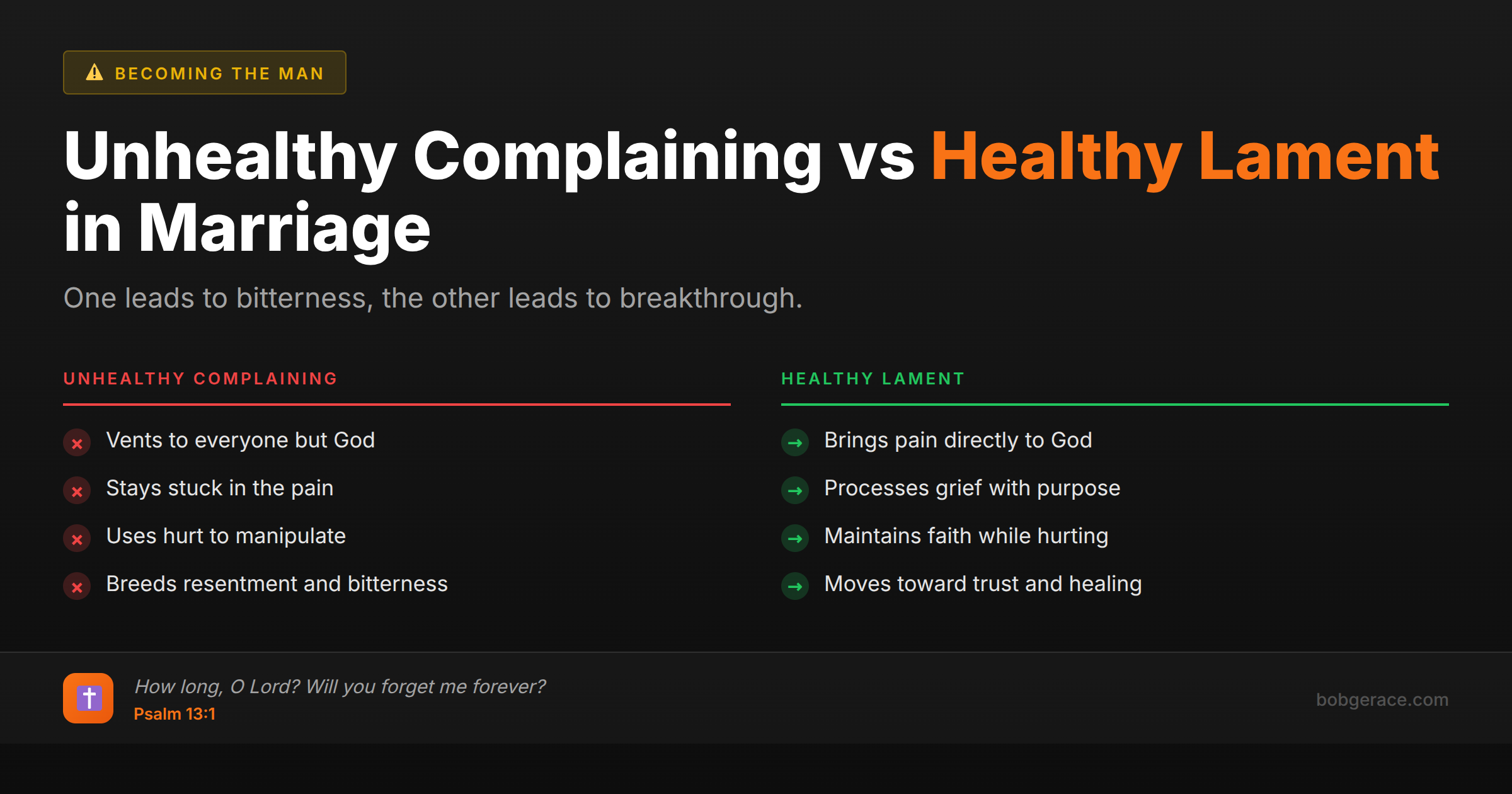
Healthy lament is the biblical practice of honestly expressing grief, disappointment, and pain to God while maintaining faith and hope. Unlike complaining or venting, lament follows a specific pattern: it acknowledges real suffering, brings that pain directly to God, and ultimately moves toward trust and praise. In marriage, healthy lament allows you to process deep disappointments—whether about your spouse, your relationship, or circumstances affecting your marriage—without becoming bitter or destructive. Healthy lament is not about staying stuck in pain or using your hurt to manipulate others. Instead, it's about being radically honest with God about your struggles while choosing to believe He is good and sovereign. This practice actually strengthens your faith and your marriage because it prevents resentment from building up and helps you process difficult emotions in a God-honoring way.
The Full Picture
Most Christian men have never learned the difference between healthy lament and destructive complaining. We're told to "count it all joy" and "give thanks in all circumstances," but we're rarely taught what to do with the deep disappointments that come with marriage and life.
Healthy lament is not: - Complaining to get your way - Venting to friends or family about your spouse - Staying stuck in bitterness - Demanding God change your circumstances - Using your pain to manipulate others
Healthy lament IS: - Honest expression of real pain to God - Submission to God's sovereignty even in suffering - Movement from despair toward hope - Faith-building through wrestling with God - Relationship-strengthening by processing hurt properly
In marriage, healthy lament might involve grieving the wife you thought you married, the intimacy you expected, or the partnership you envisioned. It's bringing those unmet expectations and real hurts to God instead of letting them fester or using them as weapons against your spouse.
The Psalms show us that God can handle our raw emotions. David didn't pretend everything was fine when it wasn't. He brought his complaints, his fears, his anger, and his confusion directly to God. But notice—most lament psalms end with declarations of trust and praise.
Healthy lament actually protects your marriage because it prevents you from becoming chronically resentful. When you process your disappointments with God first, you're free to love your spouse without the burden of unspoken expectations and unprocessed hurt.
What's Really Happening
From a therapeutic perspective, healthy lament serves as a crucial emotional regulation strategy that prevents the development of chronic resentment and depression. When men suppress difficult emotions or express them inappropriately, they often develop what we call 'emotional debt'—accumulated feelings that eventually demand payment through relationship conflict or personal dysfunction.
Neurologically, the process of lament activates the prefrontal cortex while calming the amygdala's fight-or-flight response. This creates space for higher-order thinking and genuine emotional processing. Unlike venting, which often reinforces negative neural pathways, lament includes elements of hope and surrender that literally rewire the brain toward resilience.
In marriages, I consistently see that men who practice healthy lament report greater emotional intimacy with their spouses. This occurs because lament requires vulnerability and emotional awareness—skills that directly transfer to marital communication. When a man can honestly acknowledge his disappointments to God, he's more capable of expressing needs and concerns to his wife without blame or manipulation.
The key therapeutic element is that lament includes both acknowledgment of pain AND movement toward acceptance and hope. This prevents the rumination cycles that characterize depression and the blame patterns that destroy marriages. Men who lament healthily develop greater emotional differentiation—they can feel deeply without being controlled by those feelings.
What Scripture Says
Scripture is filled with examples of godly men who practiced healthy lament. The book of Psalms alone contains over 60 lament psalms, showing us that honest grief is not only acceptable but necessary for spiritual health.
Psalm 13:1-2 - "How long, O Lord? Will you forget me forever? How long will you hide your face from me? How long must I wrestle with my thoughts and day after day have sorrow in my heart?"
David models radical honesty with God about his pain and confusion. He doesn't pretend to be fine when he's not.
Psalm 42:11 - "Why, my soul, are you downcast? Why so disturbed within me? Put your hope in God, for I will yet praise him, my Savior and my God."
This shows the movement from despair to hope that characterizes healthy lament. The psalmist acknowledges his depression but chooses to trust God.
Job 1:21 - "The Lord gave and the Lord has taken away; may the name of the Lord be praised."
Even in devastating loss, Job demonstrates how to grieve while maintaining faith in God's sovereignty.
Jeremiah 20:7 - "You deceived me, Lord, and I was deceived; you overpowered me and prevailed. I am ridiculed all day long; everyone mocks me."
Jeremiah brings his complaints directly to God, showing that even prophets struggled with disappointment and confusion.
Matthew 26:39 - "Going a little farther, he fell with his face to the ground and prayed, 'My Father, if it is possible, may this cup be taken from me. Yet not as I will, but as you will.'"
Jesus himself models healthy lament in Gethsemane—honest about his anguish but surrendered to the Father's will.
What To Do Right Now
-
1
Schedule weekly lament time - Set aside 20 minutes each week to honestly pour out your heart to God about marriage disappointments
-
2
Write out your complaints - Use the Psalms as a template to express your real feelings to God in writing
-
3
End with declarations of trust - Always conclude your lament by declaring something true about God's character
-
4
Stop venting to others - Commit to bringing your marriage frustrations to God first before discussing them with anyone else
-
5
Practice surrender prayers - Regularly pray 'Your will be done' regarding your unmet expectations in marriage
-
6
Study lament psalms weekly - Read one lament psalm each week to learn healthy patterns of expressing grief to God
Related Questions
- Did Jesus have emotions?
- What does Scripture say about male emotionality?
- What does David model about emotional expression?
- How do I pray when I'm angry at God?
- What is biblical lament?
- What psalms help in marital crisis?
- How do I pray through this?
- How do I lament biblically?
- What psalms speak to this kind of anguish?
- How do I pray when I can't form words?
Also find Bob on
Subscribe for weekly videos on Christian marriage.
Bring Your Actual Marriage to a Coach
You know what lament is. The hard part is doing it in your specific situation—when her disappointment feels personal, when your grief keeps cycling back. A coach who knows your story helps you practice this under real pressure.
Talk to Bob →