What is 'shoulder to shoulder' vs. 'face to face' connection?
6 min read
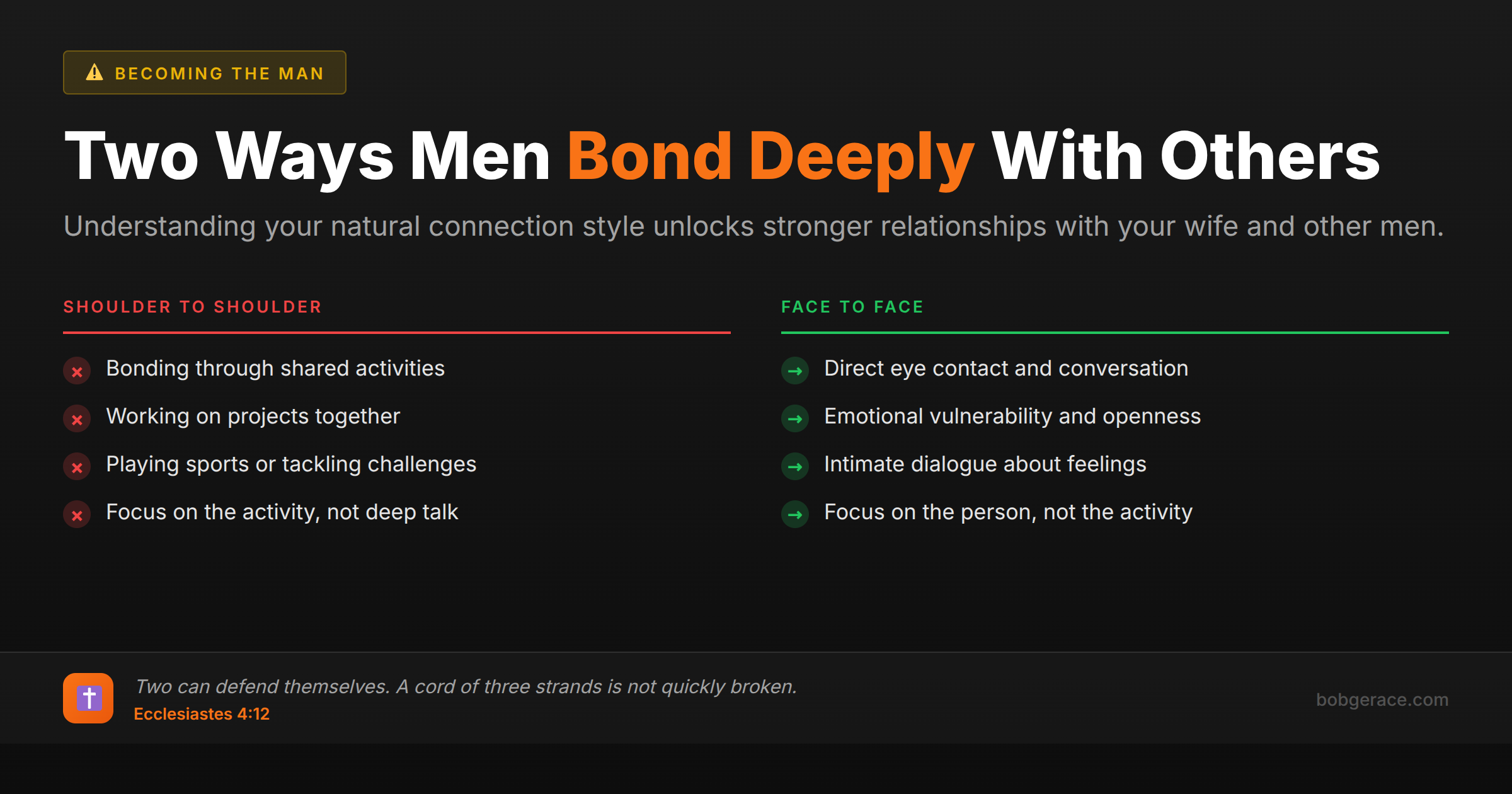
Shoulder to shoulder connection happens when men bond through shared activities and experiences - working on projects, playing sports, or tackling challenges together. The focus is on the activity, not necessarily deep conversation. Face to face connection involves direct eye contact, emotional vulnerability, and intimate conversation - the style women typically prefer. Most men naturally gravitate toward shoulder-to-shoulder bonding. We build trust and intimacy through doing things together rather than sitting across from each other talking about feelings. This isn't wrong or inferior - it's how God designed masculine connection. The problem comes when we only operate in one mode and miss opportunities for deeper intimacy with our wives or stronger brotherhood with other men.
The Full Picture
Understanding these two connection styles will revolutionize your relationships - both with your wife and with other men. Here's what's really going on.
Shoulder-to-shoulder connection is activity-based bonding. Think about when you feel closest to your male friends: probably when you're working on a car together, playing basketball, hunting, or building something. The conversation flows naturally around the shared task. Trust builds through competence and reliability. You're literally standing shoulder-to-shoulder, facing the same direction, taking on the same challenge.
This is how most men naturally connect. We don't need to look into each other's eyes to feel close. We feel close when we're doing something meaningful together. The activity creates the bond.
Face-to-face connection is conversation-based bonding. This involves sitting across from someone, making eye contact, asking questions about feelings, sharing vulnerabilities, and processing emotions together. Women typically excel at and prefer this style. They face each other, focus entirely on the relationship dynamic, and build intimacy through emotional transparency.
Here's the critical insight: Both styles matter. Your marriage needs both. Your friendships need both. You need both.
Many men avoid face-to-face connection because it feels unnatural or threatening. Many women dismiss shoulder-to-shoulder connection as 'superficial' because they don't understand how meaningful shared activities can be for men.
The strongest relationships incorporate both. Start with your natural shoulder-to-shoulder strength, then gradually build face-to-face skills. Don't abandon what works - expand it.
What's Really Happening
From a psychological perspective, these connection styles reflect different neurological and social patterns that develop early in life. Research shows that boys typically develop social bonds through parallel play and shared activities, while girls often prefer face-to-face interaction and verbal processing.
This isn't just cultural - there are biological components. Male brains often process emotional connection through action and problem-solving pathways, while female brains more readily access emotional processing through verbal and facial recognition centers.
The challenge in modern relationships is that face-to-face connection has been elevated as the 'mature' or 'healthy' standard, while shoulder-to-shoulder bonding gets dismissed as avoidance. This creates shame in men about their natural connection style and frustration in women who don't understand its value.
Healthy masculine development requires both modalities. Shoulder-to-shoulder connection builds confidence, competence, and tribal belonging. Face-to-face connection develops emotional intelligence, vulnerability skills, and intimate bonding capacity.
In my practice, I see men who've been pushed too quickly into face-to-face intimacy without honoring their shoulder-to-shoulder foundation. They become anxious, withdrawn, or performative. The solution isn't choosing one over the other - it's integrating both styles authentically.
For married men especially, learning to transition between these modes based on what your relationship needs in the moment is crucial relationship intelligence.
What Scripture Says
Scripture beautifully demonstrates both connection styles and shows us that God designed men for both shoulder-to-shoulder and face-to-face relationships.
Shoulder-to-shoulder connection appears throughout the Bible. In Ecclesiastes 4:12, we read *"Though one may be overpowered, two can defend themselves. A cord of three strands is not quickly broken."* This speaks to men standing together, facing the same challenges, stronger because they're united in purpose.
Jesus called the disciples while they were working: *"As Jesus walked beside the Sea of Galilee, he saw Simon and his brother Andrew casting a net into the lake, for they were fishermen. 'Come, follow me,' Jesus said, 'and I will send you out to fish for people'"* (Mark 1:16-17). He invited them into shoulder-to-shoulder ministry - working together for the Kingdom.
But Jesus also modeled face-to-face intimacy. John 15:15 records Jesus saying, *"I no longer call you servants, because a servant does not know his master's business. Instead, I have called you friends, for everything that I learned from my Father I have made known to you."* This is vulnerable, direct, emotional connection.
David and Jonathan demonstrate both styles perfectly. They fought together in battle (shoulder-to-shoulder), but 1 Samuel 18:1 tells us *"Jonathan became one in spirit with David, and he loved him as himself."* Their covenant relationship (1 Samuel 18:3-4) included both shared mission and deep emotional bond.
Proverbs 27:17 captures the integration: *"As iron sharpens iron, so one person sharpens another."* True sharpening requires both working together and challenging each other directly - both connection styles working in harmony.
What To Do Right Now
-
1
Identify your natural style - Are you more comfortable with shoulder-to-shoulder or face-to-face connection? Most men default to shoulder-to-shoulder.
-
2
Strengthen your natural style - If you're shoulder-to-shoulder, initiate more activities with your wife and male friends. Do things together regularly.
-
3
Gradually expand your weak style - If face-to-face feels uncomfortable, start with 10-minute conversations with your wife about non-emotional topics.
-
4
Create shoulder-to-shoulder opportunities - Invite another man to work on a project, go to the gym, or tackle a shared challenge together this week.
-
5
Practice face-to-face skills - Ask your wife one genuine question about her day and listen without trying to fix anything. Make eye contact.
-
6
Combine both styles - Plan an activity with your wife (shoulder-to-shoulder) followed by intentional conversation time (face-to-face). Notice how both contribute to intimacy.
Related Questions
- Why do I need other men?
- What is 'male friendship deficit'?
- Why do men struggle to connect with men?
- What activities build male connection?
- What is healthy male intimacy?
- What does masculine community provide?
- What does it mean to 'hold space'?
- How do I become emotionally intelligent?
- What does emotional co-regulation look like?
Also find Bob on
Subscribe for weekly videos on Christian marriage.
Not Sure How This Lands in Your Marriage?
A coach who knows your wife's actual complaints and your specific relational blind spots can show you where shoulder-to-shoulder works and where you need face-to-face.
Talk to Bob →