Why do men struggle to connect with men?
6 min read
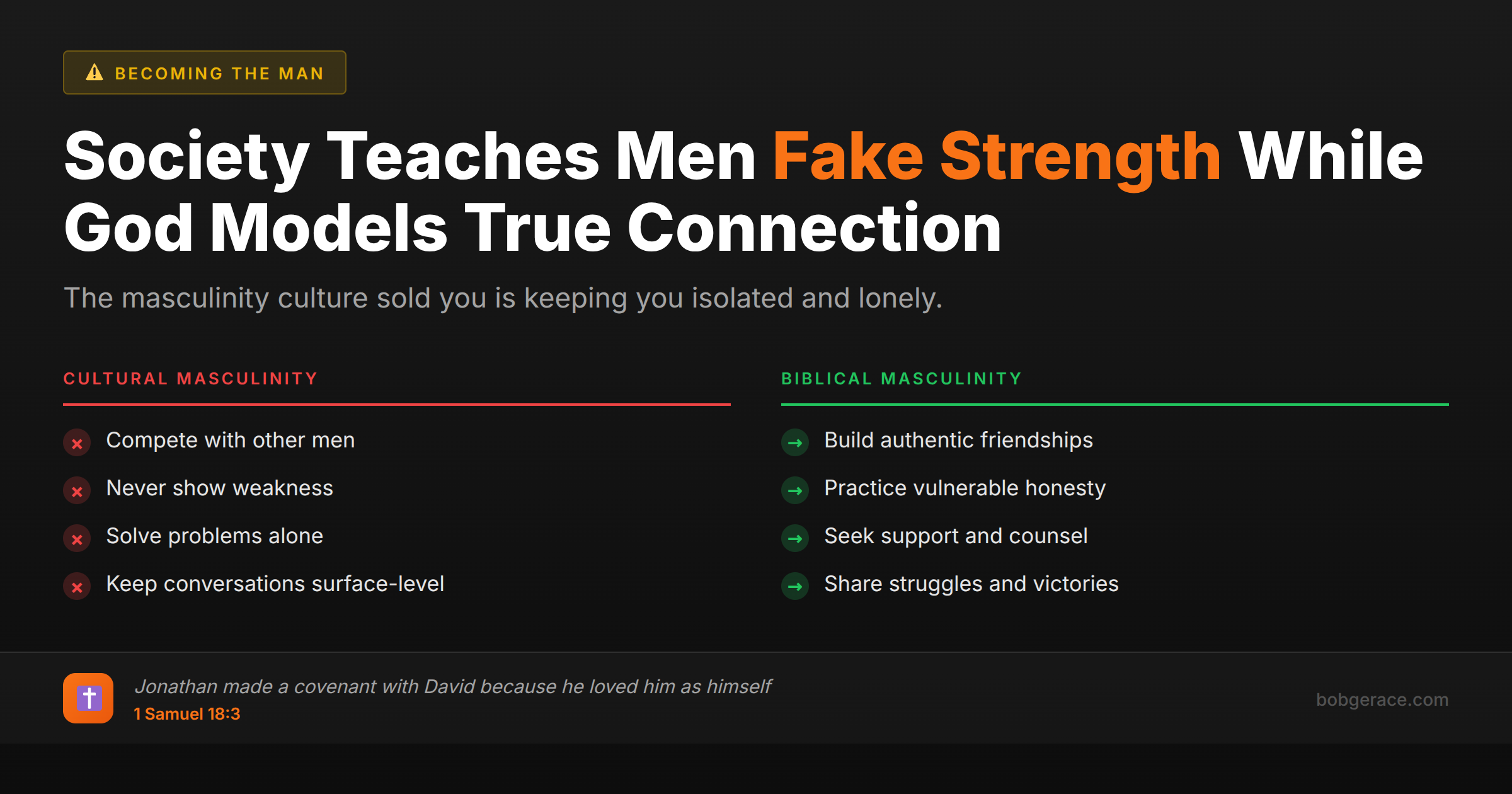
Men struggle to connect with other men primarily because of societal conditioning that equates vulnerability with weakness. From childhood, we're taught to compete rather than collaborate, to appear strong rather than admit struggle, and to solve problems independently rather than seek support. This creates a perfect storm where men desperately need authentic friendship but lack the emotional tools to build it. We've been programmed to keep conversations surface-level, avoid emotional topics, and maintain a protective distance even with our closest male friends. The result? Isolation masquerading as independence, and loneliness disguised as strength.
The Full Picture
The male connection crisis runs deeper than most realize. Statistics reveal a sobering reality: men report having fewer close friends than previous generations, and many admit they have no one they can truly confide in outside of their spouse.
This isolation begins early. Boys learn quickly that showing emotion or seeking comfort from other males is socially unacceptable. The playground teaches us that vulnerability invites attack, so we develop defensive mechanisms that persist into adulthood. We become experts at surface-level interaction – talking about sports, work, or hobbies while carefully avoiding anything that reveals our inner world.
The competitive nature ingrained in masculine culture compounds this problem. Even in friendship, men often feel compelled to present their best selves, creating relationships built on performance rather than authenticity. We measure ourselves against other men constantly, making genuine connection feel risky and exposing.
Fear drives much of this behavior. Fear of judgment, fear of appearing weak, fear of being rejected if we show our true selves. Many men have experienced betrayal or mockery when they've attempted vulnerability, creating wounds that make future connection attempts feel dangerous.
Modern culture has also removed many traditional gathering spaces where men naturally connected – trade guilds, military service, neighborhood communities. Without these organic connection points, men must intentionally pursue friendship, a skill many never learned.
The irony is profound: the very traits that make men effective providers and protectors – independence, emotional control, problem-solving focus – become barriers to the deep friendships their souls desperately need.
What's Really Happening
From a psychological perspective, men's connection struggles stem from what I call 'emotional atrophy' – the systematic weakening of relational muscles through years of disuse. The male brain, while naturally wired for problem-solving and action, is equally capable of deep emotional connection when properly developed.
The core issue is attachment insecurity formed in early relationships. Many men learned that emotional needs were burdens to be minimized rather than valid aspects of human experience. This creates an internal conflict: the fundamental human need for connection battles against learned patterns of emotional self-sufficiency.
Neurologically, men often process emotions differently, requiring more time and space to identify and articulate feelings. Our culture's rapid-fire interaction style doesn't accommodate this processing difference, leaving many men feeling inadequate in emotional conversations.
Shame plays a central role. Men carry deep shame about their need for connection, viewing it as weakness rather than strength. This shame creates a defensive cycle where the very behaviors that could lead to connection – honesty, vulnerability, emotional expression – feel threatening to their masculine identity.
The therapeutic breakthrough comes when men realize that authentic connection actually enhances rather than diminishes their effectiveness as husbands, fathers, and leaders. Men with strong male friendships report better marriages, improved mental health, and greater life satisfaction. The vulnerability required for male friendship becomes a strength that transforms every other relationship.
What Scripture Says
Scripture presents a radically different model of masculinity – one where connection and vulnerability are signs of strength, not weakness. God himself models relationship within the Trinity, showing us that authentic connection is woven into the fabric of divine nature.
The friendship between David and Jonathan demonstrates the depth possible in male relationships: *'Jonathan made a covenant with David because he loved him as himself'* (1 Samuel 18:3). Their bond survived jealousy, political pressure, and family conflict because it was rooted in covenant commitment rather than mere compatibility.
Jesus revolutionized masculine connection by calling his disciples friends, not just followers: *'I no longer call you servants, because a servant does not know his master's business. Instead, I have called you friends, for everything that I learned from my Father I have made known to you'* (John 15:15). This friendship was built on transparency and shared purpose.
The early church understood community as essential, not optional: *'And let us consider how we may spur one another on toward love and good deeds, not giving up meeting together, as some are in the habit of doing'* (Hebrews 10:24-25). Men were called to active encouragement of other men.
Proverbs repeatedly emphasizes the value of male friendship: *'As iron sharpens iron, so one person sharpens another'* (Proverbs 27:17). This sharpening requires friction, honesty, and mutual challenge – the very elements many men avoid.
Paul's relationships with Timothy, Barnabas, and Silas show that spiritual fathers and brothers are God's design for male development. We're called to both mentor and be mentored, to both encourage and be encouraged.
What To Do Right Now
-
1
Identify one man you respect and invite him for coffee with the specific purpose of deepening your friendship
-
2
Practice vulnerability by sharing one current struggle or fear with a trusted male friend this week
-
3
Join or create a men's group focused on authentic sharing rather than just activities
-
4
Initiate deeper conversations by asking questions like 'How are you really doing?' instead of surface-level check-ins
-
5
Schedule regular, consistent time with male friends – treat these commitments as seriously as business meetings
-
6
Be the friend you wish you had by reaching out first, following up on conversations, and showing genuine interest in other men's lives
Related Questions
- Why do I need other men?
- What is 'male friendship deficit'?
- What's different about male bonding?
- I've never had close male friends
- What is 'shoulder to shoulder' vs. 'face to face' connection?
- How do I find other men?
- I never learned to process emotions
- What is 'alexithymia' and do I have it?
- How do I identify what I'm feeling?
- What did I learn about emotions from my father?
Also find Bob on
Subscribe for weekly videos on Christian marriage.
You Don't Have to Figure This Out Alone
Coaching isn't group theory—it's a human who knows your specific marriage, hears what's actually happening in your life, and helps you apply this where it counts.
Talk to Bob →