What's different about male bonding?
6 min read
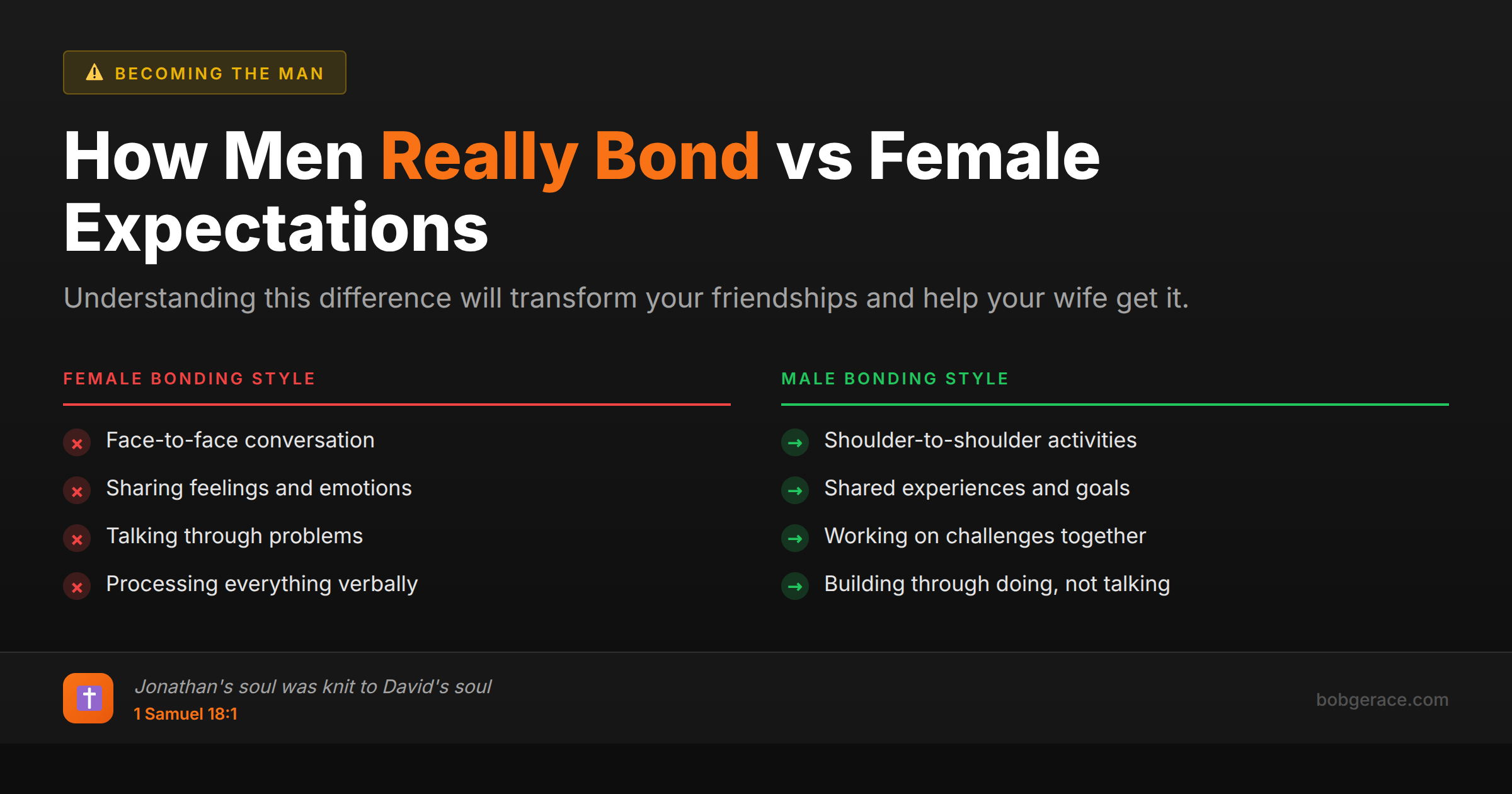
Male bonding is fundamentally different from how women connect. While women typically bond face-to-face through conversation and emotional sharing, men bond shoulder-to-shoulder through shared activities and common purpose. Men don't need to talk about their feelings to feel connected - they build relationships through doing things together, whether it's work, sports, or tackling challenges side by side. This difference isn't a flaw - it's by design. Men create deep, lasting bonds through shared experiences, mutual respect, and working toward common goals. Understanding this can transform how you build friendships with other men and help your wife understand why your relationships look different from hers.
The Full Picture
Male bonding operates on a completely different wavelength than female connection, and that's not a bug - it's a feature. Women typically connect through what researchers call "tend and befriend" - face-to-face conversation, emotional sharing, and verbal intimacy. Men, on the other hand, bond through shared action and common purpose.
Think about your closest male friendships. They probably weren't built through heart-to-heart conversations over coffee. They were forged in the trenches - working on a project together, playing sports, serving in the military, or tackling a challenge side by side. Men connect through doing, not just talking.
This shows up in how men communicate too. We're more likely to offer solutions than sympathy, to show care through actions rather than words, and to express loyalty through reliability rather than emotional declarations. When your buddy needs help moving, you don't ask questions - you show up with your truck.
Male bonding is also hierarchical in healthy ways. Men naturally establish pecking orders and roles within groups. This isn't about dominance for its own sake - it's about creating structure that allows the group to function effectively. Every man knows his role, respects the leadership, and contributes his strengths.
The problem comes when modern culture tries to feminize male bonding or when men abandon it altogether. Without strong male connections, men become isolated, emotionally dependent on their wives alone, and lose touch with their masculine identity. Your marriage suffers when you don't have other men in your life who understand and reinforce what it means to be a man.
What's Really Happening
From a neurological standpoint, male brains are wired differently for social connection. Men have less active mirror neuron systems, which means they're less naturally attuned to emotional mimicry and facial expressions. Instead, men's brains show greater activation in areas associated with spatial reasoning and goal-directed behavior during social interactions.
This explains why men bond more effectively through shared activities. When men work together toward a common goal, their brains release oxytocin - the same bonding hormone women get from intimate conversation. But for men, this happens through cooperation and achievement, not emotional sharing.
Testosterone also plays a crucial role. Higher testosterone levels correlate with increased desire for status, competition, and group membership. Male bonding often involves elements of friendly competition or hierarchy establishment - this isn't toxic masculinity, it's biological reality. Men need to know where they stand in relation to other men.
What I see in my practice is that men who lack strong male friendships often struggle with identity confusion and place unhealthy emotional demands on their marriages. Their wives become their only source of validation and connection, which creates an imbalanced dynamic. Women aren't designed to be a man's only emotional outlet - they need the reinforcement and understanding that comes from other men who share similar experiences and challenges.
What Scripture Says
Scripture is filled with examples of powerful male bonding that strengthened God's people. David and Jonathan formed one of the most famous friendships in history: *"The soul of Jonathan was knit to the soul of David, and Jonathan loved him as his own soul"* (1 Samuel 18:1). Their bond was forged through shared battles and common purpose, not endless emotional conversations.
Jesus modeled male bonding with His disciples. He didn't gather them for sensitivity sessions - He called them to action: *"Follow me, and I will make you fishers of men"* (Matthew 4:19). They bonded through shared mission, facing challenges together, and working toward the kingdom of God.
The early church understood the power of brotherhood. *"Iron sharpens iron, and one man sharpens another"* (Proverbs 27:17). This isn't about gentle encouragement - it's about the friction and challenge that comes when men hold each other accountable and push each other toward excellence.
Paul's ministry was built on male partnerships - with Barnabas, Timothy, and Silas. These weren't casual friendships but strategic alliances for advancing the gospel: *"Two are better than one, because they have a good return for their labor"* (Ecclesiastes 4:9).
God designed men to be builders, warriors, and leaders together. The Bible never shows isolated men as the ideal - it shows men connected to other men in purpose-driven relationships that strengthen their ability to lead their families and serve God's kingdom.
What To Do Right Now
-
1
Identify one activity you enjoy and find other men who share that interest - join a club, team, or group
-
2
Stop trying to bond with men the way women do - focus on doing things together rather than just talking
-
3
Establish regular, recurring activities with male friends - weekly basketball, monthly camping, quarterly projects
-
4
Be reliable and consistent in your male relationships - show up when you say you will
-
5
Accept hierarchy and roles within male groups - don't try to democratize every decision
-
6
Explain to your wife how male bonding works so she understands why your friendships look different from hers
Related Questions
- Why do I need other men?
- What is 'male friendship deficit'?
- Why do men struggle to connect with men?
- What is 'shoulder to shoulder' vs. 'face to face' connection?
- What activities build male connection?
- What is healthy male intimacy?
- How do I become emotionally intelligent?
- What does emotional attunement look like?
- What does 'holding space' actually mean?
- What does Scripture say about brotherhood?
Also find Bob on
Subscribe for weekly videos on Christian marriage.
Your Marriage Needs More Than Theory
A coach who knows your specific situation can help you build the brotherhood and emotional infrastructure your marriage actually needs right now.
Talk to Bob →