What's the difference between righteous anger and unrighteous?
6 min read
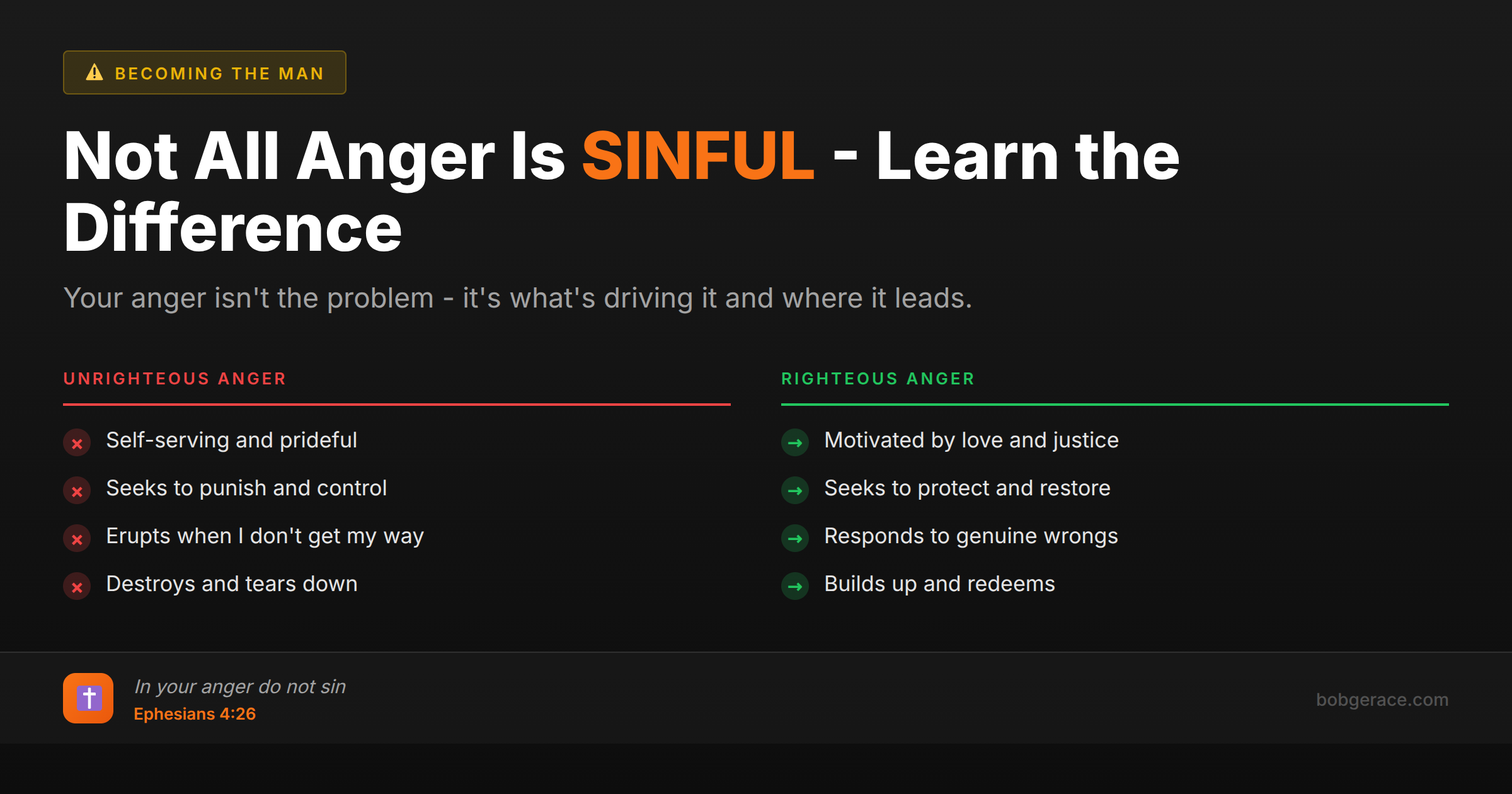
Righteous anger is anger that aligns with God's character - it's motivated by love, seeks justice, and aims to protect or restore what's right. It's controlled, purposeful, and ultimately redemptive. Unrighteous anger, on the other hand, is self-serving, destructive, and motivated by pride, hurt, or the desire to control others. The key difference isn't the emotion itself, but the motivation, expression, and goal. Righteous anger says 'this isn't right and needs to change for everyone's good.' Unrighteous anger says 'I'm not getting what I want and someone's going to pay.' In marriage, righteous anger might arise when you see your spouse being self-destructive, while unrighteous anger erupts when your spouse doesn't meet your expectations.
The Full Picture
Here's what most people get wrong about anger: they think it's either all good or all bad. But Scripture shows us that anger itself is morally neutral - it's an emotion that can serve righteousness or sin, depending on how we handle it.
Righteous anger has four key characteristics:
First, it's motivated by love and justice, not personal offense. When Jesus cleansed the temple, He wasn't angry because His feelings were hurt - He was angry because God's house was being dishonored and people were being exploited.
Second, it's controlled and purposeful. Righteous anger doesn't explode in destructive ways. It channels energy toward constructive action that addresses the root problem.
Third, it seeks restoration, not revenge. The goal is always to make things right, not to punish or get even.
Fourth, it's temporary and proportionate. Righteous anger doesn't nurse grudges or blow small issues out of proportion.
Unrighteous anger, by contrast:
- Springs from wounded pride, unmet expectations, or desire for control - Expresses itself destructively through harsh words, manipulation, or violence - Seeks to punish or dominate rather than restore - Lingers and grows, feeding on resentment and bitterness
In marriage, this distinction is crucial. When your spouse makes a mistake, righteous anger says, 'This behavior is hurting you and us - let's figure out how to change it.' Unrighteous anger says, 'You've made me look bad and now you're going to suffer.'
The same triggering event can produce either response. The difference lies in your heart motivation and how you choose to express that anger.
What's Really Happening
From a clinical perspective, the distinction between righteous and unrighteous anger often comes down to what we call 'primary versus secondary emotions.' Unrighteous anger is frequently a secondary emotion - a defense against deeper feelings of hurt, fear, shame, or powerlessness.
When someone cuts you off in traffic, the immediate anger might mask fear about safety or shame about being disrespected. In marriage, anger often covers vulnerability. 'You never listen to me' might really mean 'I'm scared that I don't matter to you.'
Righteous anger, however, tends to be more primary and values-driven. It emerges when we witness genuine injustice or harm - not just personal slight. This type of anger actually serves healthy psychological functions: it energizes us to address problems, sets appropriate boundaries, and motivates positive change.
Neurologically, both types of anger activate the same brain regions - the amygdala and stress response systems. But righteous anger maintains better prefrontal cortex engagement, keeping our executive functioning online. This is why righteous anger feels more controlled and purposeful, while unrighteous anger often feels overwhelming and regrettable afterward.
The key therapeutic insight is learning to pause and ask: 'What's underneath this anger?' If it's wounded ego or unmet personal demands, that's likely unrighteous anger that needs to be processed differently. If it's genuine concern for justice, welfare, or moral principles, that anger can be channeled constructively.
In couples therapy, I help partners distinguish between 'I'm angry because you hurt my feelings' (which needs empathy and communication) versus 'I'm angry because this behavior is destructive' (which needs boundaries and accountability). Both are valid, but they require different responses.
What Scripture Says
Scripture doesn't condemn anger itself, but it gives us clear guidelines for handling it righteously. Ephesians 4:26 says, *'In your anger do not sin: Do not let the sun go down while you are still angry.'* Notice it doesn't say 'don't get angry' - it says 'don't sin in your anger.'
Jesus Himself demonstrated righteous anger. John 2:13-17 describes Him driving out the money changers: *'He made a whip out of cords, and drove all from the temple courts... To those who sold doves he said, "Get these out of here! Stop turning my Father's house into a market!"'* His anger was motivated by zeal for God's house and concern for those being exploited.
James 1:19-20 gives us the practical framework: *'Everyone should be quick to listen, slow to speak and slow to become angry, because human anger does not produce the righteousness that God desires.'* This warns us that our natural, flesh-driven anger rarely serves God's purposes.
The Psalms show us that even righteous anger must be surrendered to God. Psalm 37:8 says, *'Refrain from anger and turn from wrath; do not fret—it leads only to evil.'* This doesn't contradict righteous anger, but warns against letting any anger consume us or drive us to sinful action.
Proverbs 29:11 contrasts the wise and foolish response: *'Fools give full vent to their rage, but the wise bring calm in the end.'* Righteous anger seeks to bring calm and resolution, while unrighteous anger just vents without purpose.
Finally, Colossians 3:8 calls us to *'rid yourselves of all such things as these: anger, rage, malice, slander, and filthy language from your lips.'* This refers to the unrighteous expressions of anger that tear down rather than build up.
The biblical pattern is clear: anger that serves God's purposes and seeks restoration is righteous. Anger that serves our pride and seeks revenge is sin.
What To Do Right Now
-
1
Pause and pray before responding - Ask God to show you whether your anger is righteous or self-serving, and for wisdom in how to respond.
-
2
Check your motivation - Ask yourself: 'Am I angry because something is genuinely wrong, or because I'm not getting what I want?'
-
3
Consider the goal - Does your anger seek to restore, protect, and build up, or to punish, control, and tear down?
-
4
Choose your expression carefully - Even righteous anger must be expressed in love, with gentleness and respect for the other person.
-
5
Address the root issue - Don't just vent the emotion; take constructive action to address whatever triggered the righteous anger.
-
6
Let it go quickly - Whether righteous or unrighteous, don't let anger take root in your heart. Surrender it to God and move toward resolution.
Related Questions
- What does 'be angry and sin not' mean?
- What does James say about human anger?
- Is my anger a fruit problem or root problem?
- What does Scripture say about self-control?
- What's underneath the anger — fear, shame, hurt?
- What is 'secondary emotion' and is anger covering something?
- How do I handle righteous anger without sin?
- What does it mean that he's not my real enemy?
- How do I love my enemy when he's sleeping with my wife?
- What does 'vengeance is mine' mean practically?
Also find Bob on
Subscribe for weekly videos on Christian marriage.
Not Sure Which Anger You're Carrying?
A coach who knows your marriage can help you see what's driving it — and what to do with it before it does more damage.
Talk to Bob →