What if godly people disagree on what I should do?
6 min read
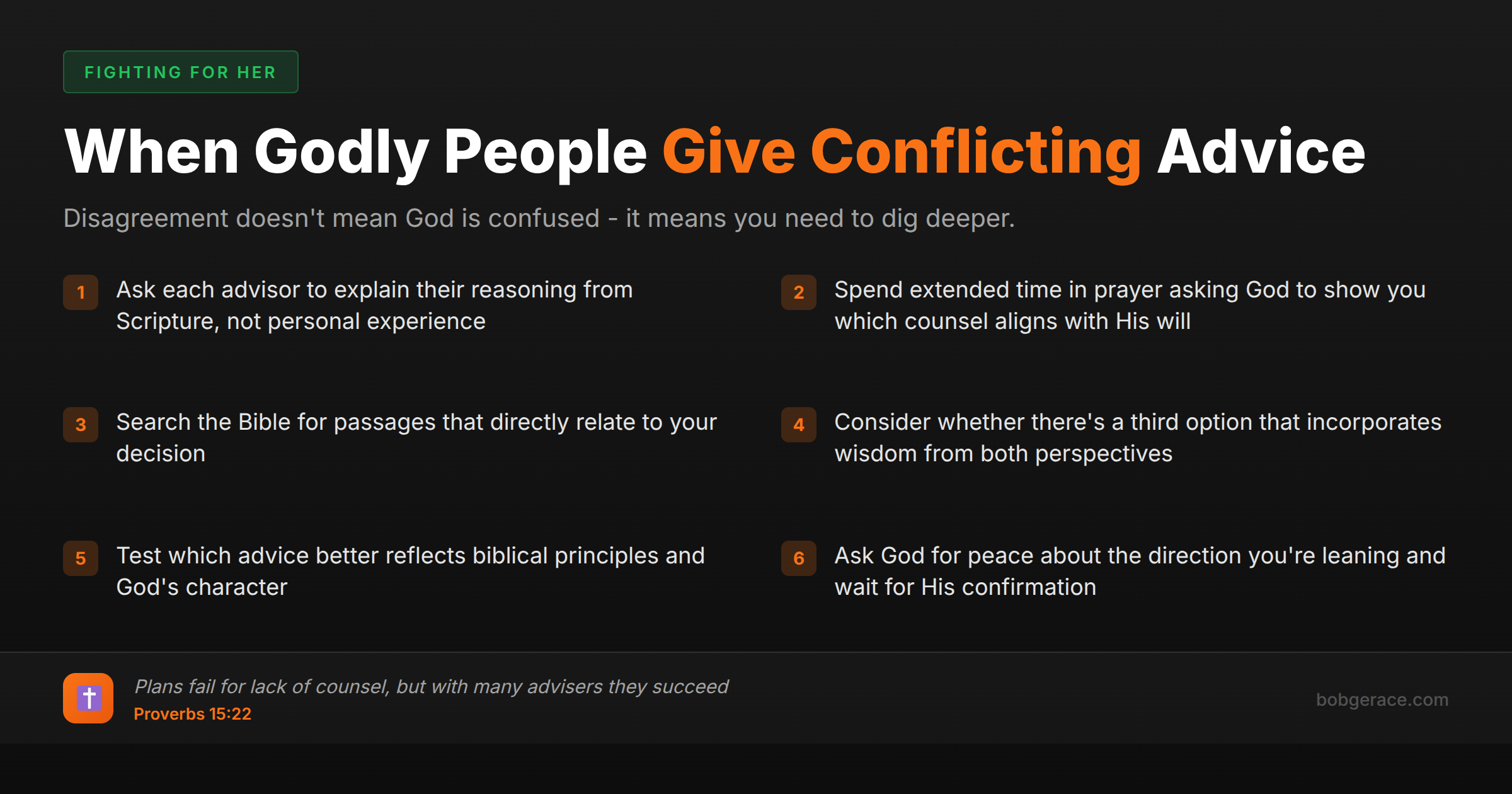
When godly people give you conflicting advice, it doesn't mean God is confused or that His will is unclear. It means you need to dig deeper in your discernment process. Start by examining whether both advisors truly understand your full situation and are speaking from Scripture, not just personal preference. Then take their counsel back to God in prayer, asking Him to confirm His direction through His Word. Remember, godly people can have different perspectives on the same situation while still being faithful believers. Your job isn't to pick the advice that feels easiest, but to seek the counsel that aligns most clearly with biblical truth and God's character. Sometimes the disagreement itself is God's way of slowing you down to ensure you're truly seeking His will rather than just collecting opinions that support what you already want to do.
The Full Picture
Getting conflicting advice from godly people you trust can feel incredibly frustrating and confusing. You sought out multiple perspectives hoping for clarity, and instead you're left with more questions than answers. This scenario is more common than you might think, and it doesn't reflect poorly on anyone involved.
Why Good People Give Different Advice
First, understand that godly people can disagree for legitimate reasons. They may have different life experiences that shape their perspective. One advisor might emphasize mercy while another emphasizes justice—both biblical values that sometimes seem to pull in different directions. They might also be working with incomplete information about your situation, or they could be at different stages of spiritual maturity in certain areas.
The Hidden Opportunity
What feels like confusion might actually be God's protection. When you get one clear voice telling you exactly what to do, it's easy to move forward without truly seeking God yourself. But when you face conflicting counsel, you're forced to go deeper in your relationship with Him. You can't just outsource your discernment to others—you have to develop it yourself.
Beyond Personal Preference
Sometimes disagreement arises because advisors are giving you their personal preferences rather than biblical counsel. Ask yourself: Are they pointing you toward Scripture, or toward what worked for them? Are they considering your unique circumstances, or applying a one-size-fits-all approach? The goal isn't to find someone who agrees with what you want to do, but to find the path that honors God most clearly.
What's Really Happening
From a psychological perspective, conflicting advice often triggers what we call "analysis paralysis"—the inability to make decisions when faced with too many options or contradictory information. Your brain interprets the disagreement as danger, activating your stress response and making clear thinking more difficult.
The Authority Transfer Problem
Many people unconsciously transfer the responsibility for their decisions to their advisors. When those advisors disagree, it creates a crisis because you're not sure whose authority to follow. This reveals an important growth opportunity: learning to hold advisory input lightly while taking personal responsibility for your choices.
Confirmation Bias in Action
You might find yourself gravitating toward the advisor whose counsel aligns with what you already wanted to do. This is confirmation bias—our tendency to seek information that confirms our existing //blog.bobgerace.com/mirror-method-marriage-transform-limiting-beliefs/:beliefs. While it's natural, it can prevent you from hearing what God might actually be saying through the more challenging counsel.
The Integration Process
Healthy decision-making involves integrating multiple perspectives rather than simply choosing between them. Sometimes the best path forward incorporates elements from both pieces of advice. Other times, the disagreement highlights aspects of your situation that need more careful examination. The key is learning to synthesize input rather than just selecting it.
Building Decision-Making Confidence
This situation, while uncomfortable, is actually building your capacity to make decisions independently while still honoring wise counsel. You're developing the skill of discernment—learning to recognize God's voice among many voices.
What Scripture Says
Scripture gives us clear principles for navigating conflicting counsel while maintaining our dependence on God's wisdom.
Seek Multiple Counselors "Plans fail for lack of counsel, but with many advisers they succeed" (Proverbs 15:22). Getting multiple perspectives is biblical—God uses various people to speak into our lives. The disagreement doesn't invalidate this principle; it refines it.
Test Everything Against Scripture "But when he, the Spirit of truth, comes, he will guide you into all the truth" (John 16:13). The Holy Spirit uses God's Word as the ultimate standard for evaluating all counsel. Any advice that contradicts clear biblical teaching should be rejected, regardless of the source.
Seek God's Wisdom Directly "If any of you lacks wisdom, you should ask God, who gives generously to all without finding fault, and it will be given to you" (James 1:5). When human wisdom conflicts, go directly to the source. God promises to give wisdom to those who ask for it.
Consider the Fruit "By their fruit you will recognize them" (Matthew 7:16). Evaluate the potential outcomes of each piece of advice. Which path would produce fruit that honors God and builds His kingdom? Which aligns with the character of Christ?
Peace as a Guide "Let the peace of Christ rule in your hearts" (Colossians 3:15). God often confirms His will through a deep sense of peace that transcends understanding. Which direction gives you genuine peace—not just relief from pressure, but the peace that comes from knowing you're aligned with God's heart?
Walk by Faith "Trust in the Lord with all your heart and lean not on your own understanding" (Proverbs 3:5-6). Ultimately, your confidence must rest in God's faithfulness, not in the perfection of human counsel.
What To Do Right Now
-
1
Go back to each advisor and ask them to explain their reasoning from Scripture, not just personal experience
-
2
Spend extended time in prayer asking God to show you which counsel aligns with His will for your situation
-
3
Search the Bible for passages that directly relate to your decision and see which advice better reflects biblical principles
-
4
Consider whether there's a third option that incorporates the wisdom from both perspectives
-
5
Ask God for peace about the direction you're leaning and pay attention to His confirmation through circumstances
-
6
Make your decision based on what honors God most, then move forward with confidence in His sovereignty
Related Questions
- How do I discern God's will for my marriage?
- What role does Scripture play in discernment?
- What role does wise counsel play?
- What role do circumstances play?
- How do I distinguish my desires from God's direction?
- How do I hear God when I'm in crisis?
- Does God want me to stay in this marriage?
- How do I know God's will in this?
- What does wise counsel look like?
- How do I separate fear from wisdom?
Also find Bob on
Subscribe for weekly videos on Christian marriage.
Bring Your Specific Situation to Bob
When you're getting conflicting counsel, a coach who knows your marriage—not just the theory—can help you discern what God is actually saying to you.
Talk to Bob →