What is the Colossians 3 instruction?
6 min read
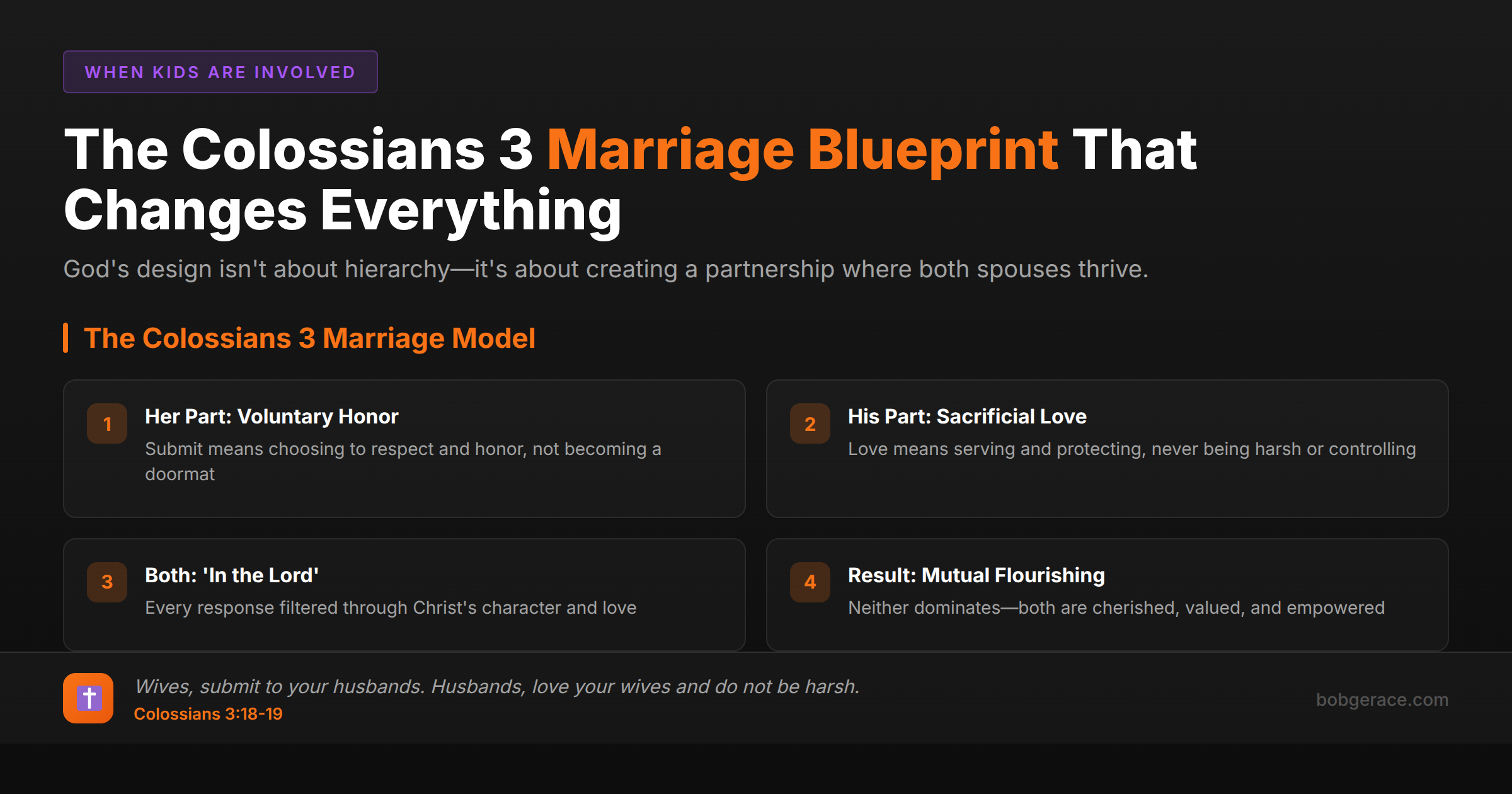
Colossians 3:18-19 contains God's foundational marriage instructions: 'Wives, submit yourselves to your husbands, as is fitting in the Lord. Husbands, love your wives and do not be harsh with them.' This isn't about hierarchy or control—it's about creating a harmonious partnership where both spouses fulfill distinct but equally valuable roles. The wife's submission is voluntary respect and honor, while the husband's love is sacrificial service and protection. Both commands are given 'in the Lord,' meaning they operate within Christ's love and character. This creates a beautiful dance of mutual honor where neither spouse dominates or diminishes the other. When followed correctly, these instructions don't create inequality—they eliminate it by ensuring both partners are cherished, valued, and empowered in their unique strengths.
The Full Picture
Colossians 3:18-19 sits in the middle of Paul's instructions for Christian living, right after he tells all believers to 'clothe yourselves with compassion, kindness, humility, gentleness and patience' and to 'let the peace of Christ rule in your hearts.' This context matters enormously.
The passage isn't isolated relationship advice—it's part of a complete transformation of how Christians should live. Paul is describing what happens when Christ's character flows through every area of our lives, including marriage.
The Greek word for 'submit' (hupotasso) doesn't mean blind obedience or becoming a doormat. It's a military term meaning 'to arrange under,' like soldiers in formation working together toward a common goal. It's about voluntary cooperation and respect, not forced compliance.
Similarly, the command for husbands to 'love' uses the Greek word agape—the same self-sacrificing love Christ showed when He died for us. This isn't just romantic feelings; it's a commitment to put your wife's wellbeing above your own comfort, always.
The phrase 'in the Lord' transforms everything. Both commands are filtered through Christ's character. A wife submits as unto the Lord—meaning she honors her husband the way she honors Christ. A husband loves as Christ loved—meaning he serves, protects, and sacrifices for his wife's good.
This creates a beautiful cycle: when a husband loves his wife like Christ, submission becomes easy and natural. When a wife respects and honors her husband, loving her becomes a joy rather than a burden. Neither spouse is diminished; both are elevated and empowered.
The instruction also includes the warning against harshness, showing that God cares about not just actions but attitudes and methods.
What's Really Happening
From a psychological standpoint, the Colossians 3 model addresses fundamental human needs in remarkable ways. Research consistently shows that women tend to feel most secure in relationships when they experience consistent love, care, and emotional safety. Men, conversely, often thrive when they feel respected, trusted, and valued for their contributions.
The biblical model directly addresses these core needs. When a husband loves his wife sacrificially—putting her needs first, protecting her emotionally, and consistently showing care—he creates the safety she needs to flourish. When a wife responds with respect and honor—trusting his leadership and expressing appreciation—she meets his deep need for significance and respect.
What's fascinating is how this breaks negative cycles. Many marriages get trapped in demand-withdraw patterns where one partner's criticism triggers the other's defensiveness, which triggers more criticism. The Colossians model interrupts this by having both spouses focus on giving what the other needs most rather than demanding what they want.
The 'in the Lord' aspect provides crucial emotional regulation. When spouses filter their responses through Christ's character rather than their immediate emotions, they make decisions from their best selves rather than their triggered, defensive selves. This creates emotional safety and predictability—key ingredients for secure attachment.
The model also addresses power dynamics healthily. Instead of creating dominance hierarchies, it establishes complementary roles where both partners have significant influence and value. The wife's input and perspective are treasured; the husband's decisions are made in love and service.
Neurologically, this approach activates the brain's reward systems rather than threat-detection systems, creating positive feedback loops that strengthen the marriage bond over time.
What Scripture Says
The Colossians 3 instruction connects to a broader biblical understanding of marriage throughout Scripture:
Ephesians 5:22-25 expands the concept: 'Wives, submit yourselves to your own husbands as you do to the Lord... Husbands, love your wives, just as Christ loved the church and gave himself up for her.' This shows the eternal model—Christ's relationship with His people.
1 Peter 3:7 adds crucial detail: 'Husbands, in the same way be considerate as you live with your wives, and treat them with respect as the weaker partner and as heirs with you of the gracious gift of life, so that nothing will hinder your prayers.' God takes this so seriously that He warns men their prayers will be hindered if they don't honor their wives properly.
Genesis 2:24 establishes the foundation: 'That is why a man leaves his father and mother and is united to his wife, and they become one flesh.' The Colossians instruction serves this ultimate goal of unity and oneness.
Proverbs 31:28-29 shows the result: 'Her children arise and call her blessed; her husband also, and he praises her: Many women do noble things, but you surpass them all.' When these principles are followed, wives flourish and are celebrated.
1 Corinthians 7:3-4 emphasizes mutuality: 'The husband should fulfill his marital duty to his wife, and likewise the wife to her husband. The wife does not have authority over her own body but yields it to her husband. In the same way, the husband does not have authority over his own body but yields it to his wife.' Both spouses serve each other.
The consistent biblical pattern is complementary partnership where both spouses are honored, valued, and empowered to fulfill their God-given design while serving something greater than themselves.
What To Do Right Now
-
1
Study the context - Read all of Colossians 3 together to understand how verses 18-19 fit into Christ-like living
-
2
Define terms together - Discuss what 'submit' and 'love' actually mean in biblical context, not cultural assumptions
-
3
Identify current patterns - Look at where you might be demanding instead of giving what your spouse needs most
-
4
Practice the 'in the Lord' filter - Before responding to conflict, ask 'How would Christ handle this situation?'
-
5
Create feedback loops - Regularly ask your spouse how well you're fulfilling your biblical role and listen without defensiveness
-
6
Seek wise counsel - Find mature Christian couples who model these principles successfully and learn from their example
Related Questions
- What is the Ephesians 5 framework?
- What does 1 Peter 3 say to husbands and wives?
- What does 'love your wife as Christ loves the church' mean?
- What is biblical headship?
- What does submission mean?
- What is 'sacrificial headship'?
- What does Scripture say about divorce?
- What did Jesus say about divorce?
- What does biblical forgiveness require of me?
- How do I model Christ to my kids in this?
Also find Bob on
Subscribe for weekly videos on Christian marriage.
Ready to Apply This to Your Marriage?
Understanding Colossians 3 is one thing. Living it out in your specific marriage—with your wife, your history, your stuck points—is another. A coach helps you bridge that gap.
Talk to Bob →