What did marriage look like in the 1st century context?
6 min read
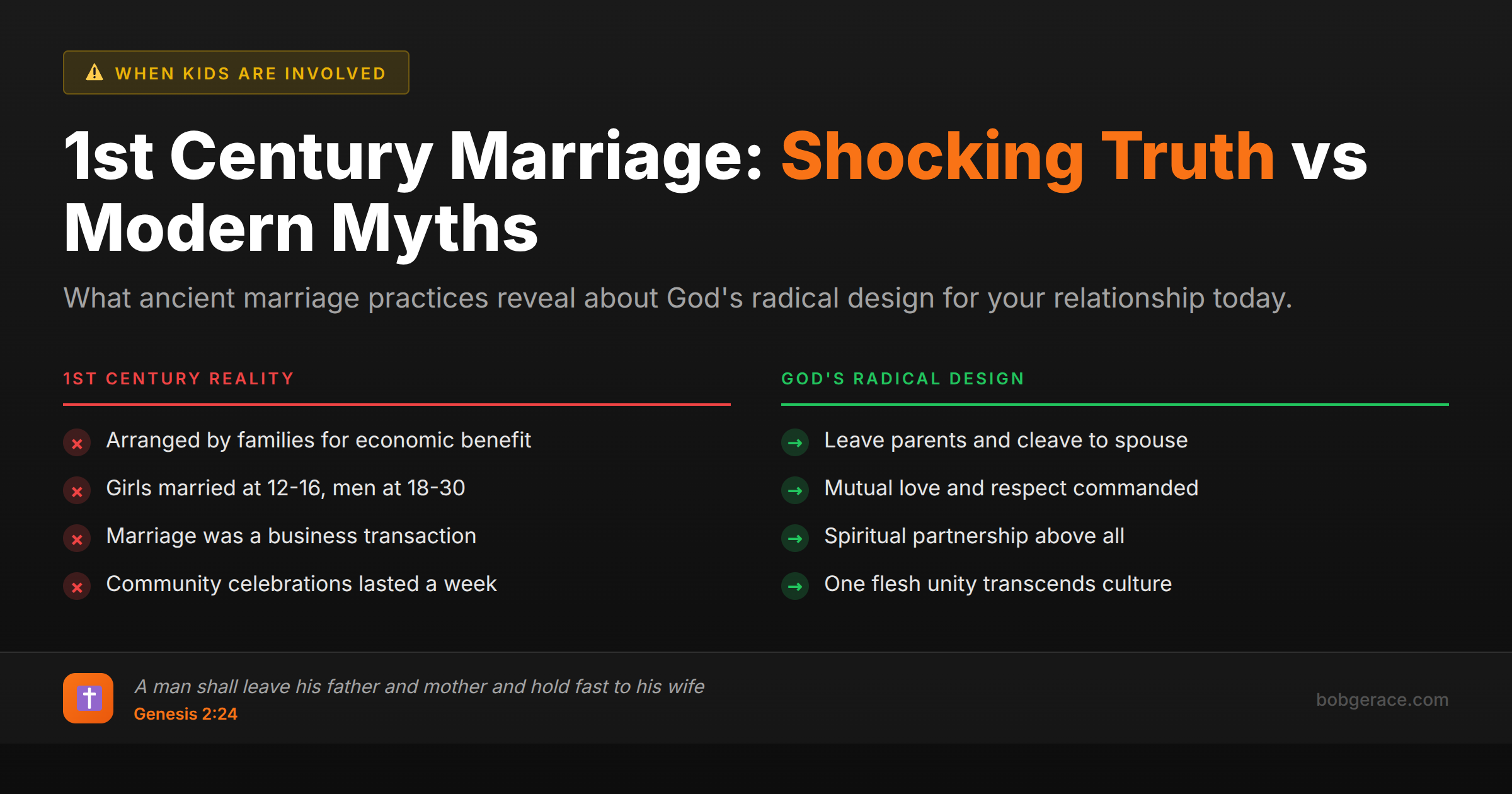
First-century marriage was fundamentally different from modern Western marriage in structure, purpose, and practice. Marriages were primarily economic and social arrangements between families, typically involving young women (12-16) and older men (18-30). The process included betrothal contracts, bride prices, and elaborate community celebrations that could last up to a week. However, within this cultural framework, Jesus and Paul introduced revolutionary concepts about mutual love, respect, and spiritual partnership that elevated marriage beyond mere social contract. Understanding this context helps us grasp why biblical teachings about marriage were so radical for their time and how they apply to our marriages today.
The Full Picture
Marriage in the 1st century Roman-Jewish world operated within a complex web of social, economic, and religious expectations that shaped every aspect of the relationship. Unlike our modern concept of romantic love as the foundation for marriage, first-century unions were strategic alliances between families designed to preserve bloodlines, consolidate wealth, and ensure social stability.
The Marriage Process began with family negotiations, often when the bride was still a child. Fathers held complete authority over marriage arrangements, and the bride's consent, while sometimes considered, was not required. The betrothal period was legally binding and could only be dissolved through divorce, even though the couple hadn't yet cohabitated. This explains why Joseph needed to divorce Mary when he discovered her pregnancy.
Economic transactions dominated the process. The groom's family paid a *mohar* (bride price) to compensate the bride's family for their loss, while the bride's family provided a dowry. These weren't symbolic gestures but substantial financial arrangements that could make or break families economically.
Gender roles were strictly defined by both Roman law and Jewish tradition. Wives had limited legal rights, couldn't own property independently, and were expected to manage households while remaining largely invisible in public life. Men held absolute authority (*patria potestas* in Roman law) over wives, children, and household slaves.
Wedding celebrations were community affairs lasting up to seven days, featuring processions, feasts, and rituals that publicly established the union's legitimacy. The entire community participated because marriage affected everyone's social and economic networks.
Yet within this restrictive framework, we see glimpses of genuine affection and partnership in biblical accounts, suggesting that love could and did develop within these arranged marriages.
What's Really Happening
From a therapeutic perspective, understanding first-century marriage context is crucial for modern couples struggling with biblical role interpretations. Many marriage conflicts I see stem from misapplying cultural practices as divine mandates without recognizing the revolutionary nature of New Testament teachings within their historical setting.
Cultural conditioning from that era emphasized survival and social order over individual fulfillment. Modern couples often feel guilty for desiring emotional intimacy and partnership equality because they've been taught these desires conflict with biblical submission. However, when we understand that Paul's instructions actually elevated women's status and emphasized mutual love within an oppressive cultural system, it transforms how we apply these principles.
Attachment theory helps us recognize that while marriage structures have changed, core human needs for security, intimacy, and connection remain constant. First-century couples developed these bonds within arranged marriages through shared hardship, common purpose, and gradual emotional investment. Modern couples can learn from this gradual approach rather than expecting instant romantic fulfillment.
Power dynamics in ancient marriages reflected broader societal inequalities that Jesus consistently challenged. When we see Christ's interactions with women—speaking publicly with the Samaritan woman, defending Mary's right to learn, treating Martha and Mary as intellectual equals—we understand that restrictive cultural practices don't represent God's ideal for marriage relationships.
The key insight for modern couples is recognizing that biblical marriage principles transcend cultural expressions. The call for sacrificial love, mutual submission, and Christ-centered partnership can be lived out authentically within our current cultural context without replicating ancient social structures that often diminished human dignity and potential.
What Scripture Says
Scripture provides both cultural snapshots of first-century marriage and timeless principles that transcend historical context. Understanding this distinction is essential for applying biblical truth to modern marriages.
Genesis 2:24 establishes God's original design: *"Therefore a man shall leave his father and his mother and hold fast to his wife, and they shall become one flesh."* This principle of leaving, cleaving, and unity applied even within arranged marriage systems, emphasizing the primacy of the marriage bond over extended family loyalties.
Ephesians 5:22-33 must be read within its cultural context. Paul's instruction for wives to submit was revolutionary because he simultaneously commanded husbands to love sacrificially: *"Husbands, love your wives, as Christ loved the church and gave himself up for her."* In a culture where wives were property, Paul elevated them to beloved partners deserving Christ-like devotion.
1 Corinthians 7:3-4 presents radical mutuality: *"The husband should give to his wife her conjugal rights, and likewise the wife to her husband. For the wife does not have authority over her own body, but the husband does. Likewise the husband does not have authority over his own body, but the wife does."* This mutual authority was unheard of in first-century marriage.
Galatians 3:28 provides the theological foundation: *"There is neither Jew nor Greek, there is neither slave nor free, there is no male and female, for you are all one in Christ Jesus."* This spiritual equality transformed how Christians understood marriage relationships.
1 Peter 3:7 instructs husbands to treat wives as *"fellow heirs of the grace of life,"* emphasizing spiritual partnership and mutual inheritance in God's kingdom. This language elevated women far beyond their cultural status.
These passages reveal that while Scripture acknowledges cultural realities, it consistently points toward mutual love, respect, and spiritual partnership as God's design for marriage.
What To Do Right Now
-
1
Study biblical marriage passages within their historical context, distinguishing between cultural practices and eternal principles
-
2
Discuss with your spouse how first-century marriage insights might reshape your understanding of biblical roles and responsibilities
-
3
Identify areas where cultural expectations (ancient or modern) might be hindering your spiritual partnership and mutual growth
-
4
Pray together about how to embody Christ-like love and sacrificial service within your current cultural context
-
5
Seek counsel from mature believers who demonstrate healthy biblical marriage principles in contemporary settings
-
6
Commit to applying timeless biblical principles—mutual love, sacrificial service, spiritual partnership—while adapting cultural expressions to honor God in your time and place
Related Questions
- What does 'head' mean in Greek?
- What is the Ephesians 5 framework?
- What is the Genesis 1-2 creation pattern?
- What happened to marriage at the Fall?
- What does redemption do to marriage roles?
- What are the main views on complementarian vs. egalitarian?
- What does 'love your wife as Christ loves the church' mean?
- What does biblical forgiveness require of me?
- What does restoration look like in Scripture?
Also find Bob on
Subscribe for weekly videos on Christian marriage.
Ready to apply this to your actual marriage?
Understanding first-century context is one thing. Translating it into what you do Monday morning with your wife is another. A coach helps you close that gap.
Talk to Bob →