How do I pray when I can't form words?
5 min read
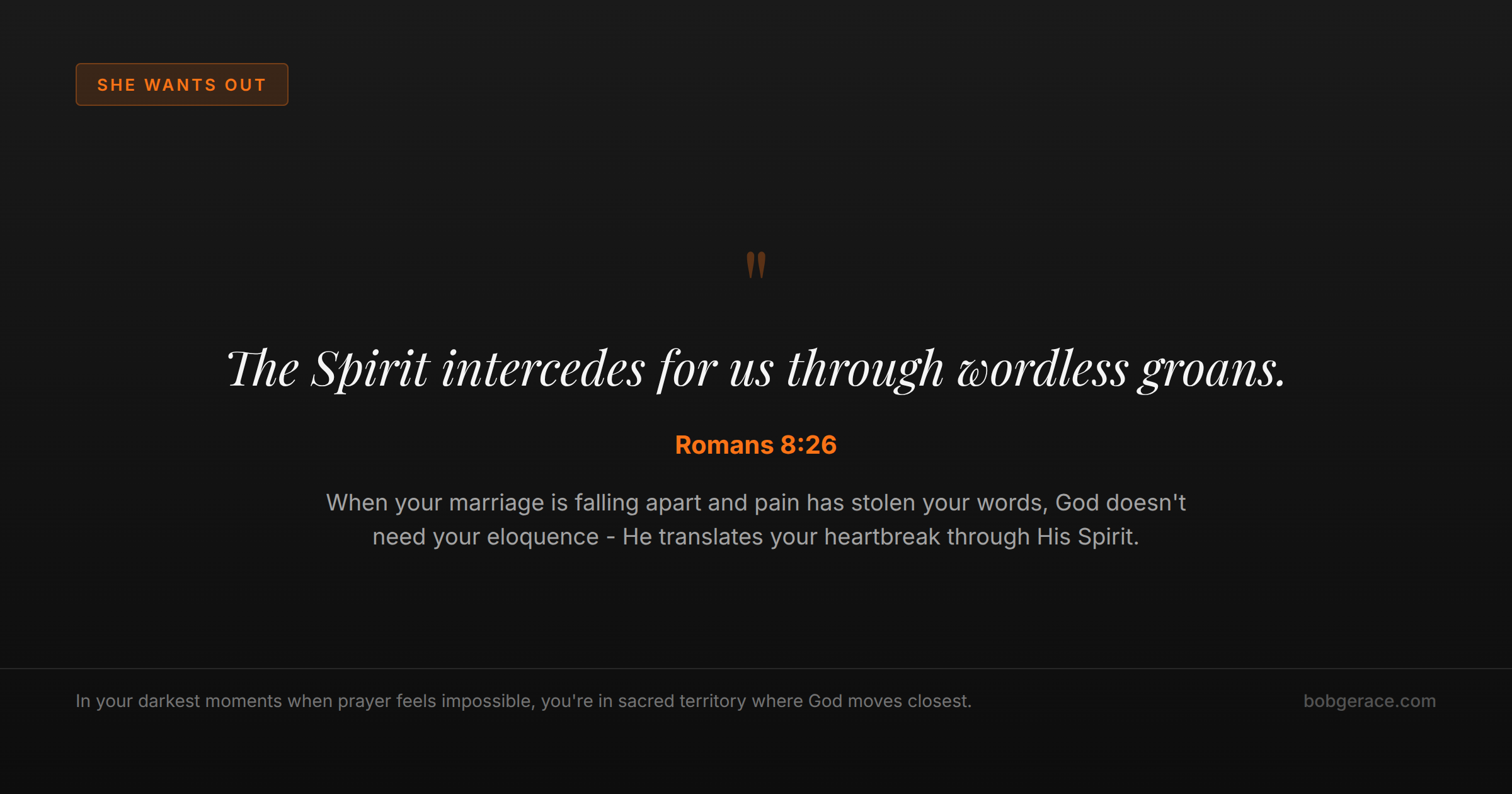
When your marriage is falling apart and the pain is so deep you can't even form a prayer, you're in sacred territory. God doesn't need your eloquent words - He hears the groaning of your heart, the silent screams of your soul, and every unspoken plea for help. The truth is, some of the most powerful prayers happen without words. Your tears are prayers. Your desperate sighs are prayers. Even your angry silence toward God is a form of prayer because you're still turned toward Him, even in your fury. Don't let the enemy convince you that God has abandoned you because you can't find the right words. He's closest when you're most broken.
The Full Picture
Spiritual speechlessness is normal in crisis. When your wife says she's done, when your world is imploding, when everything you thought you knew about your life gets shattered - words often fail us. This isn't a sign of weak faith; it's a sign of human limitation in the face of overwhelming pain.
Your body is praying even when your mind can't. That knot in your stomach, the tightness in your chest, the way you can barely breathe - these physical responses are your whole being crying out to God. You don't need to translate this into King James English for God to understand.
Common mistakes men make: • Believing they must have profound words to reach God • Thinking silence equals abandonment by God • Comparing their prayers to others who seem more articulate • Avoiding prayer altogether because they feel inadequate
What's really happening spiritually: You're in the wilderness. Every biblical hero went through seasons where words failed them. Moses argued with God about his speech. David had days of silence. Jeremiah complained bitterly. Job questioned everything. Yet God never left any of them.
The gift in wordless prayer: Sometimes God uses our inability to speak to quiet our minds and let Him do the talking. When we stop trying to manage the conversation, we might actually hear His voice more clearly. Your wordless prayer might be the most honest conversation you've ever had with God.
What's Really Happening
From a neurobiological perspective, intense emotional trauma literally affects our language centers. When the limbic system is flooded with stress hormones like cortisol and adrenaline, the prefrontal cortex - responsible for language and rational thought - goes offline. This is why you might find yourself literally speechless in crisis moments.
This phenomenon, called 'tonic immobility' or 'freeze response,' is one of our primary survival mechanisms. Your brain is prioritizing survival over communication. Understanding this can reduce the shame many men feel when they can't articulate their prayers during their darkest moments.
Research in trauma therapy shows that non-verbal processing often accesses deeper emotional truths than verbal processing. When we move beyond words, we tap into what psychologists call 'felt sense' - the body's wisdom about what's happening emotionally and spiritually.
The therapeutic concept of 'holding space' - simply being present with difficult emotions without trying to fix or change them - parallels what happens in wordless prayer. You're not failing to communicate with God; you're communicating in a different, often more authentic language.
Many of my clients discover that their most profound spiritual breakthroughs happen not through eloquent prayers, but through raw, wordless encounters with the divine. The clinical term is 'non-ordinary states of consciousness,' but in faith terms, it's simply meeting God where words end and presence begins.
What Scripture Says
Scripture is filled with examples of wordless prayer and God's response to our speechlessness. Romans 8:26 tells us, 'In the same way, the Spirit helps us in our weakness. We do not know what we ought to pray for, but the Spirit himself intercedes for us through wordless groans.' God anticipated our speechless moments and provided His Spirit as translator.
Psalm 38:9 declares, 'All my longings lie open before you, Lord; my sighing is not hidden from you.' David understood that God hears what we cannot say. Your longings, your sighs, your desperate heart cries - God sees and hears them all.
1 Kings 19:11-12 shows us that God often speaks not in the earthquake, wind, or fire, but in 'a gentle whisper.' Sometimes we need to stop talking to hear Him. Elijah found God not in the dramatic displays but in the quiet moment that followed.
Nehemiah 2:4 gives us a powerful example: 'Then I prayed to the God of heaven, and I answered the king...' This was likely a split-second, wordless prayer - what theologians call 'arrow prayers' - brief, desperate pleas shot toward heaven.
Matthew 6:8 reminds us, 'Your Father knows what you need before you ask him.' God isn't waiting for your perfect presentation. He already knows your heart, your pain, your desperate need for your marriage to survive. Hebrews 4:13 confirms, 'Nothing in all creation is hidden from God's sight. Everything is uncovered and laid bare before the eyes of him to whom we must give account.'
What To Do Right Now
-
1
Sit in silence for 5 minutes and simply breathe - let God hear your heartbeat as your prayer
-
2
Write one word on paper that captures your pain and place it before God as your offering
-
3
Take a walk outside and let creation be your prayer language - no words necessary
-
4
Listen to instrumental worship music and let the melodies carry what words cannot
-
5
Hold your wedding ring and let the weight of your commitment be your prayer
-
6
Read Psalm 13 aloud - let David's honest questions become your own wordless cry
Related Questions
- Is God present in this chaos?
- What psalms speak to this kind of anguish?
- How do I lament biblically?
- What does it mean to 'cast my anxiety on Him'?
- How do I surrender without giving up?
- Is my desperation faith or codependency?
- How do I not lose my mind right now?
- What is biblical lament?
- What psalms help in marital crisis?
- How do I pray for my wife when she's hurting me?
Also find Bob on
Subscribe for weekly videos on Christian marriage.
When You Can't Pray, Talk to a Coach
Your marriage has specifics—patterns, history, wounds—that no app can see. A coach hears your actual story and helps you move when you're stuck.
Talk to Bob →