What does it mean to 'cast my anxiety on Him'?
6 min read
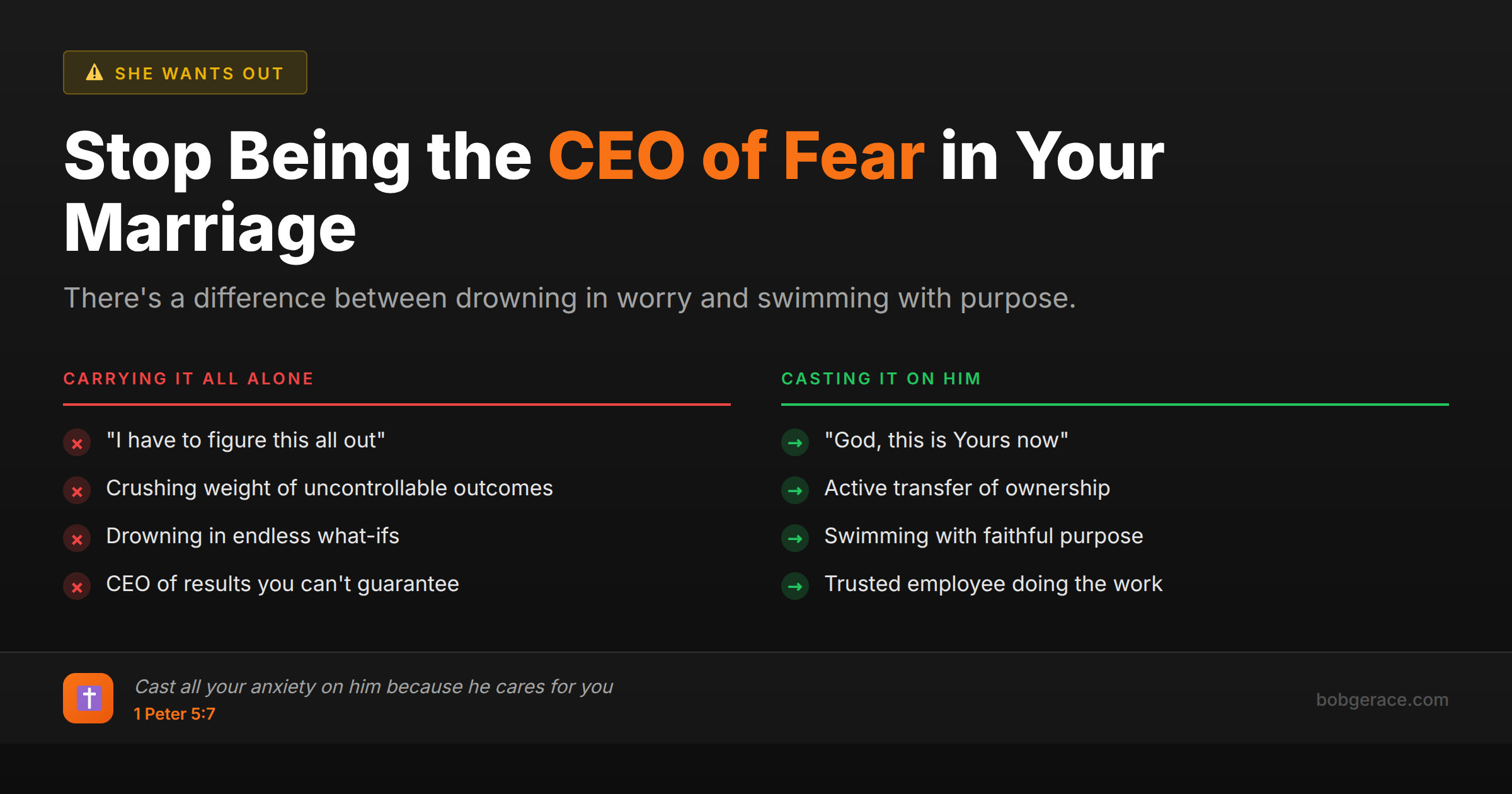
Casting your anxiety on Him isn't about pretending your problems don't exist or sitting back waiting for miracles. It's an active transfer of ownership - moving from "I have to figure this all out" to "God, this is Yours now, but I'm still going to act wisely." When your marriage is in crisis, casting anxiety means you stop carrying the crushing weight of outcomes you can't control. You still do the work - the counseling, the changes, the hard conversations - but you're no longer the CEO of results. You become the faithful employee who does his job well and trusts the Boss with the big picture. It's the difference between drowning in worry and swimming with purpose.
The Full Picture
Most men hear "cast your anxiety on Him" and think it means passive resignation - just pray and everything will magically work out. That's not biblical, and it's not helpful. Real casting is more like a business partnership transfer. You're handing over the stress, the sleepless nights, and the crushing responsibility for outcomes, but you're still showing up to work.
Here's what this looks like practically: You still go to marriage counseling, but you're not carrying the weight of whether she'll engage. You still work on yourself, but you're not devastated if she doesn't notice immediately. You still have difficult conversations, but you're not responsible for her responses.
The anxiety transfer happens in three areas:
• Timing - You stop obsessing over how long healing will take • Outcomes - You release control over whether she stays or goes • Performance - You quit trying to be perfect to earn her back
Many guys make the mistake of casting and recasting - they pray, feel better for an hour, then grab the worry back. Real casting involves building new mental habits. When anxiety hits, you acknowledge it: "There's that fear about losing my family." Then you literally speak it out: "God, I'm giving this to You again."
This isn't denial or spiritual bypassing. You're acknowledging the reality of your situation while refusing to be crushed by things outside your control. You become response-able instead of responsible for everything.
What's Really Happening
From a psychological perspective, "casting anxiety" aligns closely with Acceptance and Commitment Therapy (ACT) principles. When we attempt to control outcomes we cannot influence, we create additional suffering beyond the original problem. The research shows that experiential avoidance - fighting against difficult emotions - actually intensifies anxiety and prolongs distress.
Neurologically, chronic anxiety keeps your brain in hypervigilant survival mode. The prefrontal cortex, responsible for rational decision-making, becomes compromised when the amygdala is constantly activated. This explains why anxious husbands often make poor decisions during marriage crises - they're literally thinking from their fight-or-flight center.
The act of "casting" creates what we call cognitive defusion - separating yourself from your anxious thoughts rather than being consumed by them. Instead of "I am anxious," it becomes "I'm having anxious thoughts." This subtle shift creates psychological space for more effective responses.
Studies on religious coping show that surrender-based strategies - like casting anxiety on God - correlate with better mental health outcomes compared to self-directed religious coping. The key difference is locus of control. Men who maintain responsibility for their actions while releasing control over outcomes show greater resilience and less depression.
This process also activates what researchers call the "tend and befriend" response rather than fight-or-flight. When you genuinely transfer worry to a trusted source (God), your nervous system can shift from crisis mode to collaborative mode, enabling better decision-making and relational connection.
What Scripture Says
The foundation text is 1 Peter 5:7: "Cast all your anxiety on him because he cares for you." The Greek word for "cast" (epiripto) means to throw upon or place upon - it's an active, intentional transfer, not wishful thinking.
Philippians 4:6-7 gives us the process: "Do not be anxious about anything, but in every situation, by prayer and petition, with thanksgiving, present your requests to God. And the peace of God, which transcends all understanding, will guard your hearts and your minds in Christ Jesus." Notice the sequence: acknowledge the anxiety, pray specifically, include gratitude, then receive peace.
Matthew 6:25-26 addresses the core fear many men face: "Therefore I tell you, do not worry about your life, what you will eat or drink; or about your body, what you will wear... Look at the birds of the air; they do not sow or reap or store away in barns, and yet your heavenly Father feeds them. Are you not much more valuable than they?" This isn't about being irresponsible - birds still work for food, but they don't worry about tomorrow's supply.
Psalm 55:22 promises: "Cast your cares on the Lord and he will sustain you; he will never let the righteous be shaken." Sustain doesn't mean everything works out as you hoped - it means you'll have what you need to handle whatever comes.
Proverbs 16:9 balances human responsibility with divine sovereignty: "In their hearts humans plan their course, but the Lord establishes their steps." You still plan and act wisely, but you trust God with the ultimate direction and outcomes.
What To Do Right Now
-
1
Write down your three biggest marriage anxieties and physically place the paper in your Bible as a symbolic transfer to God
-
2
Create a daily "casting prayer" - specifically name each worry and verbally give it to God each morning
-
3
Develop a trigger response: when anxiety hits, immediately say "God, I'm giving this back to You" out loud
-
4
Focus your energy only on actions within your direct control - your words, choices, and responses
-
5
Set a "worry window" - allow yourself 10 minutes daily to feel anxious, then deliberately redirect to productive action
-
6
Practice gratitude for what God has already sustained you through - build evidence of His faithfulness in crisis
Related Questions
- How do I pray when I can't form words?
- Is God present in this chaos?
- What psalms speak to this kind of anguish?
- How do I lament biblically?
- Is my desperation faith or codependency?
- How do I surrender without giving up?
- How do I pray through this?
- How do I trust a God who let this happen?
- What is biblical lament?
- How do I pray when I'm angry at God?
Also find Bob on
Subscribe for weekly videos on Christian marriage.
You Don't Have to Decode Your Marriage Alone
Casting anxiety works better when someone who knows your specific situation helps you separate what's yours to carry from what isn't. Bob coaches men through this daily.
Talk to Bob →