What psalms speak to this kind of anguish?
5 min read
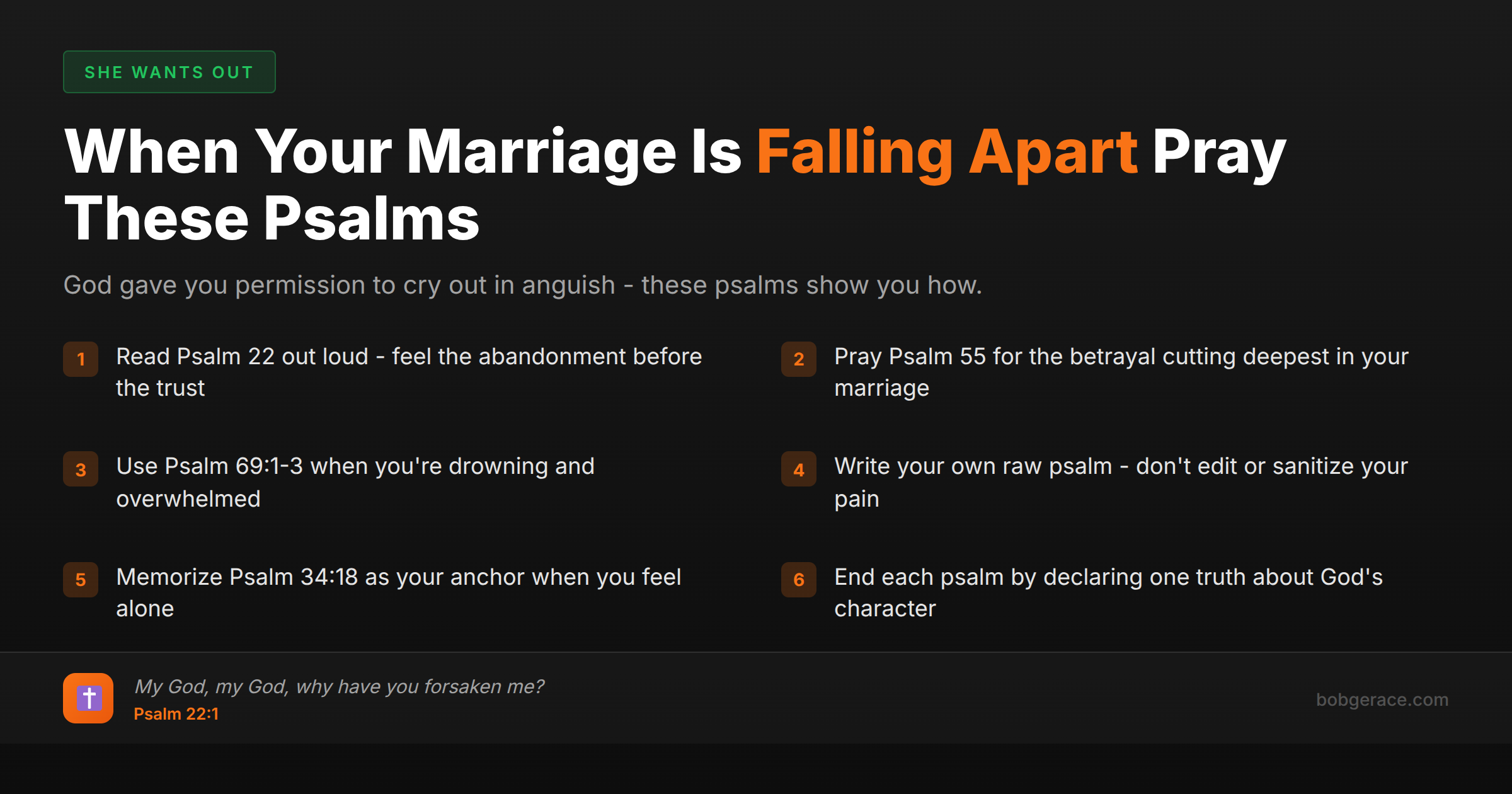
When your marriage is falling apart and your faith feels shaken, the Psalms become a lifeline. David and other psalmists knew crushing anguish - betrayal, abandonment, desperation. Psalm 22 opens with Christ's own words from the cross: "My God, my God, why have you forsaken me?" That's permission to feel forsaken. Psalm 55 captures marital betrayal perfectly: "If an enemy were insulting me, I could endure it... But it is you, a man like myself, my companion, my close friend." Psalm 69 speaks to feeling overwhelmed: "I sink in the miry depths, where there is no foothold." These aren't pretty prayers - they're gut-wrenching cries that God not only allows but preserves in His Word for men like you.
The Full Picture
The Psalms aren't sanitized spiritual platitudes - they're the raw prayers of men who faced crushing circumstances and didn't pretend everything was fine. When your wife wants out and your world is crumbling, you need psalms that match your reality, not your Sunday school answers.
Psalm 22 is where Jesus went in His darkest hour. It starts with abandonment but moves through anguish toward trust. Psalm 55 specifically addresses betrayal by someone close - David's friend, but it applies to marital betrayal too. The psalmist admits wanting to "flee far away" and describes his heart as "anguished within me."
Psalm 69 captures the drowning sensation: "Save me, O God, for the waters have come up to my neck. I sink in the miry depths." Psalm 142 is David's prayer when trapped in a cave - feeling completely alone and overwhelmed.
Common mistakes men make: They try to pray pretty prayers instead of honest ones. They think their anger and desperation somehow disqualify them from approaching God. They avoid the "difficult" psalms because they seem too negative.
The truth is this: God gave you these psalms precisely because He knew you'd face moments like this. The psalmists modeled radical honesty with God - they complained, questioned, even accused God of abandoning them. Yet they always returned to His character and faithfulness, even when they couldn't see it.
What's Really Happening
From a psychological perspective, the Psalms function as what we call "emotional regulation through narrative processing." When you're in crisis, your prefrontal cortex - the part of your brain responsible for rational thinking - goes offline. You're operating from your limbic system, which is all emotion and survival instinct.
The Psalms provide a structured way to process overwhelming emotions. They validate your experience while gradually shifting your perspective. Research in narrative therapy shows that when people can articulate their suffering within a larger framework of meaning, they experience reduced anxiety and depression.
What's particularly powerful about the Psalms is their emotional arc. They typically begin with complaint or desperation, move through processing, and often end with declarations of trust - even when circumstances haven't changed. This mirrors healthy grief processing and post-traumatic growth patterns we see in therapy.
The Psalms also model what psychologists call "cognitive flexibility" - the ability to hold multiple perspectives simultaneously. David can cry out "God has abandoned me" and "I will trust in Him" within the same psalm. This isn't contradiction; it's emotional maturity.
For men specifically, the Psalms provide permission to feel and express emotions that our culture often labels as weakness. They model masculine vulnerability - strength that acknowledges limitation and need for help.
What Scripture Says
Scripture doesn't shy away from human anguish - it embraces it as part of the human experience that God meets with compassion.
Psalm 22:1-2 - "My God, my God, why have you forsaken me? Why are you so far from saving me, so far from my cries of anguish? My God, I cry out by day, but you do not answer, by night, but I find no rest." Even Christ used these words, validating your feelings of abandonment.
Psalm 55:12-14 - "If an enemy were insulting me, I could endure it; if a foe were rising against me, I could hide. But it is you, a man like myself, my companion, my close friend, with whom I once enjoyed sweet fellowship at the house of God." This captures the unique pain of intimate betrayal.
Psalm 69:1-3 - "Save me, O God, for the waters have come up to my neck. I sink in the miry depths, where there is no foothold. I have come into the deep waters; the floods engulf me. I am worn out calling for help; my throat is parched."
Psalm 142:4 - "Look and see, there is no one at my right hand; no one is concerned for me. I have no refuge; no one cares for my life."
Psalm 34:18 - "The Lord is close to the brokenhearted and saves those who are crushed in spirit."
Psalm 56:8 - "Record my misery; list my tears on your scroll - are they not in your record?" God keeps track of your pain.
What To Do Right Now
-
1
Read Psalm 22 out loud, letting yourself feel the abandonment before moving to the trust
-
2
Write your own psalm - start with your raw complaint to God, don't edit or sanitize
-
3
Memorize Psalm 34:18 as an anchor verse when you feel completely alone
-
4
Pray through Psalm 55 specifically for the betrayal you're experiencing in your marriage
-
5
Use Psalm 69:1-3 as your prayer when the crisis feels overwhelming and you're drowning
-
6
End each psalm reading by declaring one truth about God's character, even if you don't feel it
Related Questions
- How do I pray when I can't form words?
- Is God present in this chaos?
- How do I lament biblically?
- What does it mean to 'cast my anxiety on Him'?
- Is my desperation faith or codependency?
- How do I surrender without giving up?
- How do I pray through this?
- Does God care about my marriage?
- What is biblical lament?
- How do I pray when I'm angry at God?
Also find Bob on
Subscribe for weekly videos on Christian marriage.
Bring Your Specific Marriage to a Coach
The Psalms give you language for the anguish. A coach helps you apply that to your actual situation—what's happening in your marriage, where you're stuck, what move comes next.
Talk to Bob →