How do I lament biblically?
5 min read
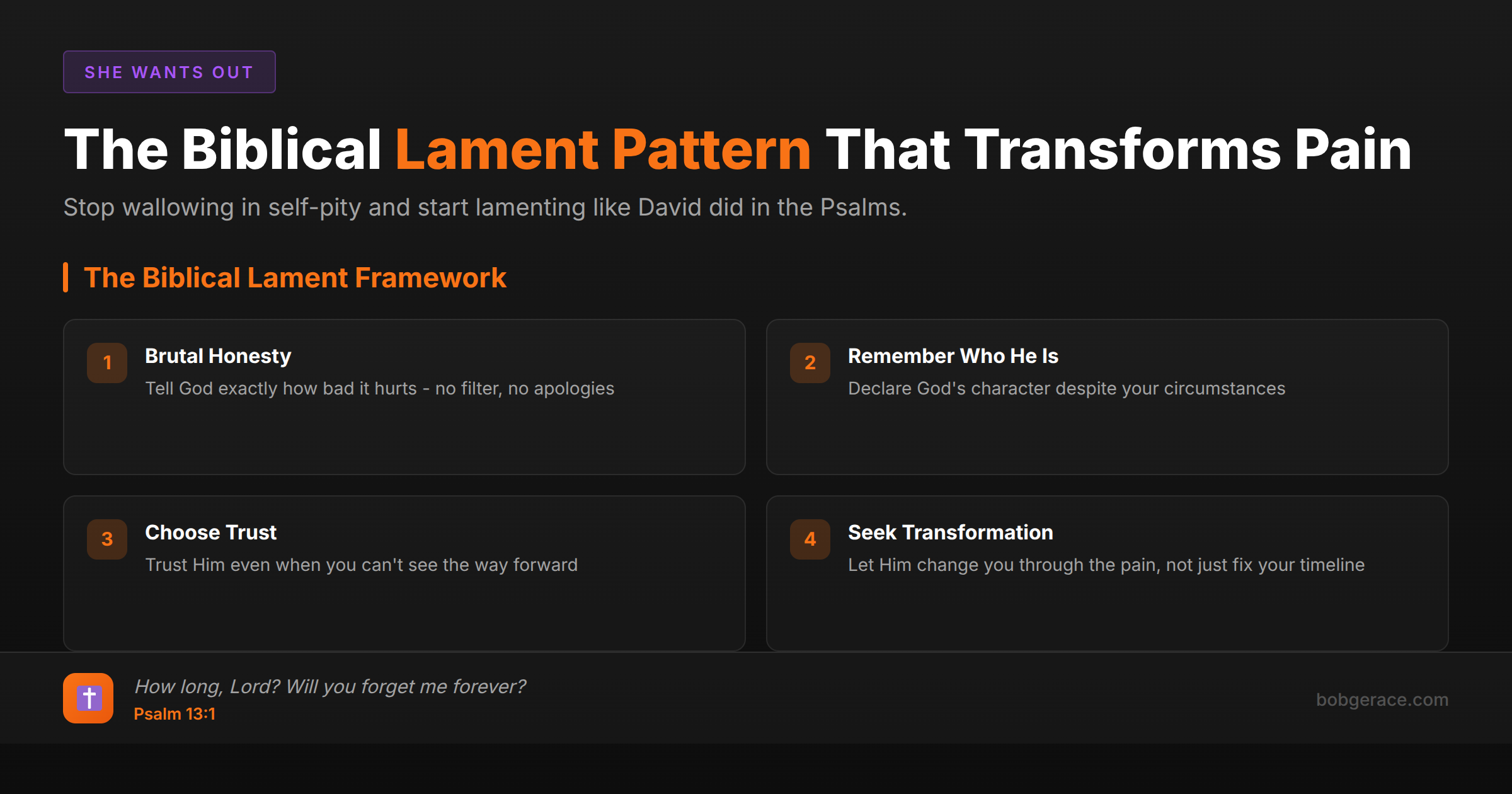
Biblical lament isn't wallowing in self-pity - it's bringing your raw, unfiltered pain directly to God with brutal honesty and stubborn faith. It's what David did in the Psalms when his world was falling apart, and it's what you need when your marriage feels like it's dying. Lament follows a pattern: you tell God exactly how bad it hurts, you remember who He is despite your circumstances, and you choose to trust Him even when you can't see the way forward. It's not pretty, it's not comfortable, but it's authentic worship in the darkest moments. This isn't about getting God to fix your marriage on your timeline - it's about letting Him transform you through the pain.
The Full Picture
Most men think biblical faith means putting on a brave face and "trusting God" without acknowledging the depth of their pain. That's not biblical - that's religious performance. True biblical lament is radically honest about your anguish while remaining anchored in God's character.
Lament has four key movements that we see throughout the Psalms:
• Honest complaint - You tell God exactly how you're feeling without sugar-coating it • Petition - You ask God specifically for what you need • Expression of trust - You declare what you know to be true about God's character • Praise or vow - You commit to worship Him regardless of the outcome
The mistake most men make is either skipping the honest complaint ("I shouldn't feel angry at God") or getting stuck there without moving toward trust. Biblical lament isn't venting - it's a journey from despair to hope through raw honesty.
When your wife says she's done, when your marriage feels hopeless, when you're questioning everything - that's exactly when you need to lament. David wrote his most powerful psalms when he was running for his life, when his own son betrayed him, when everything was falling apart. He didn't pretend it was fine - he brought his pain to the only One who could handle it.
This isn't about manipulating God to save your marriage. It's about letting God meet you in your deepest pain and transform you through it. Sometimes the answer is restoration. Sometimes it's strength to endure. Always, it's a deeper relationship with Him.
What's Really Happening
From a psychological perspective, lament serves as a crucial emotional regulation strategy that validates suffering while maintaining hope. Research in grief counseling shows that suppressed emotions often manifest as depression, anxiety, or even physical symptoms. Biblical lament provides a structured framework for processing intense emotions without getting lost in them.
The neurological impact of chronic relationship stress creates what we call 'emotional dysregulation' - your fight-or-flight system stays activated, making clear thinking nearly impossible. Lament engages both the emotional and rational parts of your brain through a process similar to what we see in effective trauma therapy.
The progression from complaint to trust mirrors the therapeutic concept of 'post-traumatic growth' - the idea that people can emerge from crisis stronger than before. But this only happens when we fully acknowledge the depth of our pain rather than bypassing it.
What makes biblical lament unique is its ultimate orientation toward transcendence rather than just catharsis. While secular grief work focuses on acceptance and moving forward, lament adds the dimension of meaning-making through relationship with God. This provides what psychologists call 'cognitive restructuring' - a fundamental shift in how you interpret your circumstances.
The communal aspect of lament - knowing others have walked this path - reduces the isolation that intensifies emotional pain. When men read David's raw honesty in the Psalms, they realize their own dark thoughts and feelings are part of the human experience, not evidence of spiritual failure.
What Scripture Says
Scripture is filled with lament, showing us it's not only acceptable but necessary for spiritual health. Psalm 13:1-2 captures the raw honesty: "How long, Lord? Will you forget me forever? How long will you hide your face from me? How long must I wrestle with my thoughts and day after day have sorrow in my heart?"
David doesn't apologize for his pain - he brings it directly to God. But notice how Psalm 13:5-6 ends: "But I trust in your unfailing love; my heart rejoices in your salvation. I will sing the Lord's praise, for he has been good to me." This is the movement from complaint to trust.
Lamentations 3:19-24 shows us that remembering God's character transforms our perspective: "I remember my affliction and my wandering, the bitterness and the gall. I well remember them, and my soul is downcast within me. Yet this I call to mind and therefore I have hope: Because of the Lord's great love we are not consumed, for his compassions never fail. They are new every morning; great is your faithfulness."
Even Jesus modeled lament. In Matthew 26:38-39, facing the cross, He said: "My soul is overwhelmed with sorrow to the point of death... My Father, if it is possible, may this cup be taken from me. Yet not as I will, but as you will." He was completely honest about His anguish while surrendering to the Father's plan.
Psalm 62:8 gives us the invitation: "Trust in him at all times, you people; pour out your hearts to him, for God is our refuge." The word 'pour out' means to empty completely - hold nothing back.
What To Do Right Now
-
1
Set aside 20 minutes daily to write out your raw, unfiltered thoughts and feelings to God
-
2
Read one psalm of lament each day (Psalms 3, 6, 13, 22, 42, 88) and notice the pattern
-
3
Tell God specifically what you're afraid of and what you need from Him
-
4
Write down three truths about God's character that remain constant despite your circumstances
-
5
Ask God to show you what He wants to change in you through this crisis
-
6
End each lament session by declaring your commitment to trust Him regardless of the outcome
Related Questions
- How do I pray when I can't form words?
- Is God present in this chaos?
- What psalms speak to this kind of anguish?
- What does it mean to 'cast my anxiety on Him'?
- Is my desperation faith or codependency?
- How do I surrender without giving up?
- How do I pray through this?
- What is biblical lament?
- What psalms help in marital crisis?
- How do I pray when I'm angry at God?
Also find Bob on
Subscribe for weekly videos on Christian marriage.
Bring Your Actual Marriage to a Coach
Lament is personal—your pain, your marriage, your story. A coach who knows where you are can help you apply this when the Psalms feel distant and your wife feels gone.
Talk to Bob →