Nothing I do seems to matter to her
6 min read
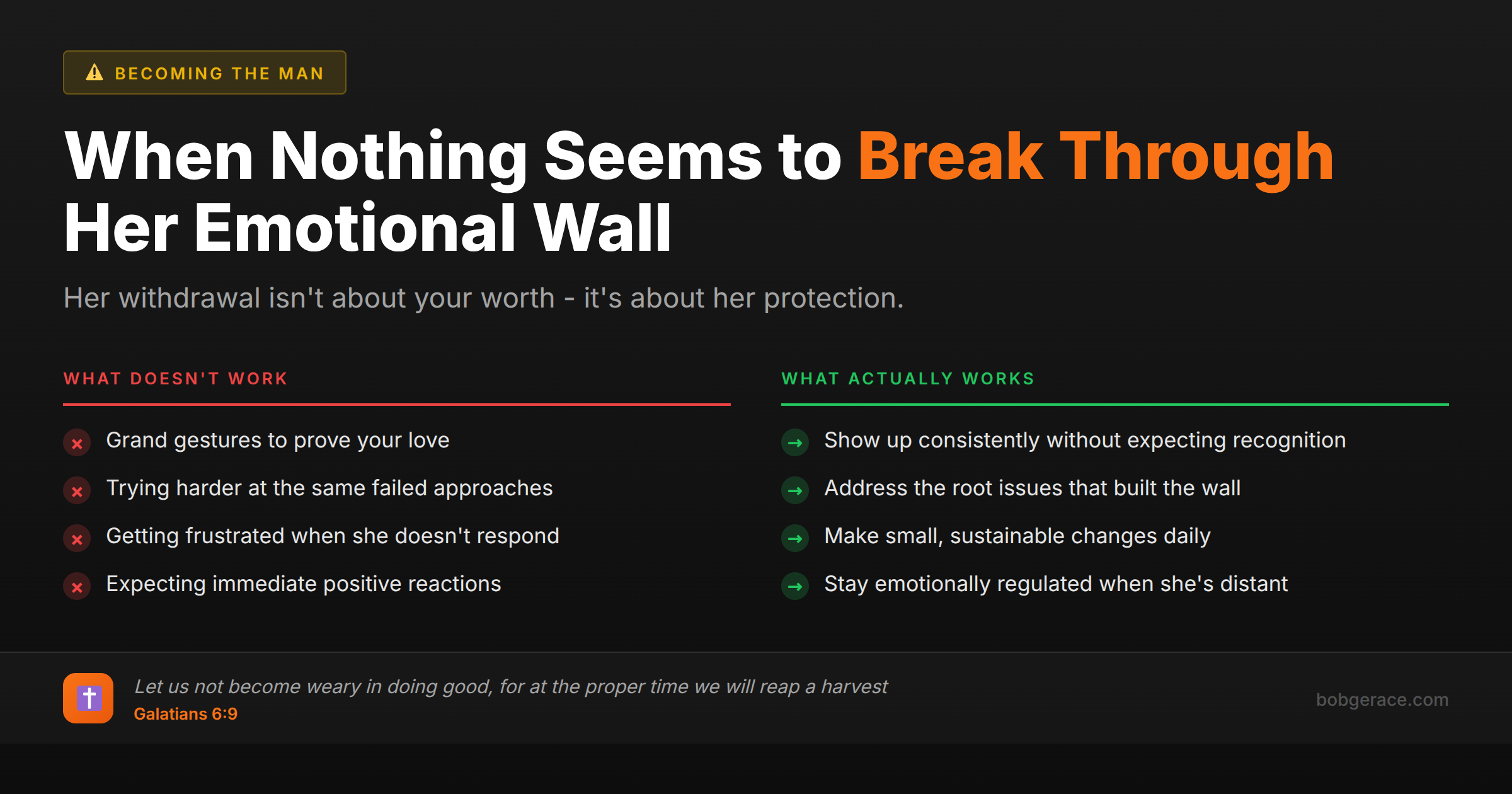
When nothing you do seems to matter to your wife, it's not because your efforts are worthless - it's because she's likely built an emotional wall to protect herself from further disappointment or hurt. This wall didn't appear overnight, and it won't come down with grand gestures or trying harder at the same things that haven't worked. The key is understanding that her emotional withdrawal is often a symptom of deeper issues in the relationship. She may have lost trust in your consistency, felt unheard for so long that she's stopped expecting change, or simply reached a point where self-protection feels safer than hope. Your efforts may actually feel threatening to someone who's trying to guard their heart.
The Full Picture
The emotional wall your wife has built isn't about rejecting you - it's about surviving disappointment. When someone says "nothing I do seems to matter," they're usually describing the frustrating experience of hitting this invisible barrier over and over again.
Here's what's likely happening: Your wife has experienced repeated cycles of hope and disappointment. Maybe you've made promises before that weren't kept, or perhaps there were patterns of behavior that created emotional distance. Over time, her heart learned to protect itself by not fully receiving your efforts, no matter how sincere they are now.
This creates a painful cycle. You try harder, she remains guarded, you feel rejected and frustrated, which can lead to giving up or trying even harder in ways that feel overwhelming to her. Meanwhile, she's watching to see if this "new you" is sustainable or if it's another temporary change that will fade once things settle down.
The wall isn't permanent, but it has a purpose. It's protecting her from the pain of getting her hopes up again. She may even be testing your efforts unconsciously - will you give up when the results aren't immediate? Will you get angry when she doesn't respond the way you hope? Her guarded response is actually information about how deeply she's been hurt and how much healing needs to happen.
Understanding this changes everything. Instead of seeing her lack of response as rejection, you can see it as a wounded person being cautious. Instead of trying harder at the same things, you can focus on consistency, patience, and addressing the root issues that built the wall in the first place. The goal isn't to get an immediate positive response - it's to prove over time that you're safe and that change is real and lasting.
What's Really Happening
From a therapeutic perspective, what you're experiencing is likely your wife's attachment system in protective mode. When someone has been hurt or disappointed repeatedly in their primary relationship, their nervous system learns to expect disappointment rather than connection.
This manifests as what we call 'emotional numbing' or 'defensive detachment.' Your wife isn't choosing to be unresponsive out of spite - her brain is literally protecting her from the neurobiological stress of hope followed by disappointment. The emotional center of her brain has learned that staying disconnected feels safer than risking further hurt.
The frustrating part for you is that this protective mechanism doesn't distinguish between past harmful behaviors and current positive efforts. Her nervous system is essentially saying, 'We've been hurt before in this relationship, so we're not fully trusting any new behaviors until we see long-term consistency.'
This is why grand gestures often backfire - they can feel overwhelming or manipulative to someone in protective mode. What rebuilds trust is small, consistent actions over time that prove safety and reliability. Think of it like earning back the trust of a scared animal - sudden movements and intense efforts will cause more withdrawal.
The healing process requires patience because you're not just changing current dynamics - you're helping her nervous system unlearn protective patterns that developed over months or years. This isn't about her being stubborn; it's about basic neurobiology and how our brains protect us from repeated relational trauma.
What Scripture Says
Scripture gives us profound wisdom about rebuilding trust and connection when relationships have been damaged. Galatians 6:9 reminds us, *"Let us not become weary in doing good, for at the proper time we will reap a harvest if we do not give up."* This verse speaks directly to your situation - the harvest of restored connection will come, but not according to your timeline.
Proverbs 15:1 teaches us, *"A gentle answer turns away wrath, but a harsh word stirs up anger."* When your efforts aren't received as you hope, your response matters enormously. Gentleness and patience, even in the face of seeming rejection, demonstrates the character change your wife needs to see.
1 Corinthians 13:4-7 defines love in ways that speak directly to breaking through emotional walls: *"Love is patient, love is kind... it is not easily angered, it keeps no record of wrongs... Love never fails."* Notice that biblical love doesn't depend on the response it receives - it's characterized by persistence and kindness regardless of immediate results.
Ephesians 4:2-3 calls us to *"Be completely humble and gentle; be patient, bearing with one another in love. Make every effort to keep the unity of the Spirit through the bond of peace."* This patience isn't passive waiting - it's active, consistent love that creates space for healing.
Luke 15:20 shows us the father watching for his prodigal son's return, running to meet him while he was still far off. Sometimes rebuilding connection means proving you'll be there consistently, watching and waiting with love, even before you see signs of your wife's heart returning. God models this kind of persistent, patient love for us, and calls us to extend it to our spouses.
What To Do Right Now
-
1
Stop trying to get immediate positive responses and focus on consistency instead - show up the same way day after day without expecting recognition
-
2
Address any underlying issues that built the wall - have honest conversations about past hurts and take full responsibility for your part
-
3
Make small, sustainable changes rather than dramatic gestures - her nervous system needs to see reliability, not intensity
-
4
Demonstrate emotional regulation when she doesn't respond positively - your reaction to her guardedness will either build or erode trust
-
5
Give her explicit permission to be cautious and take time - let her know you understand why she's protecting herself and that you're committed for the long haul
-
6
Seek to understand her inner world without trying to fix or change her response - ask questions, listen deeply, and validate her experience
Related Questions
- She's indifferent — not angry, just empty
- She responds to me like I'm a stranger
- She lights up for everyone but me
- She's physically present but emotionally gone
- She stopped fighting — is that worse?
- She seems happier when I'm not around
- What is 'emotional disengagement'?
- Is her shutdown protective or permanent?
- What is 'deactivation' and did I cause it?
- What is 'negative sentiment override' and does she have it?
Also find Bob on
Subscribe for weekly videos on Christian marriage.
You Need a Coach Who Knows Your Marriage
Breaking through her wall isn't about trying harder—it's about doing different things in the right sequence for your specific situation. A coach helps you see what you can't see alone.
Talk to Bob →