She says she's 'fine' but she's not
6 min read
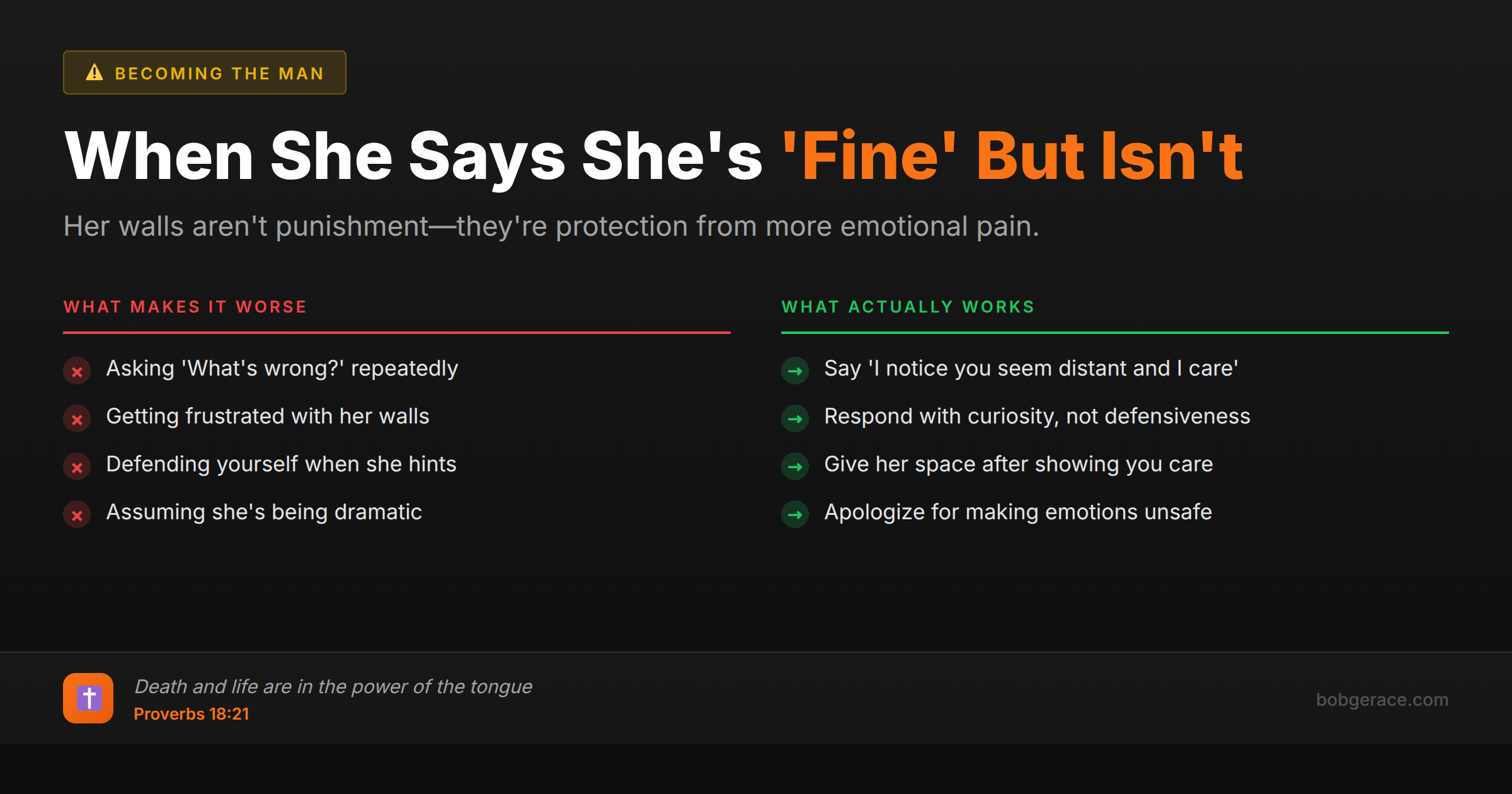
When she says she's 'fine' but clearly isn't, she's protecting herself behind an emotional wall. This isn't about being difficult—it's about self-preservation. She's learned that expressing her real feelings hasn't led to the connection she needs, so she's shut down to avoid further disappointment or conflict. The word 'fine' has become her shield. Behind it, she's likely feeling unheard, disconnected, or hopeless about the relationship improving. She's not trying to punish you; she's trying to survive emotionally. Breaking through requires genuine curiosity about her inner world, not frustration about her walls.
The Full Picture
'Fine' is code for 'I've given up trying to be heard.'
When your wife defaults to 'fine,' she's not being stubborn or manipulative. She's protecting herself from further emotional injury. Think about it: how many times has she tried to express her real feelings, only to be dismissed, minimized, or met with defensiveness?
The fine fortress is built brick by brick: - Every time her concerns were brushed off - Each moment she felt misunderstood - When vulnerability was met with solutions instead of empathy - After arguments where she felt unheard - Through years of feeling like her emotions were inconvenient
What 'fine' really means: - 'I don't have the energy to fight anymore' - 'You won't understand anyway' - 'It's easier to say nothing than risk being hurt again' - 'I'm protecting what's left of my heart'
The danger zone: When wives retreat to 'fine,' they're often mentally and emotionally checking out. This isn't a phase—it's a protective strategy. The longer it continues, the more disconnected she becomes from both you and the marriage.
Here's what most husbands miss: You can't logic your way past 'fine.' You can't demand emotional transparency. You can't force her to open up by getting frustrated with her walls. The only way through is to become genuinely safe—someone she can trust with her real feelings without fear of judgment, defensiveness, or having her emotions minimized.
What's Really Happening
The 'fine' response represents what we call emotional self-protection through withdrawal. When a woman repeatedly says she's fine while clearly distressed, she's engaging in what psychologists recognize as a trauma response—specifically, the 'freeze' response to relational threat.
Neurologically, here's what happens: Her nervous system has learned that emotional expression in the relationship leads to stress, not relief. The brain's threat detection system now categorizes vulnerability as dangerous, so it shuts down emotional expression as a protective mechanism.
This creates a neurochemical pattern: Stress hormones like cortisol remain elevated while connection hormones like oxytocin decrease. She's literally wired now to expect emotional disconnection, making 'fine' feel safer than authentic expression.
The attachment perspective: This behavior often stems from anxious-avoidant attachment patterns. She once reached for connection (anxious), but when consistently met with dismissal or conflict, she shifted to avoidance as a survival strategy.
Breaking the pattern requires: Creating consistent experiences of emotional safety. Her nervous system needs to learn through repeated positive interactions that vulnerability won't be punished. This isn't about one conversation—it's about rewiring her neurological expectation of safety in the relationship through patient, consistent, empathetic responses over time.
What Scripture Says
God designed marriage as the deepest human expression of emotional and spiritual intimacy, but sin creates walls that separate us from each other.
Proverbs 18:21 reminds us that 'Death and life are in the power of the tongue.' When we've used words carelessly or defensively, we may have inadvertently created death in our wife's willingness to be vulnerable.
Ephesians 4:29 calls us to 'Let no corrupting talk come out of your mouths, but only such as is good for building up, as fits the occasion, that it may give grace to those who hear.' Have your responses to her emotions been grace-giving or grace-killing?
1 Peter 3:7 specifically instructs husbands to 'live with your wives in an understanding way, showing honor to the woman as the weaker vessel, since they are heirs with you of the grace of life.' Understanding her need for emotional safety isn't weakness—it's honoring her design.
James 1:19 teaches us to 'be quick to hear, slow to speak, slow to anger.' When she's retreated to 'fine,' we need to become students of her heart, not critics of her communication style.
Genesis 2:25 describes the original design: 'And the man and his wife were both naked and were not ashamed.' This wasn't just physical—it was complete emotional vulnerability without fear. That's what she's protecting herself from because shame has entered where safety should reign.
God calls you to become a safe harbor for her heart, creating the conditions where she can risk being known again.
What To Do Right Now
-
1
Stop asking 'What's wrong?' and start saying 'I notice you seem distant, and I care about what you're feeling.'
-
2
When she says 'fine,' respond with 'I love you and I'm here when you're ready to talk' then give her space.
-
3
Examine your typical responses to her emotions—do you defend, fix, minimize, or truly listen?
-
4
Apologize specifically for times you've made it unsafe for her to share her real feelings.
-
5
Practice responding to difficult emotions with curiosity instead of defensiveness for 30 days.
-
6
Create regular, pressure-free opportunities for connection without demanding she open up immediately.
Related Questions
- She won't talk about our problems
- She shuts down when I try to connect
- She shares her feelings with everyone but me
- She stopped fighting — is that worse?
- She's indifferent — not angry, just empty
- Nothing I do seems to matter to her
- What is 'emotional disengagement'?
- What is 'stonewalling' and why does she do it?
- What does 'emotional flooding' feel like for her?
- Why did she stop fighting?
Also find Bob on
Subscribe for weekly videos on Christian marriage.
Your Marriage Isn't Generic
A coach who knows your specific story can see what you can't—why she's shut down with you, what she actually needs to feel safe again. You don't have to keep guessing alone.
Talk to Bob →