She won't talk about our problems
6 min read
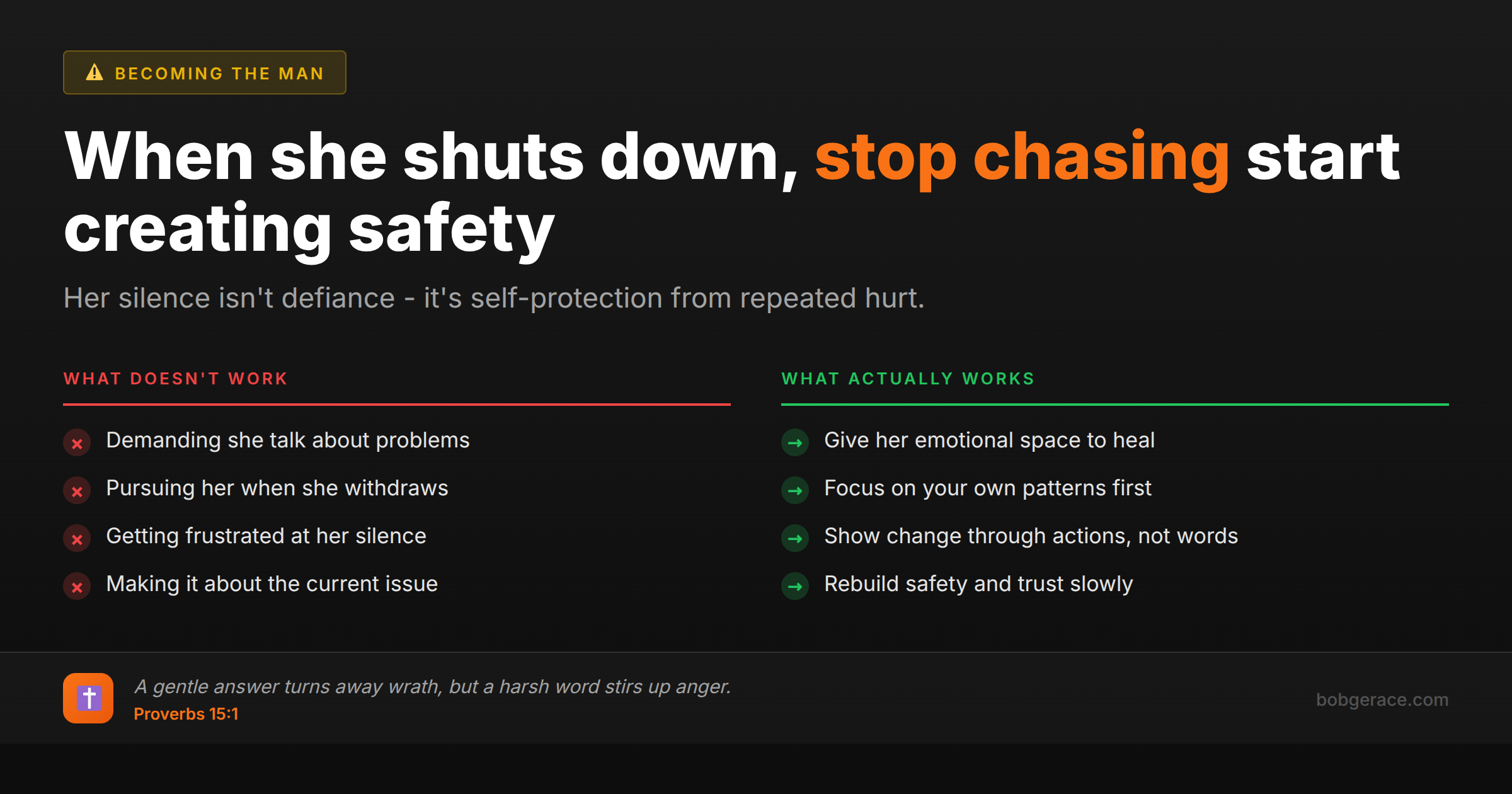
When your wife won't talk about problems, she's likely protecting herself from what feels like repeated hurt or futility. This emotional shutdown doesn't happen overnight - it's usually the result of feeling unheard, criticized, or hopeless about change for an extended period. She may have tried to communicate in the past but felt dismissed or overwhelmed by conflict. This silence isn't necessarily about the current issue - it's about the safety of the relationship itself. When someone builds an emotional wall, they're essentially saying 'I can't risk being vulnerable with you right now.' The key isn't forcing conversation, but rebuilding the foundation of trust and safety that makes open communication possible.
The Full Picture
When your wife stops talking about problems, you're witnessing the final stage of emotional withdrawal - not the beginning. Most women don't start marriages by shutting down communication. They typically begin with high hopes for connection and resolution. The silence you're experiencing now likely developed through a predictable pattern.
The Shutdown Cycle
It often starts with repeated attempts to address issues that either get dismissed, turned into arguments, or result in temporary fixes that don't last. Over time, she may have concluded that bringing up problems creates more pain than staying quiet. This isn't manipulation - it's emotional survival.
Many husbands interpret this silence as stubbornness or lack of caring, but it's usually the opposite. She may care so much that the potential for disappointment feels unbearable. The emotional wall becomes her protection against hope that might be crushed again.
What Silence Really Means
Her refusal to engage doesn't necessarily mean she's given up on the marriage - though it might. It could mean she's protecting what's left of her emotional energy. Think of it like someone who's been burned repeatedly by a stove. Eventually, they stop reaching for it, not because they don't want warmth, but because they can't handle another burn.
The challenge is that this creates a vicious cycle. The more she withdraws, the more frustrated you become. The more you push for communication, the more unsafe she feels. Breaking this cycle requires understanding that her silence is communication - it's telling you the relationship doesn't feel safe enough for vulnerability right now.
What's Really Happening
From a clinical perspective, emotional shutdown in marriage often reflects a nervous system response to chronic relational stress. When someone experiences repeated unsuccessful attempts at conflict resolution, their brain begins to associate relationship discussions with threat, triggering protective mechanisms.
This phenomenon, known as 'emotional flooding,' occurs when someone becomes so overwhelmed by intense emotions that their ability to think clearly and communicate effectively shuts down. For many women, this manifests as withdrawal rather than escalation. It's not a conscious choice - it's a neurobiological response to feeling unsafe.
The critical factor here is 'felt safety.' Even in marriages without abuse, one partner can feel emotionally unsafe due to patterns like criticism, defensiveness, contempt, or stonewalling - what researcher John Gottman calls the 'Four Horsemen.' When these patterns persist, the brain learns that relationship conversations equal danger.
Recovery requires what we call 'co-regulation' - the ability of one partner's calm, consistent presence to help regulate the other's nervous system. This happens through predictable safety, not through words. Small, consistent actions that demonstrate respect and care can gradually rebuild the neurological pathways that allow for open communication. The goal isn't to force conversation, but to create conditions where your wife's nervous system recognizes relationship discussions as safe rather than threatening.
What Scripture Says
Scripture provides profound wisdom about communication, safety, and restoration in relationships. When someone has withdrawn emotionally, the biblical response isn't to demand engagement, but to create conditions for healing and trust.
Gentleness Over Force
*"A gentle answer turns away wrath, but a harsh word stirs up anger."* (Proverbs 15:1) When your wife has stopped talking, gentleness becomes crucial. This verse reminds us that the tone and approach we bring to conflict determines the outcome. Harsh demands for communication will only strengthen her emotional walls.
*"Be completely humble and gentle; be patient, bearing with one another in love."* (Ephesians 4:2) Patience here doesn't mean passive waiting, but active love that creates safety over time.
Understanding Before Being Understood
*"Everyone should be quick to listen, slow to speak and slow to become angry."* (James 1:19) This principle becomes vital when dealing with emotional shutdown. Your wife's silence is communication - it's telling you something important about her emotional state and the relationship's safety level.
Pursuing Like Christ
*"Husbands, love your wives, just as Christ loved the church and gave himself up for her."* (Ephesians 5:25) Christ's pursuit of the church wasn't demanding or entitled - it was sacrificial and patient. When someone has withdrawn, Christ-like pursuit means creating safety and demonstrating change rather than demanding engagement.
*"Above all, love each other deeply, because love covers over a multitude of sins."* (1 Peter 4:8) This deep love creates the environment where vulnerability becomes possible again.
What To Do Right Now
-
1
Stop pursuing conversation about the problems. Give her emotional space while you work on creating safety. Pushing for dialogue right now will likely backfire.
-
2
Examine your own patterns. Ask yourself honestly: How have you typically responded when she's brought up problems in the past? What might have contributed to her withdrawal?
-
3
Focus on small, consistent actions. Do thoughtful things without expecting anything in return. Show her through behavior, not words, that you're changing.
-
4
Address your own emotional regulation. Work on staying calm and non-reactive. Her walls won't come down if she sees you as emotionally unpredictable.
-
5
Apologize for past patterns without expecting immediate forgiveness. Acknowledge ways you may have made communication feel unsafe, without defending yourself.
-
6
Get professional help for yourself. A counselor can help you understand your contribution to the communication breakdown and develop healthier approaches.
Related Questions
- She shuts down when I try to connect
- She says she's 'fine' but she's not
- She shares her feelings with everyone but me
- She stopped fighting — is that worse?
- She's indifferent — not angry, just empty
- Nothing I do seems to matter to her
- What is 'stonewalling' and why does she do it?
- What is 'emotional disengagement'?
- Why did she stop fighting?
- What does 'emotional flooding' feel like for her?
Also find Bob on
Subscribe for weekly videos on Christian marriage.
You Can't Script This One Alone
When your wife has shut down, the next move matters. A coach who knows your marriage can see what you can't—and help you rebuild safety without pushing her further away.
Talk to Bob →