She shares her feelings with everyone but me
6 min read
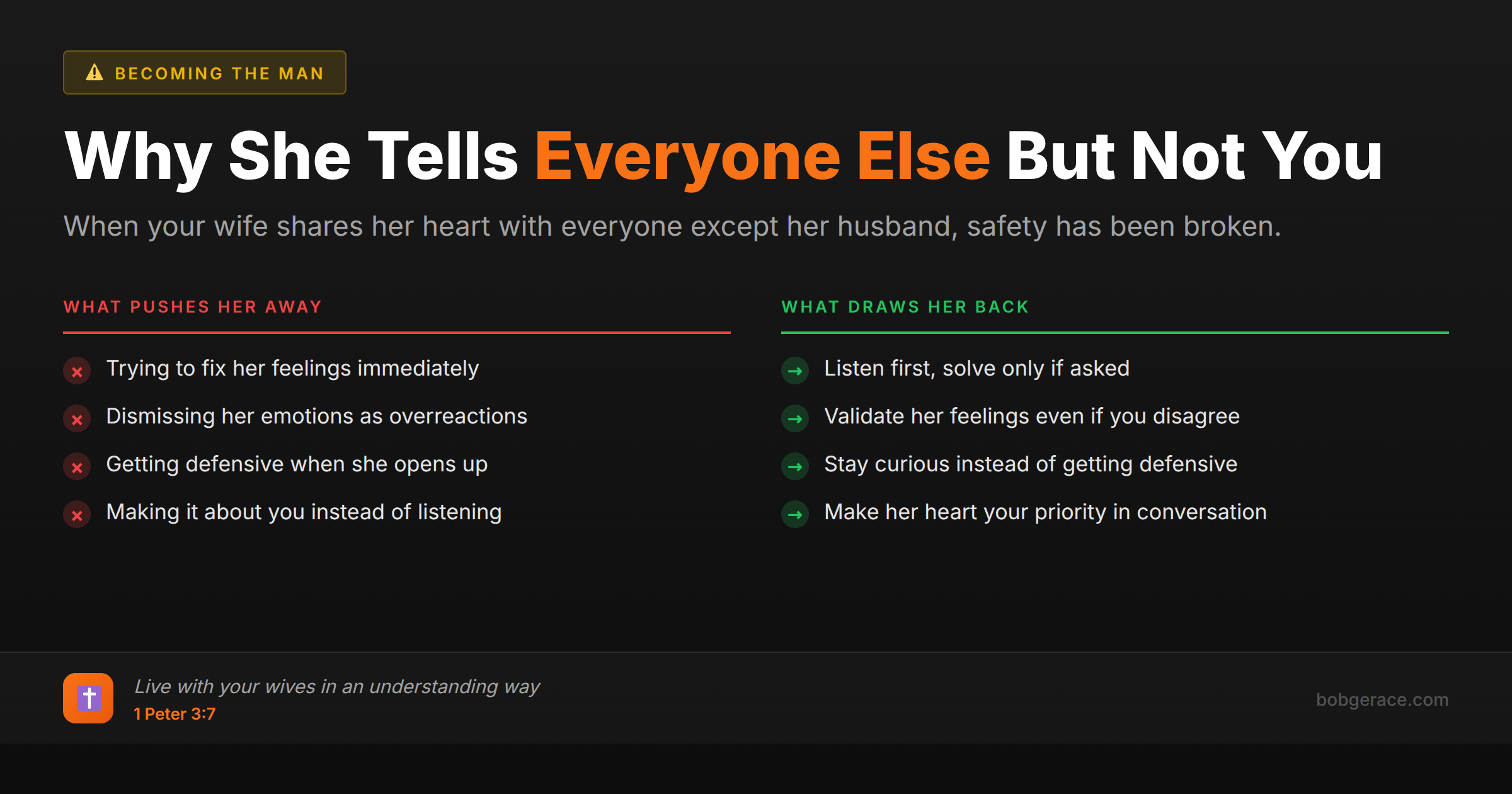
When your wife shares her feelings with friends, family, or even strangers but keeps you at arm's length emotionally, it's a clear sign that trust has been damaged in your relationship. This isn't about her being malicious or intentionally hurtful - it's about safety. She's learned, through repeated experiences, that sharing vulnerable parts of herself with you doesn't feel emotionally safe. This pattern typically develops over time when wives feel dismissed, criticized, or unheard when they've tried to open up. Maybe past conversations turned into arguments, or her feelings were minimized or met with solutions instead of understanding. The good news is this wall can come down, but it requires you to rebuild trust through consistent, patient actions that prove you're a safe harbor for her heart again.
The Full Picture
Here's what's really happening when your wife becomes an open book with everyone except you: she's protecting herself. This behavior isn't random or vindictive - it's a survival mechanism that developed because somewhere along the way, sharing her inner world with you became associated with pain, frustration, or disappointment.
Think about it from her perspective. When she talks to her sister about work stress, her sister listens and validates her feelings. When she shares the same concern with you, maybe you immediately jump into fix-it mode, tell her she's overreacting, or turn the conversation back to your own problems. Over time, she learns where it's safe to be vulnerable and where it's not.
The pattern usually looks like this: She tries to share something meaningful → you respond in a way that feels dismissive, critical, or overwhelming to her → she pulls back a little → this cycle repeats until she stops trying with you altogether. Meanwhile, other people in her life continue to provide the empathy and understanding she craves.
This creates a painful irony: the person who should be her closest confidant becomes the last person she'd trust with her deepest thoughts. You're left feeling like a stranger in your own marriage while watching her light up in conversations with others.
The emotional wall serves a purpose - it protects her from further hurt. But it also prevents the intimacy you both actually want. She's not sharing with others to spite you; she's sharing with them because they've proven to be emotionally safe harbors. The question isn't why she talks to them - it's why she stopped feeling safe talking to you.
What's Really Happening
From a psychological standpoint, this behavior represents what we call 'selective emotional disclosure' - a protective mechanism that develops when the primary attachment relationship feels unsafe for vulnerability. Your wife's brain has essentially categorized you as emotionally risky based on past interactions.
When we experience repeated emotional injuries in our most important relationship, we unconsciously start distributing our emotional needs across multiple relationships to minimize risk. It's actually quite adaptive - she's meeting her need for connection and validation while protecting herself from further hurt in the relationship that matters most.
The neurological reality is that her brain now associates emotional sharing with you with stress responses - elevated cortisol, increased vigilance, and defensive positioning. Meanwhile, sharing with friends or family activates her reward system, releasing oxytocin and dopamine. Her brain literally feels safer being vulnerable with others.
This pattern often develops gradually through what therapists call 'micro-abandonments' - small moments where she felt unheard, dismissed, or emotionally unsafe. Maybe you interrupted her, offered solutions when she needed empathy, or seemed distracted when she was sharing something important. None of these incidents felt catastrophic in the moment, but they accumulated into a protective wall.
The good news is that brains are remarkably plastic. With consistent, safe interactions, you can literally rewire her neural pathways around emotional safety with you. This requires what we call 'earned security' - proving through actions, not words, that you're a safe harbor for her vulnerable emotions again.
What Scripture Says
Scripture calls husbands to be the safest place on earth for their wives' hearts. Ephesians 5:29 reminds us that 'no one ever hated their own body, but they feed and care for their body, just as Christ does the church.' This includes nourishing her emotional and spiritual needs, not just physical ones.
1 Peter 3:7 specifically instructs husbands to 'live with your wives in an understanding way, showing honor to the woman as the weaker vessel, since they are heirs with you of the grace of life, so that your prayers may not be hindered.' Notice that God connects our treatment of our wives directly to our spiritual life - when we fail to provide understanding and honor, even our prayers are affected.
The principle of Proverbs 18:13 is crucial here: 'If one gives an answer before he hears, it is his folly and shame.' How many times have we interrupted our wives' sharing with solutions, corrections, or our own stories? True listening requires humility and patience.
James 1:19 provides the blueprint for rebuilding emotional safety: 'Let every person be quick to hear, slow to speak, slow to anger.' This isn't just good advice - it's God's design for healthy communication. When your wife shares her heart, your first response should be listening, not talking.
God designed marriage to be a reflection of Christ's relationship with the church. Ephesians 5:25-26 shows us that Christ's love is sanctifying and cleansing - it makes the church more beautiful, not more beaten down. Your response to your wife's emotions should leave her feeling more valued, understood, and cherished, not defensive or diminished.
Galatians 6:2 calls us to 'bear one another's burdens, and so fulfill the law of Christ.' Your wife's emotions - even the difficult ones - aren't problems to solve but burdens to help carry with love and understanding.
What To Do Right Now
-
1
Stop trying to solve everything - When she does share, resist the urge to fix, correct, or minimize. Your job is to listen and understand, not to provide solutions unless she specifically asks.
-
2
Apologize for past dismissiveness - Acknowledge times when you've been impatient, critical, or inattentive when she's tried to open up. Own your part in creating the wall.
-
3
Create safe conversation space - Put devices away, make eye contact, and give her your full attention during conversations. Show through body language that you're fully present.
-
4
Validate before you respond - Before sharing your perspective, reflect back what you heard: 'It sounds like you felt really frustrated when...' This shows you're actually listening.
-
5
Ask curious questions, not leading ones - Instead of 'Why didn't you just...' try 'Help me understand what that felt like for you.' Show genuine interest in her inner world.
-
6
Be patient with the process - Rebuilding emotional trust takes time. Don't expect immediate results, and don't get frustrated if she doesn't immediately start confiding in you again.
Related Questions
- She won't talk about our problems
- She shuts down when I try to connect
- She says she's 'fine' but she's not
- She stopped fighting — is that worse?
- She's indifferent — not angry, just empty
- Nothing I do seems to matter to her
- What is 'emotional disengagement'?
- She doesn't want to be touched
- Why does she seem numb/flat/dead inside?
- What did I do that made vulnerability feel unsafe?
Also find Bob on
Subscribe for weekly videos on Christian marriage.
You Don't Have to Rebuild This Alone
A coach who knows your marriage can see what you're missing and help you become safe again for her. This isn't generic advice—it's calibrated to where you actually are.
Talk to Bob →