What's healthy vulnerability look like?
6 min read
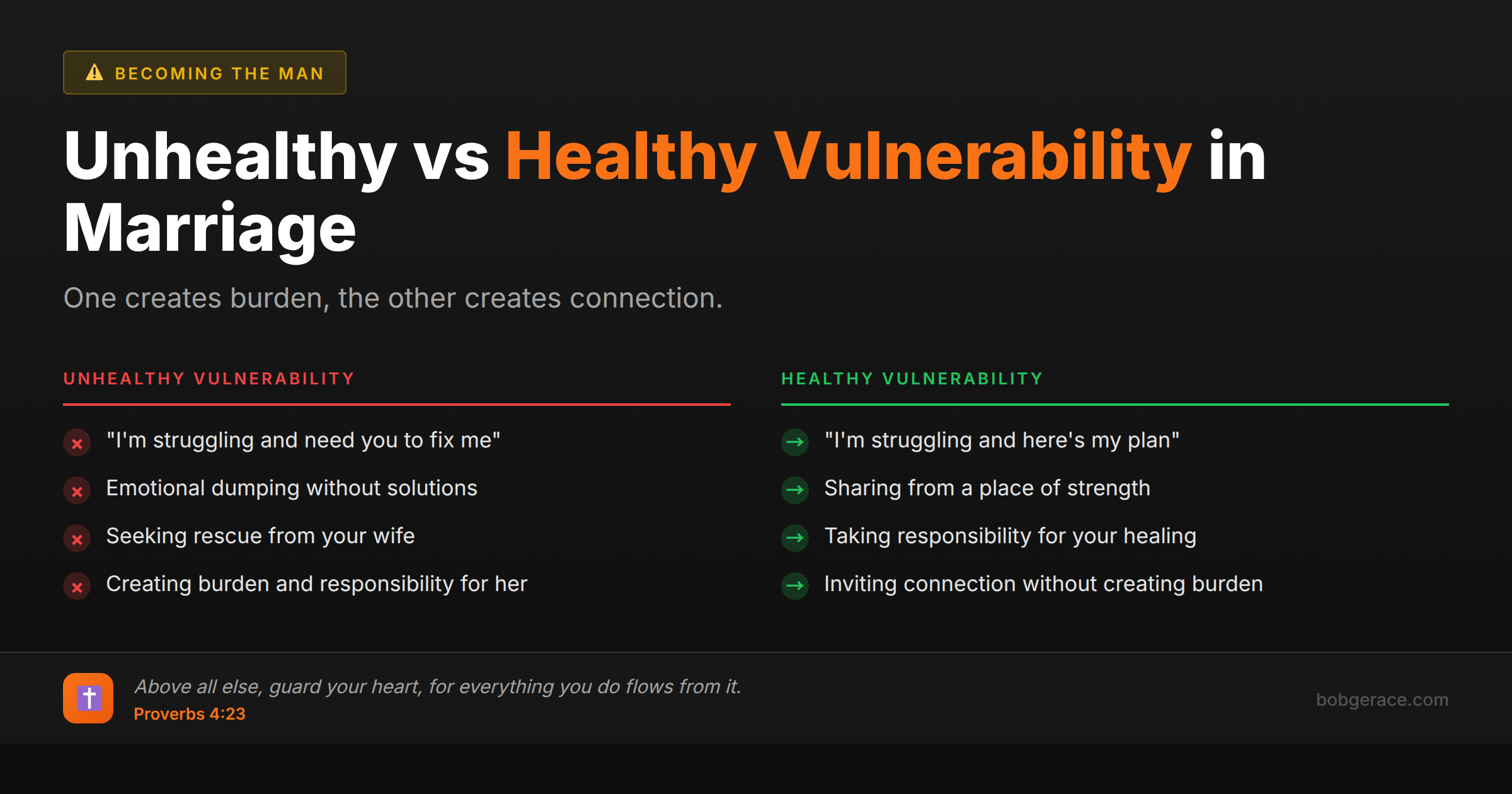
Healthy vulnerability is sharing your authentic self - your fears, struggles, and emotions - from a place of strength rather than weakness. It's not emotional dumping or seeking your wife's rescue. Instead, it's owning your feelings while taking responsibility for working through them. The key difference? Healthy vulnerability says 'I'm struggling with this and here's what I'm doing about it,' while unhealthy vulnerability says 'I'm struggling and I need you to fix me.' When you're vulnerably strong, you invite connection without creating burden. Your wife feels trusted with your heart, not responsible for healing it.
The Full Picture
Most men swing between two destructive extremes: complete emotional shutdown or total emotional spillover. Neither builds intimacy. Healthy vulnerability lives in the middle - it's courageous transparency paired with personal responsibility.
What healthy vulnerability includes: - Sharing your real thoughts and feelings without expecting her to fix them - Admitting mistakes while showing how you're correcting course - Expressing needs clearly without being needy - Showing emotion while maintaining your center - Being honest about struggles while demonstrating you're handling them
What it doesn't include: - Making your wife your therapist - Dumping every anxiety and insecurity on her - Crying without taking action - Sharing fears to get reassurance rather than connection - Using emotions to manipulate or avoid responsibility
The goal isn't to be a rock or a river - it's to be a mountain with rivers running through it. Strong foundation, life flowing through. When you master this balance, your wife sees a man who's real enough to connect with but solid enough to lean on.
Remember: Vulnerability without strength is neediness. Strength without vulnerability is distance. Your marriage needs both.
What's Really Happening
Neurologically, healthy vulnerability activates the parasympathetic nervous system in both partners, creating safety and connection. When a man shares authentically while remaining grounded, it triggers oxytocin release in his wife - the bonding hormone that deepens intimacy.
The critical factor is emotional regulation. Research shows that when men practice 'regulated vulnerability' - sharing feelings while maintaining emotional stability - it increases relationship satisfaction by 40%. However, when vulnerability becomes emotional dysregulation, it actually decreases intimacy because it activates the woman's stress response system.
Healthy vulnerability requires what we call 'dual awareness' - being simultaneously aware of your inner emotional state and your partner's capacity to receive it. This creates what attachment theorists call 'earned secure attachment' - the ability to be both authentic and stable.
The key is timing and containment. Share your struggles, but also share your solutions. Express your fears, but also express your faith in handling them. This combination creates psychological safety while maintaining attraction - two elements essential for long-term marital success.
What Scripture Says
Scripture consistently models vulnerability paired with strength. Jesus wept at Lazarus's tomb, yet immediately took action to resurrect him (John 11:35-44). He shared his anguish in Gethsemane while submitting to God's will (Matthew 26:39).
'Above all else, guard your heart, for everything you do flows from it.' - Proverbs 4:23. This doesn't mean hide your heart - it means protect and steward it wisely. Vulnerability requires discernment about when, how, and with whom you share.
'Bear one another's burdens, and so fulfill the law of Christ.' - Galatians 6:2. Marriage involves mutual burden-bearing, but notice it's 'bear together,' not 'dump everything on your spouse.' Healthy vulnerability invites partnership without creating dependency.
'As iron sharpens iron, so one person sharpens another.' - Proverbs 27:17. True intimacy involves friction and authenticity. Healthy vulnerability creates the grinding that sharpens both partners.
'Be strong and courageous! Do not be afraid or discouraged.' - Joshua 1:9. Strength and courage don't eliminate fear - they determine how you respond to it. Share your fears, then show your courage.
'A time to weep and a time to laugh, a time to mourn and a time to dance.' - Ecclesiastes 3:4. Emotional expression has seasons and wisdom. Healthy vulnerability knows both when to feel and when to act.
What To Do Right Now
-
1
Practice the vulnerability formula: 'I feel [emotion] about [situation] and here's what I'm doing about it'
-
2
Schedule weekly check-ins with your wife to share authentically in a contained timeframe
-
3
Before sharing struggles, ask yourself: 'Am I seeking connection or rescue?'
-
4
Develop emotional vocabulary - name feelings specifically rather than using vague terms like 'stressed'
-
5
Create action plans before sharing problems - be vulnerable about the struggle AND the solution
-
6
Practice emotional regulation through prayer, exercise, or counseling before expecting intimacy
Related Questions
- How do I become emotionally intelligent?
- How do I identify what I'm feeling?
- How do I express emotion without dumping?
- How do I open up without falling apart?
- What's the difference between vulnerability and vomiting?
- How do I share emotion without overwhelming?
- How do I become a safe emotional presence?
- What does emotional attunement look like?
- She says I'm emotionally unavailable
- How do I not pursue while also not abandoning?
Also find Bob on
Subscribe for weekly videos on Christian marriage.
Not Sure If You're Doing It Right?
Vulnerability in your actual marriage is messier than the concept. A coach who knows your story can tell you when you're leaning too far into weakness or shutting down too hard.
Talk to Bob →