How do I pray with them when I'm barely holding on?
5 min read
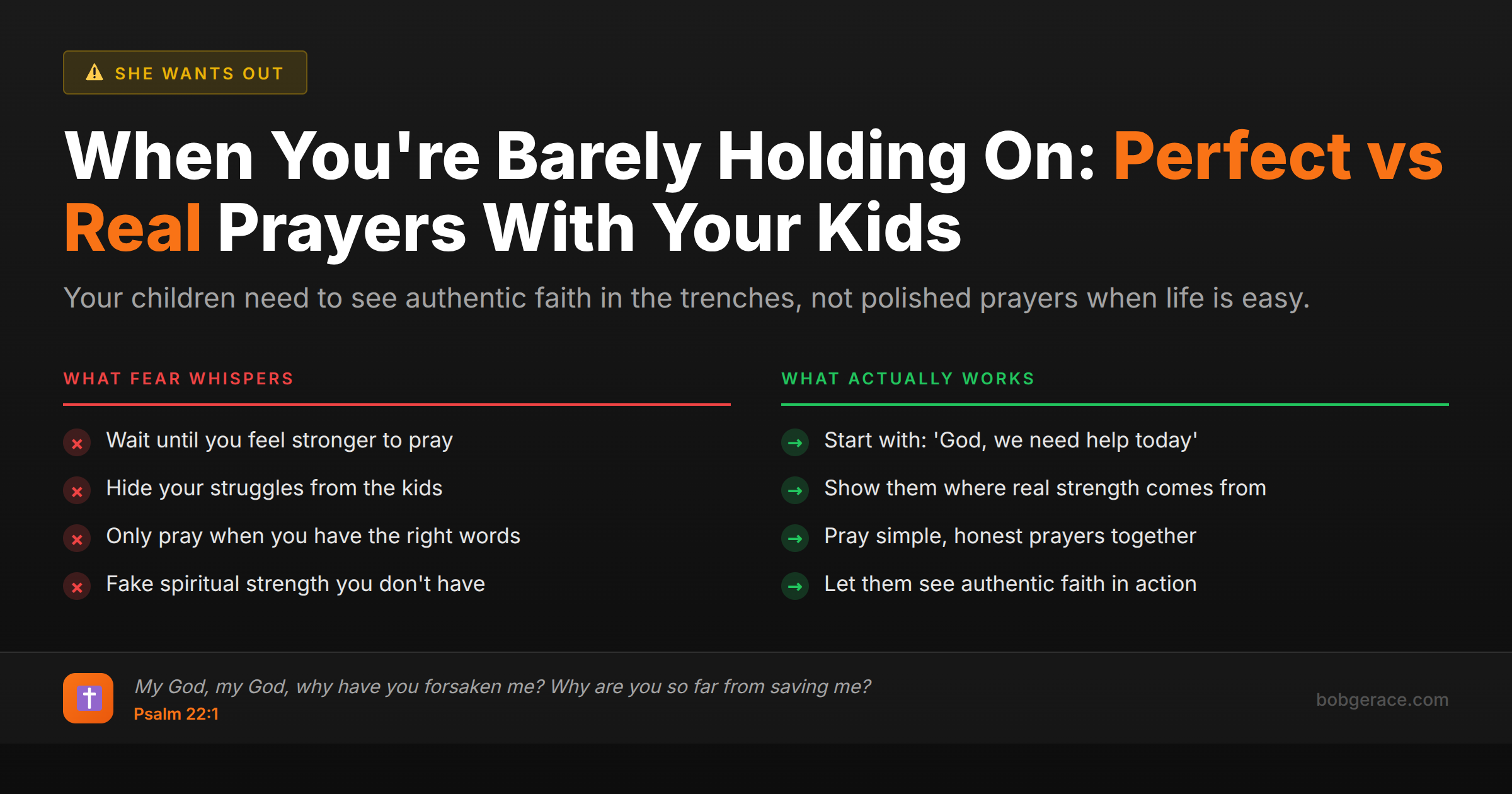
Here's the truth: your kids don't need a perfect father who has it all figured out—they need an authentic one who shows them what real faith looks like in the trenches. When you're barely holding on, that's exactly when your prayers with them become most powerful. Start simple: "God, we need help today" or "Thank you for loving us even when things are hard." Your children are learning more about God's character from watching you turn to Him in your weakness than they ever would from polished prayers when life is easy. Don't fake strength you don't have, but do show them where your strength comes from.
The Full Picture
The struggle to pray with your children when you're in crisis reveals something profound about fatherhood: you were never meant to be their savior. You're their guide to the One who is. This realization can either paralyze you or liberate you—the choice is yours.
Many fathers make the mistake of thinking they need to project invincibility during family prayer time. They believe showing doubt or pain will damage their children's faith. The opposite is true. Children have an uncanny ability to sense authenticity, and they're watching to see if your faith is real when it costs something.
Your breaking point becomes their breakthrough moment when they witness you choosing to pray anyway. Consider these approaches:
• Acknowledge the struggle: "Dad's going through a hard time, but we're going to talk to God together" • Keep it age-appropriate: Don't dump adult problems on them, but don't pretend everything's perfect • Focus on gratitude: Even in crisis, find three things to thank God for together • Pray for strength: Show them that asking for help is what strong men do
The goal isn't to have eloquent prayers—it's to model dependence on God. Your children are learning that faith isn't about having all the answers; it's about knowing who does. They're discovering that prayer isn't a religious performance but a real conversation with a loving Father who cares about their dad's pain and their family's needs.
What's Really Happening
From a psychological perspective, what you're experiencing is called cognitive dissonance—the mental discomfort that occurs when your role as spiritual leader conflicts with your current emotional state. This creates a crisis of authenticity that many fathers resolve by either abandoning prayer altogether or performing hollow religious rituals.
Research in developmental psychology shows that children benefit most from authentic emotional modeling rather than emotional suppression from their caregivers. When fathers acknowledge their struggles while maintaining their commitment to spiritual practices, children develop what psychologists call emotional resilience and secure attachment patterns.
The phenomenon you're experiencing also relates to anticipatory grief—you may be mourning the loss of the father you thought you'd be while learning to become the father your children actually need. This process, though painful, often leads to deeper, more genuine relationships.
Attachment theory suggests that children don't need perfect parents; they need parents who are emotionally available and responsive. When you pray with your children despite your own pain, you're demonstrating earned security—the ability to provide stability even when your own foundation feels shaky.
Consider that your struggle might actually be modeling healthy masculinity. Traditional masculine norms often discourage vulnerability, but research consistently shows that fathers who can express emotion appropriately while maintaining their protective role raise more emotionally intelligent children. Your willingness to pray when you're hurting teaches your children that seeking help and maintaining faith during adversity are signs of strength, not weakness.
What Scripture Says
Scripture is filled with examples of godly men who prayed from places of desperation, and their authenticity became a blessing to those around them. Psalm 22:1-2 records David crying out: "My God, my God, why have you forsaken me? Why are you so far from saving me, so far from my cries of anguish? My God, I cry out by day, but you do not answer, by night, but I find no rest." This wasn't hidden in David's private journal—it became a psalm that has comforted millions.
2 Corinthians 12:9-10 reveals Paul's approach to weakness: "But he said to me, 'My grace is sufficient for you, for my power is made perfect in weakness.' Therefore I will boast all the more gladly about my weaknesses, so that Christ's power may rest on me." Your weakness becomes the canvas on which God's strength is displayed to your children.
Ephesians 6:4 instructs fathers: "Do not exasperate your children; instead, bring them up in the training and instruction of the Lord." Pretending to have faith you don't feel is exactly the kind of religious performance that exasperates children. Honest prayer teaches them that faith is about relationship, not perfection.
Matthew 11:28 offers the invitation your children need to hear you accept: "Come to me, all you who are weary and burdened, and I will give you rest." When they hear you pray this prayer genuinely, they learn that God's invitation extends to them too.
Psalm 127:1 reminds us: "Unless the Lord builds the house, the builders labor in vain." Your acknowledgment of this truth in prayer teaches your children that family strength comes from God, not from dad's emotional perfection.
What To Do Right Now
-
1
Start with one honest sentence: 'God, I need help being the dad my kids need today'
-
2
Choose a consistent time for family prayer, even if it's just 2-3 minutes before dinner
-
3
Create a simple prayer structure: one thing you're grateful for, one thing you need help with, one blessing for each child
-
4
Ask your children to pray for you specifically: 'Will you pray that Daddy feels better tomorrow?'
-
5
Use age-appropriate honesty: 'Daddy's heart is sad today, but God loves sad hearts too'
-
6
End every prayer session with physical affection—a hug that communicates your love even when words feel empty
Related Questions
- How do I tell the kids?
- What do I say when kids ask what's happening?
- How do I be a good dad through this?
- How do I model Christ to my kids in this?
- What legacy am I leaving them through this crisis?
- How do I teach them about marriage when mine is failing?
- How do I pray through this?
- How do I pray when I'm angry at God?
- What is biblical lament?
- How do I pray for my wife when she's hurting me?
Also find Bob on
Subscribe for weekly videos on Christian marriage.
Your Kids Need You—Not a Perfect Script
If you're trying to lead your family while your marriage is falling apart, you need someone who knows your actual situation—not generic advice. Bob works with fathers who are barely holding on.
Talk to Bob →