What does faithful fatherhood look like through divorce?
5 min read
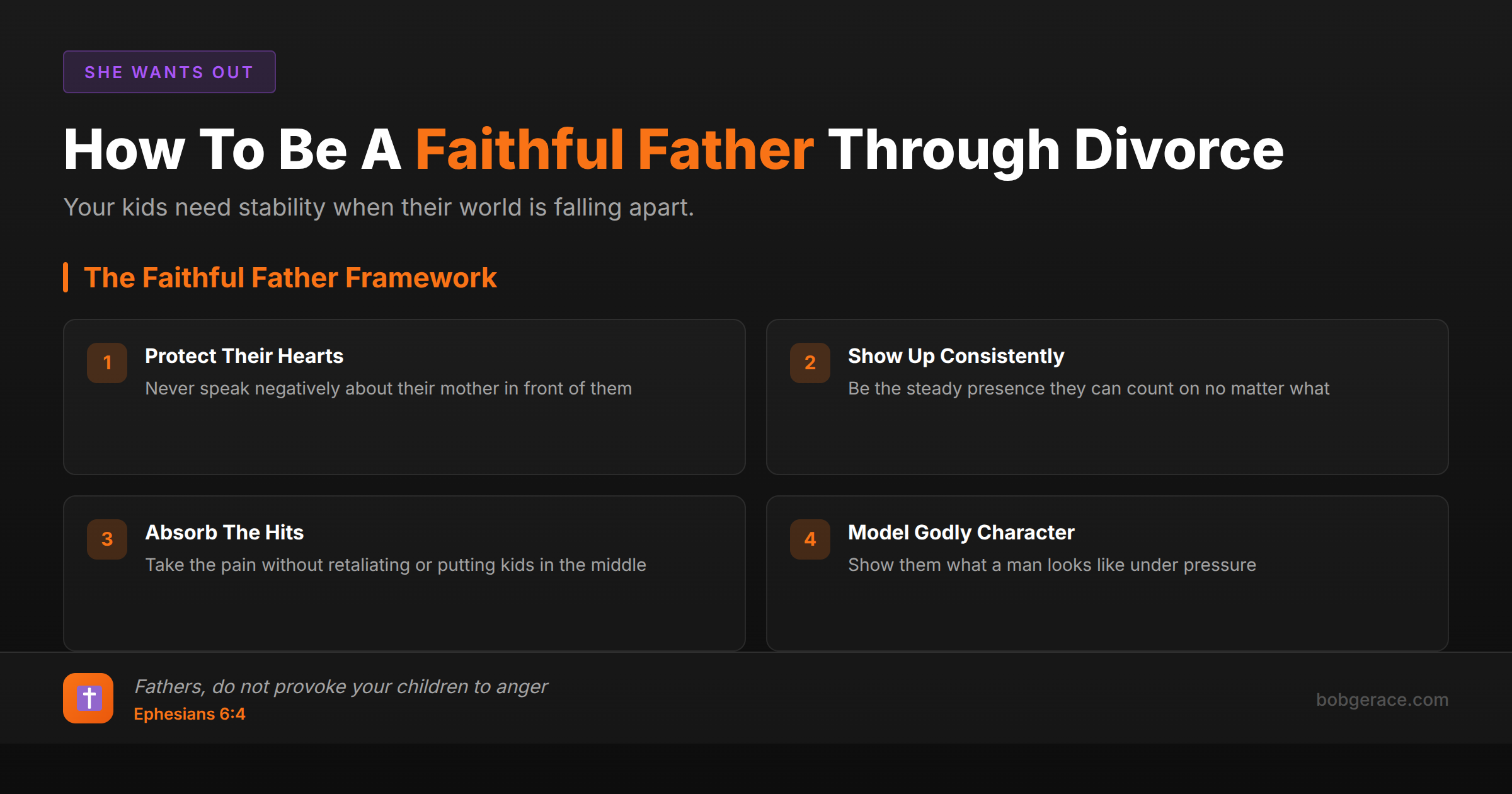
Faithful fatherhood through divorce means putting your children's emotional well-being above your own pain, anger, or need to be right. It's showing up consistently, keeping your mouth shut about their mother, and being the steady presence they desperately need when their world is falling apart. Your kids didn't choose this chaos - they're just trying to survive it. This is your chance to model what a godly man looks like under pressure. That means absorbing the hits without retaliating, speaking truth without venom, and fighting for your relationship with them without putting them in the middle of adult battles. Your faithfulness as a father isn't measured by your marriage's success, but by how you protect and nurture your children when everything else is crumbling.
The Full Picture
Divorce doesn't end your role as a father - it transforms it. Your children are watching how you handle this crisis, and they're learning what it means to be a man, a father, and a follower of Christ based on your response to the most difficult season of your life.
Your kids are not your therapists, allies, or messengers. The biggest mistake divorcing fathers make is treating their children like confidants or using them as weapons against their ex-wife. Your 8-year-old doesn't need to know why mommy and daddy are getting divorced, and your teenager shouldn't be carrying messages between houses or hearing about legal battles.
Consistency becomes everything. When their home life feels chaotic, you become their anchor. This means showing up when you say you will, maintaining routines they can count on, and being emotionally present even when you're hurting. If you have them every other weekend, make those weekends about them - not about your loneliness or your need to prove you're the 'fun parent.'
Your character under pressure defines their future relationships. How you treat their mother, how you handle conflict, how you process pain - they're taking notes. The man you are in this season becomes the template for how they'll handle their own relationships and crises. You can't control the divorce, but you can control who you become through it.
Financial responsibility doesn't equal emotional presence. Paying child support faithfully matters, but it's the bare minimum. Your kids need your time, attention, and emotional investment more than they need expensive gifts or elaborate outings designed to compete with mom.
What's Really Happening
Children of divorce experience what researchers call 'loyalty conflicts' - they feel torn between parents and guilty for loving both. When fathers maintain consistent, non-conflictual relationships with their children post-divorce, we see significantly better outcomes in academic performance, emotional regulation, and future relationship satisfaction.
The Adverse Childhood Experiences (ACEs) research shows that parental divorce can be traumatic, but the trauma isn't necessarily from the divorce itself - it's from the conflict, inconsistency, and emotional abandonment that often accompany it. Children who maintain stable relationships with both parents show resilience markers similar to children from intact families.
Parental alienation is a real phenomenon where children reject one parent due to the other parent's influence, but it's often misdiagnosed. True alienation requires systematic manipulation over time. More commonly, children distance themselves from parents who put them in the middle, who are emotionally unstable, or who consistently prioritize their own needs over the child's emotional safety.
Developmentally, children process divorce differently at different ages. Young children often blame themselves, adolescents may choose sides, and teenagers might reject family altogether as a coping mechanism. Understanding these developmental responses helps fathers adjust their approach and maintain connection without taking rejection personally.
Co-parenting effectiveness is the strongest predictor of positive child outcomes post-divorce. This doesn't require friendship with your ex-wife, but it does require business-like cooperation focused solely on the children's needs. Fathers who can separate their role as ex-husband from their role as co-parent protect their children from ongoing trauma and maintain stronger long-term relationships with their kids.
What Scripture Says
Scripture calls fathers to specific responsibilities that don't disappear during divorce. Ephesians 6:4 commands, 'Fathers, do not provoke your children to anger, but bring them up in the discipline and instruction of the Lord.' During divorce, 'provoking to anger' often happens through conflict with their mother, inconsistency, or emotional volatility.
Proverbs 22:6 reminds us to 'Train up a child in the way he should go; even when he is old he will not depart from it.' Your training isn't just in Sunday school lessons - it's in how you handle adversity, treat others, and respond to injustice. They're learning character from watching you navigate this crisis.
Jesus himself spoke to family division in Luke 14:26, acknowledging that following Him sometimes means difficult family dynamics. But 1 Corinthians 13:4-7 shows us what love looks like in practice: patient, kind, not keeping a record of wrongs. This is your blueprint for loving your children through divorce - and for how you treat their mother in front of them.
Malachi 2:16 says God hates divorce, but it also says He hates 'covering one's garment with violence.' The violence isn't just physical - it's the emotional and relational damage that ongoing conflict creates. Sometimes faithful fatherhood means protecting your children from further harm, even if that means accepting divorce.
1 Timothy 5:8 declares that anyone who doesn't provide for his family 'has denied the faith and is worse than an unbeliever.' Provision isn't just financial - it's emotional, spiritual, and relational. Your children need you to provide stability, security, and godly character modeling, especially when their world feels chaotic.
Ultimately, Matthew 18:6 warns about causing 'little ones' to stumble. Using your children as weapons, poisoning them against their mother, or prioritizing your own pain over their well-being causes them to stumble in ways that can last generations.
What To Do Right Now
-
1
Establish a 'children-only' rule: never discuss the divorce, legal proceedings, or their mother's faults when your kids are present or can overhear
-
2
Create consistent routines and traditions in your home that give them stability and something to look forward to
-
3
Write down three specific ways you can serve your children's best interests this week, even if it costs you emotionally or financially
-
4
Practice the 24-hour rule: wait a full day before responding to any communication from your ex-wife about the children when you're angry
-
5
Schedule one-on-one time with each child focused entirely on their interests, not your need to be the 'fun parent'
-
6
Ask your children directly what they need from you during this time, then listen without defending yourself or explaining adult situations
Related Questions
- How do I tell the kids?
- How do I be a good dad through this?
- What do kids need most from dad during divorce?
- How do I model Christ to my kids in this?
- How do I not badmouth her when I'm furious?
- What does a healthy co-parenting relationship look like?
- What does 'love your wife as Christ loves the church' mean?
- What is 'servant leadership'?
- How do I be the spiritual leader?
Also find Bob on
Subscribe for weekly videos on Christian marriage.
Your Kids Need You Calibrated to This
Divorce rewrites the playbook. A coach who knows your custody situation, your ex's patterns, and where your kids actually are can help you stay faithful when the script keeps changing.
Talk to Bob →