How do I show them grace without excusing sin?
5 min read
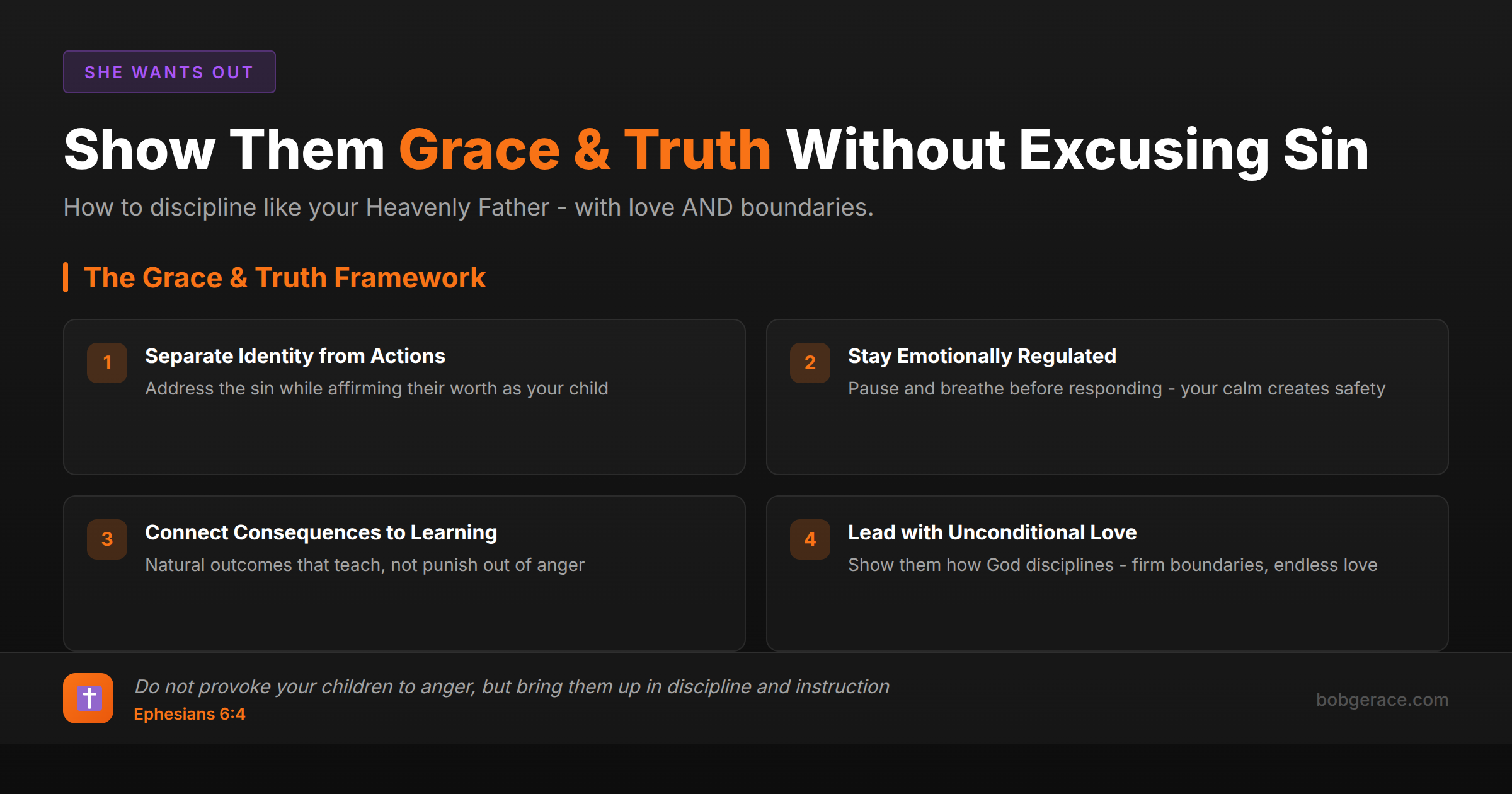
Grace and truth aren't opposites - they're dance partners. When your child sins, you address the behavior while affirming their worth. You say 'What you did was wrong and has consequences, but you are deeply loved.' The key is separating their identity from their actions. You don't excuse the sin, but you don't condemn the sinner either. This balance requires emotional maturity from you as the father. If you're angry, frustrated, or reactive, you'll either be too harsh or too permissive. Neither builds character. Your children need to see that rules matter, consequences are real, but your love is unconditional. When you get this right, you're showing them how their Heavenly Father treats them - and you.
The Full Picture
Most fathers swing between two extremes: they either come down like a hammer or they let everything slide. Both approaches fail our children and damage our relationships with them.
The hammer approach creates fear-based compliance. Kids learn to avoid getting caught rather than developing internal character. They may obey when you're watching, but they haven't internalized why the behavior matters. Worse, they begin to see you as the enemy rather than their guide.
The permissive approach feels loving in the moment but actually shows a lack of love long-term. When we excuse sin or avoid difficult conversations, we're not preparing our children for reality. The world won't give them a pass, and neither will God.
Grace-filled accountability looks different. It starts with your heart posture. You're not trying to punish - you're trying to teach. You're not trying to shame - you're trying to shape character. Here's what it looks like practically:
• You address the behavior immediately but calmly • You explain why it matters, not just what the rule is • You implement consequences that are logical, not vindictive • You affirm your love for them as a person • You pray with them and point them toward God's forgiveness
This requires you to do your own emotional work first. If you're triggered by their behavior because of your own childhood wounds or current stress, you'll either overreact or underreact. Your children need you to be steady, not perfect.
What's Really Happening
From a developmental psychology perspective, children need both warmth and structure to develop healthy emotional regulation and moral reasoning. Research by Diana Baumrind identified that authoritative parenting - high warmth combined with high expectations - produces the most well-adjusted children.
When fathers struggle to balance grace and accountability, it often stems from their own attachment history. Men who experienced harsh, critical fathers tend to overcorrect toward permissiveness, fearing they'll damage their children. Conversely, men who experienced absent or permissive fathers may overcorrect toward rigidity, believing that's what 'strong' leadership looks like.
The neurological reality is this: shame-based discipline activates the child's threat detection system, flooding their brain with stress hormones that actually impair learning. But complete permissiveness fails to develop the prefrontal cortex pathways needed for self-regulation.
Healthy discipline creates what we call 'optimal stress' - enough challenge to promote growth without overwhelming the child's capacity to cope. When you combine clear expectations with emotional safety, you're literally helping wire their brain for moral reasoning and emotional intelligence.
The father's emotional regulation during discipline moments is crucial. Children co-regulate with their parents, meaning your emotional state directly impacts their ability to receive correction. If you're dysregulated, they will be too, and no real learning occurs.
What Scripture Says
Scripture gives us the perfect model for grace-filled accountability. Ephesians 6:4 instructs fathers: 'Do not provoke your children to anger, but bring them up in the discipline and instruction of the Lord.' Notice it's discipline AND instruction - correction paired with teaching.
Hebrews 12:6 reminds us that 'the Lord disciplines the one he loves, and chastises every son whom he receives.' God's discipline flows from love, not anger. It's corrective, not punitive. This is our model as earthly fathers.
Proverbs 3:11-12 echoes this: 'My son, do not despise the Lord's discipline or be weary of his reproof, for the Lord reproves him whom he loves, as a father the son in whom he delights.' Discipline is actually an expression of delight in our children, not disappointment.
Galatians 6:1 gives practical guidance: 'If anyone is caught in any transgression, you who are spiritual should restore him in a spirit of gentleness.' The goal is always restoration, not condemnation.
1 John 1:9 shows us God's heart: 'If we confess our sins, he is faithful and just to forgive us our sins and to cleanse us from all unrighteousness.' When our children acknowledge their wrong, we extend the same grace God extends to us.
Colossians 3:21 warns: 'Fathers, do not provoke your children, lest they become discouraged.' Our correction should build them up in righteousness, not tear them down in shame.
What To Do Right Now
-
1
Pause before reacting - take three deep breaths to regulate your own emotions before addressing their behavior
-
2
Address the behavior within 24 hours, but wait until you're calm and they're receptive to conversation
-
3
Use 'I love you AND this behavior needs to change' language to separate their identity from their actions
-
4
Explain the 'why' behind the rule - help them understand how their choices affect themselves and others
-
5
Implement natural consequences that connect to the behavior rather than arbitrary punishments
-
6
End every discipline conversation with affirmation of your love and prayer for God's help in their growth
Related Questions
- How do I model Christ to my kids in this?
- What does faithful fatherhood look like through divorce?
- How do I teach them about marriage when mine is failing?
- How do I not badmouth her when I'm furious?
- How do I support their relationship with her when she's hurting me?
- What legacy am I leaving them through this crisis?
- What does forgiveness require regarding consequences?
- What does grace look like practically?
- What's the difference between forgiveness and trust?
- What is 'cheap grace' and is forgiveness enabling?
Also find Bob on
Subscribe for weekly videos on Christian marriage.
Need a Coach Who Knows Your Kids
Every family is different. A coach helps you calibrate grace and truth to your specific kids, your specific mistakes, your actual home—not theory.
Talk to Bob →