What legacy am I leaving them through this crisis?
5 min read
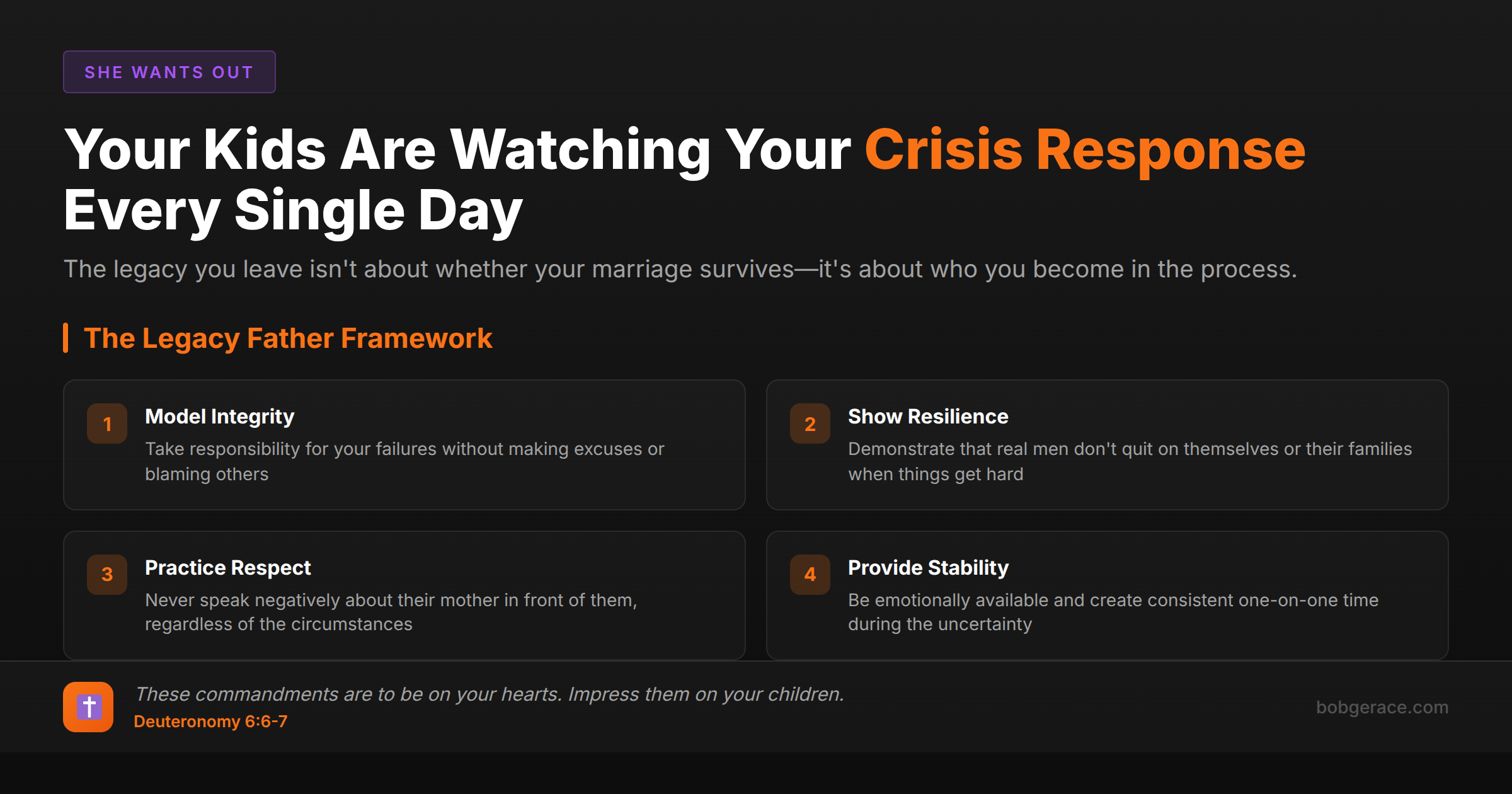
Your children are watching every move you make during this crisis, and they're forming lifelong beliefs about love, commitment, and character based on what they see. The legacy you leave isn't just about whether your marriage survives—it's about who you become in the process. Right now, you have the opportunity to model integrity, resilience, and genuine love even when everything is falling apart. Your kids need to see a man who doesn't quit on himself or his family, who takes responsibility for his failures, and who fights for what matters most. The way you handle this crisis will echo in their lives for decades, influencing how they approach their own relationships and challenges.
The Full Picture
Your children are forming their understanding of manhood, marriage, and character by watching you navigate this crisis. They're not just observing whether you win or lose—they're studying how you play the game. Every conversation they overhear, every glimpse of your emotional state, every choice you make is being archived in their developing minds as 'normal' behavior during hard times.
The legacy question cuts deeper than most men realize. You're not just dealing with your current pain; you're actively writing the script your children will reference when they face their own relationship challenges decades from now. Will they remember a father who crumbled under pressure, or one who stood firm in his values? Will they recall a man who blamed everyone else, or one who owned his mistakes and worked to change?
Many fathers make the mistake of thinking they can compartmentalize this crisis away from their children. That's impossible. Kids are emotional detectives—they pick up on tension, anger, desperation, and hope with startling accuracy. The question isn't whether this is affecting them; it's whether your response is building them up or tearing them down.
Common legacy-destroying patterns include: • Speaking negatively about their mother in front of them • Using children as emotional support or confidants • Checking out emotionally and becoming unavailable • Making promises you can't keep to ease their anxiety • Modeling victim mentality instead of ownership
The most powerful legacy you can leave is showing them that real men don't quit when things get hard. They fight for their families with wisdom, they own their failures with humility, and they pursue growth with determination. Your children need to see that love isn't just a feeling—it's a choice you make every single day, especially when you don't feel like it.
What's Really Happening
From a developmental psychology perspective, children experiencing parental conflict undergo significant neurological and emotional changes. Research from the Center for Advanced Study of Child Development shows that children as young as six months can detect marital tension, and by age three, they're actively developing coping mechanisms based on their parents' behavior patterns.
During family crisis, children experience what we call 'hypervigilance'—their nervous systems become acutely attuned to signs of safety or threat in their environment. Your emotional regulation directly impacts their ability to feel secure. When fathers model emotional stability and problem-solving during crisis, children develop resilience. When fathers model chaos, blame, or emotional dysregulation, children often develop anxiety disorders and attachment issues that persist into adulthood.
The concept of 'intergenerational transmission' is particularly relevant here. Studies consistently show that children whose fathers handled marital conflict with integrity and emotional maturity are significantly more likely to have successful relationships themselves. Conversely, children who witness their fathers using manipulation, emotional volatility, or avoidance as coping strategies are more likely to replicate these patterns.
Key neurological impacts on children during parental conflict include: • Elevated cortisol levels affecting memory and learning • Disrupted attachment formation impacting future relationships • Increased activity in brain regions associated with threat detection • Compromised development of emotional regulation skills
The good news is that positive father modeling during crisis can actually strengthen children's resilience. When fathers demonstrate accountability, emotional regulation, and persistent love despite circumstances, children develop what researchers call 'earned security'—the ability to form healthy relationships despite early adversity. Your response to this crisis is literally shaping your children's brain development and future relational capacity.
What Scripture Says
Scripture is clear about the generational impact of a father's choices and character. Exodus 34:6-7 reminds us that the consequences of our actions extend 'to the third and fourth generation,' but God's love and faithfulness extend to thousands of generations. The legacy you're building right now has exponential impact beyond what you can see.
Deuteronomy 6:6-7 commands fathers: 'These commandments that I give you today are to be on your hearts. Impress them on your children. Talk about them when you sit at home and when you walk along the road, when you lie down and when you get up.' Your children are learning about God's character through watching yours. During this crisis, they're forming beliefs about whether God can be trusted in hard times based on how you trust Him.
Ephesians 6:4 specifically instructs fathers: 'Do not exasperate your children; instead, bring them up in the training and instruction of the Lord.' Paul understood that fathers have unique power to either frustrate their children or build them up. The way you handle this crisis will either exasperate them with anxiety and insecurity, or train them in resilience and faith.
Proverbs 20:7 declares: 'The righteous lead blameless lives; blessed are their children after them.' This isn't about perfection—it's about integrity. Your children need to see a father who walks in integrity even when his world is crumbling. When you own your mistakes, pursue wisdom, and love unconditionally, you're modeling the character of God.
Joshua 24:15 challenges every father: 'As for me and my household, we will serve the Lord.' This crisis is your Joshua moment. Regardless of what your wife chooses, you get to decide what kind of man and father you'll be. Your children are watching to see if you'll choose to serve God with integrity or serve yourself with self-pity. The legacy you leave depends entirely on the choice you make right now.
What To Do Right Now
-
1
Write down the character qualities you want your children to remember about how you handled this crisis, then evaluate whether your current behavior aligns with those qualities
-
2
Stop all negative talk about their mother in front of the children, and redirect conversations toward your own growth and commitment to the family
-
3
Schedule one-on-one time with each child weekly to provide stability and emotional availability during the uncertainty
-
4
Create a personal accountability system with a trusted friend or coach to ensure you're making choices based on legacy, not emotion
-
5
Document your growth journey in a letter to your future children, acknowledging your failures while committing to become the father they deserve
-
6
Establish daily practices (prayer, exercise, reading) that model emotional regulation and personal responsibility for your children to observe
Related Questions
- How do I model Christ to my kids in this?
- What does faithful fatherhood look like through divorce?
- How do I teach them about marriage when mine is failing?
- How do I show them grace without excusing sin?
- What does 'sins of the fathers' mean and how do I break the cycle?
- How do I be a good dad through this?
- What does real transformation look like?
- How do I change from the inside out?
- What is the relationship between grace and effort?
- What might I discover through this pain?
Also find Bob on
Subscribe for weekly videos on Christian marriage.
You Don't Have to Model This Alone
A coach who knows your specific situation can help you show up as the father your kids need to see right now—not some theoretical version, but in your actual marriage, this week.
Talk to Bob →