She asked for space — can I still text?
5 min read
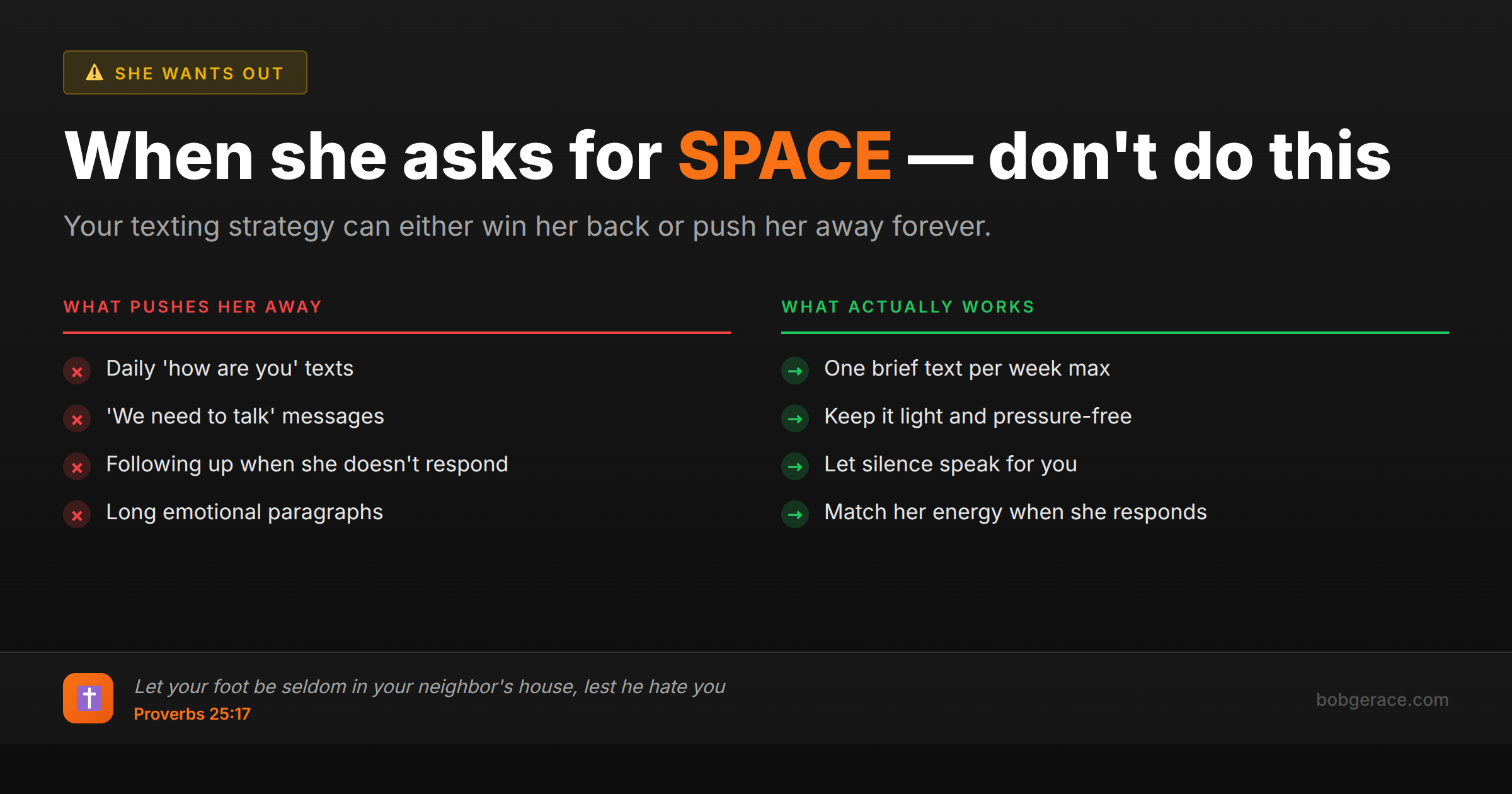
The short answer is: it depends on what kind of space she asked for and how you text. If she said 'no contact,' then no - any texting violates her boundary and pushes her further away. If she asked for 'space' without specifying no contact, then limited, respectful texting might be okay - but most guys get this wrong. Here's the brutal truth: your instinct right now is to text your way back into her heart. You want to remind her you love her, apologize again, or check if she's 'okay.' This approach backfires every time. When she asked for space, she was testing whether you can respect her needs or if you'll make this about your anxiety. Every clingy text confirms her worst fears about why she needs space in the first place.
The Full Picture
When your wife asks for space, she's essentially saying 'I need to think without feeling pressured by you.' She's overwhelmed, probably resentful, and needs time to process her feelings without your input. Your texting - no matter how well-intentioned - can easily feel like pressure.
Most men make these texting mistakes: • Sending 'good morning' and 'good night' texts (feels like emotional surveillance) • Apologizing repeatedly via text (makes you look weak and desperate) • Asking how she's doing or if she needs anything (forces her to manage your anxiety) • Sharing your feelings or progress you're making (puts pressure on her to respond positively) • Texting when you're triggered or anxious (your desperation comes through clearly)
If texting is allowed, here's what works: • Logistics only - school pickup changes, bill due dates, appointment reminders • Brief and factual - 'Picking up kids at 6pm' not 'I miss you and hope you had a good day with the kids' • No emotional content - save feelings for face-to-face conversations later • Respect response time - if she takes hours or days to respond, don't mention it
The deeper issue: Your urge to text reveals your need to control the situation and manage your own anxiety. She can sense this. The man who can give her space without making it about his discomfort is the man she might want to come back to. The man who texts because he's panicking confirms why she needed space.
Remember: space is not punishment - it's information. She's telling you what she needs to heal. Your job is to prove you can hear her and respect her needs, even when it's uncomfortable for you.
What's Really Happening
From a therapeutic perspective, when a spouse requests space, they're typically in a state of emotional flooding or relationship fatigue. Their nervous system is overwhelmed, and they need to deactivate from the relationship dynamic to gain clarity. This is actually a healthy coping mechanism, not necessarily a sign of relationship failure.
Research on attachment theory shows that anxiously attached partners often interpret space requests as abandonment threats, triggering protest behaviors like excessive texting, calling, or pursuing. However, this pursuit actually activates the requesting partner's avoidance system, creating what we call a 'pursue-withdraw cycle' that can become destructive.
The texting dilemma specifically relates to what psychologists call 'emotional labor.' When someone asks for space, they're saying they don't have the emotional bandwidth to process relationship dynamics. Each text - even seemingly innocent ones - requires emotional energy to read, interpret, and potentially respond to. This is why even 'caring' messages can feel burdensome.
Neurologically, the partner asking for space is likely dealing with elevated cortisol levels and may be in a chronic state of fight-or-flight. Their brain needs time to return to baseline before they can access the prefrontal cortex functions needed for relationship problem-solving and emotional intimacy.
The most successful outcomes I've observed occur when the non-requesting partner demonstrates what we call 'earned security' - showing they can self-regulate their anxiety and respect boundaries without becoming resentful or withdrawn themselves. This actually helps regulate both partners' nervous systems and creates conditions for eventual reconnection.
What Scripture Says
Scripture provides clear guidance on respecting others' needs and practicing self-control, especially in marriage. Philippians 2:3-4 instructs us: 'Do nothing out of selfish ambition or vain conceit. Rather, in humility value others above yourselves, not looking to your own interests but each of you to the interests of the others.' When she asks for space, putting her needs above your anxiety is biblical love in action.
1 Corinthians 13:4-5 defines love as patient and kind, noting that 'it does not insist on its own way.' Your urge to text often comes from insisting on your own way - your need for reassurance, your timeline for reconciliation, your discomfort with uncertainty. Biblical love waits patiently and doesn't demand responses.
Ecclesiastes 3:7 reminds us there is 'a time to keep silence, and a time to speak.' Wisdom knows the difference. When someone explicitly asks for space, it's time to keep silence and trust God with the outcome rather than trying to control through constant communication.
James 1:19 calls us to be 'quick to hear, slow to speak, slow to anger.' If she asked for space, you need to truly hear what she's saying instead of rushing to speak (or text) your way out of the discomfort. Being slow to speak includes being slow to text.
Proverbs 27:14 warns: 'Whoever blesses his neighbor with a loud voice, rising early in the morning, will be counted as cursing him.' Even well-intentioned messages can feel like harassment when someone has asked for space. Your 'good morning' texts might feel more like curses than blessings.
1 Peter 3:7 calls husbands to live with their wives 'in an understanding way.' Understanding her need for space - even when it hurts you - demonstrates the biblical call to truly know and honor your wife's heart.
What To Do Right Now
-
1
Clarify the boundaries - ask once what 'space' means specifically (no contact, logistics only, etc.) then respect the answer completely
-
2
Delete her number from your favorites and remove texting shortcuts that make impulsive messaging easy when you're emotional
-
3
Create a 24-hour rule - write texts in your notes app first, wait a full day, then delete them without sending
-
4
Channel your texting energy into journaling - write her all the messages you want to send, but keep them private
-
5
Focus on your own healing work - use this space to address the issues that contributed to her needing distance
-
6
Build a support network of men who can receive your emotional energy instead of burdening her with your anxiety
Related Questions
- Should I give her space or fight for her?
- How much space is too much?
- What does 'space' actually mean to her?
- If I give space, won't she think I don't care?
- What's the difference between presence and pressure?
- What is 'anxious protest behavior' and am I doing it?
- Why does my pursuing make her pull away more?
- What is the 'pursuer-distancer' dynamic?
- How do I pursue without pressuring?
- How do I not pursue while also not abandoning?
Also find Bob on
Subscribe for weekly videos on Christian marriage.
Don't Navigate This Alone
A coach who knows your specific situation can tell you what space means in your marriage and what to do while she's watching. You don't have to guess through the most important weeks of your relationship.
Talk to Bob →