What signs did I miss?
6 min read
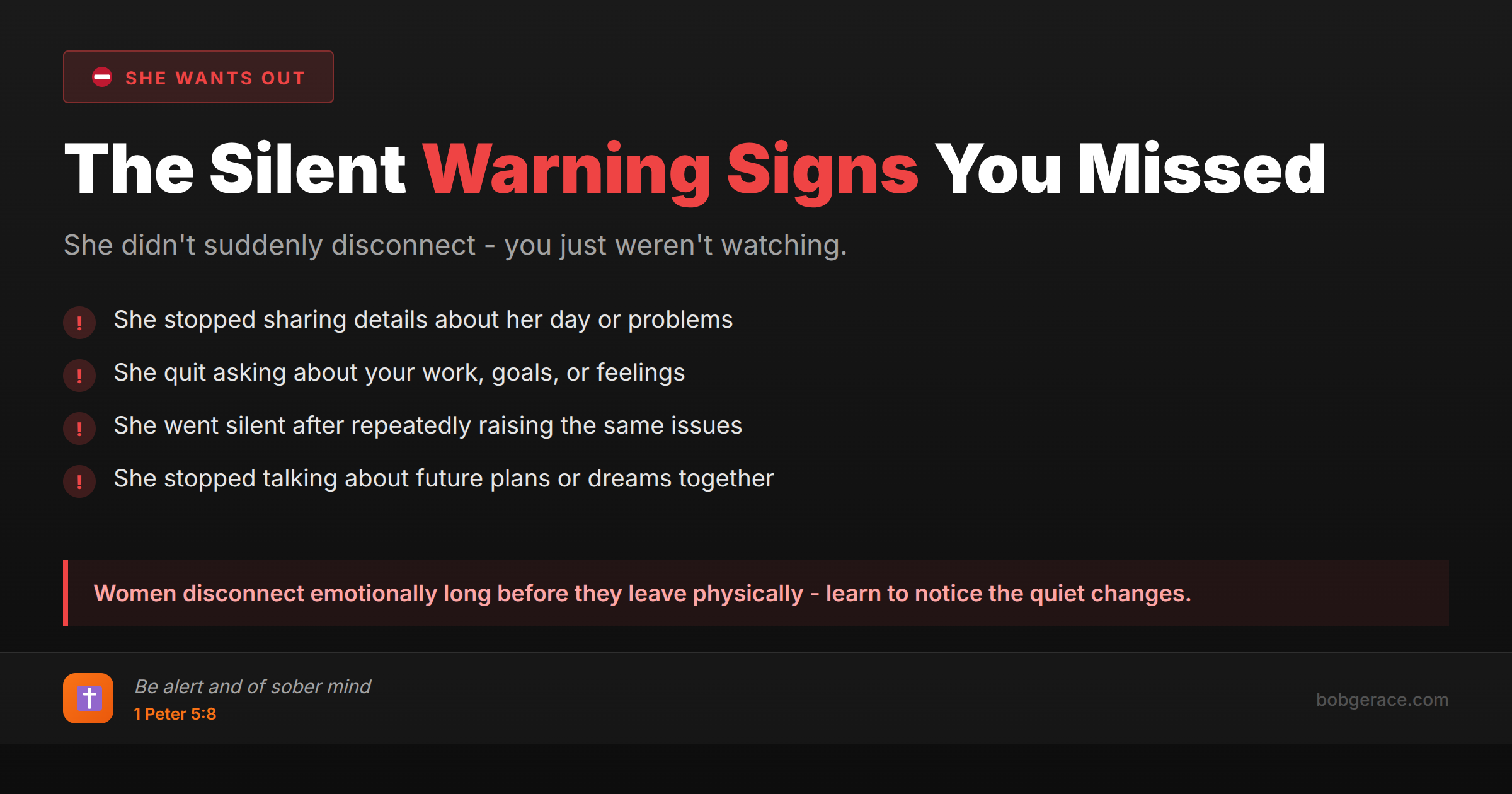
The signs you missed probably include: She stopped complaining (she gave up, not got better). She became emotionally distant. She stopped initiating affection or sex. She developed separate interests and friendships. She talked about the future in 'I' instead of 'we.' She stopped fighting — the absence of conflict meant absence of investment, not peace. She may have told you directly that she was unhappy, and you minimized it.
The Full Picture
Looking back, you'll probably recognize signs you interpreted incorrectly — or ignored entirely. Here are the most common:
1. She stopped complaining. This feels like an improvement. It's actually surrender. When a woman stops asking you to change, she's not accepting you as you are — she's decided you won't change. She's conserving energy for her exit.
2. Emotional withdrawal. She became less affectionate. Conversations became transactional. She stopped sharing her //blog.bobgerace.com/marriage-tests-christian-husband-inner-battle/:inner world. You might have called it 'being busy' or 'stress.' It was detachment.
3. Decreased or absent intimacy. Sex became infrequent or mechanical. Physical affection disappeared. This is often the clearest signal that her attachment is deactivating — but men often dismiss it as 'just a phase.'
4. Separate life development. She started building a life that doesn't include you. New friendships you're not part of. Hobbies she doesn't share. Career focus that excludes the marriage. She's practicing being single.
5. Future language shift. Listen for 'I' instead of 'we.' 'I've been thinking about moving closer to family.' 'I want to focus on my career.' When the future stops being joint, the marriage is in serious trouble.
6. She told you directly — and you minimized it. Many men, when they look back honestly, recall moments when she said clearly: 'I'm not happy.' 'I feel alone.' 'I don't know how much longer I can do this.' And they responded with 'You're overreacting' or 'Things will get better' — without changing anything.
7. Conflict avoidance. She stopped engaging in arguments. Let things slide that used to bother her. Went along with decisions without input. Apathy masquerading as agreeableness.
8. Increased criticism from you. Paradoxically, she might have become more critical right before giving up entirely — a final burst of protest behavior before resignation.
9. Seeking validation elsewhere. New male friends. Emotional intimacy outside the marriage. Perhaps not physical affairs (though possibly), but certainly emotional ones. She was getting needs met that you weren't meeting.
What's Really Happening
These signs map onto what attachment researchers call 'deactivation of the attachment system.' When someone's attachment needs have been chronically unmet, their system eventually shuts down toward that partner.
The signs above are symptoms of attachment deactivation:
- Withdrawal of emotional vulnerability: She stops sharing because sharing led to disappointment. - Reduction of pursuit: She stops seeking connection because pursuit was met with rejection or dismissal. - Building alternative attachments: She unconsciously seeks attachment needs elsewhere when they're unmet in the marriage. - 'I' vs. 'We' language: Linguistically, she's separating her identity from the couple identity. - Conflict avoidance: Fighting requires investment. She's divesting.
Gottman's research identifies the 'Four Horsemen' that predict divorce: criticism, contempt, defensiveness, and stonewalling. If you look back, you'll likely see all four operating in your marriage — from both sides.
But the most dangerous moment, clinically, is when the horsemen stop galloping. When contempt goes quiet. When criticism ceases. When stonewalling becomes the default. The absence of conflict often signals the death of hope — not its resolution.
Recognizing these signs now serves two purposes: (1) understanding how you got here, and (2) knowing what to watch for if reconciliation occurs. The same patterns will resurface if not addressed.
What Scripture Says
Hosea 4:6: 'My people are destroyed for lack of knowledge.'
You lacked knowledge — not of facts, but of awareness. You didn't know what to look for, so you didn't see it. Your marriage was being destroyed while you thought it was stable.
Proverbs 22:3: 'The prudent see danger and take refuge, but the simple keep going and pay the penalty.'
The danger was visible. The simple — not foolish, but unaware — kept going. And now the penalty has come due.
This isn't about self-flagellation. It's about gaining wisdom for the future. Whether this marriage survives or not, you need to learn what you failed to see. Otherwise, the pattern repeats.
Ezekiel 12:2: 'Son of man, you are living among a rebellious people. They have eyes to see but do not see and ears to hear but do not hear.'
The signs were visible. The words were spoken. But you didn't see and didn't hear. Perhaps you couldn't. Perhaps you didn't want to. Either way, your eyes and ears are open now.
Psalm 119:18: 'Open my eyes that I may see wonderful things in your law.'
This is your prayer: Open my eyes. Let me see what I've been missing. Not just the signs of marital distress — but the signs of how to love well, how to attend carefully, how to be the husband You've called me to be.
What To Do Right Now
-
1
Make an honest list: Review the signs above. Which ones were present in your marriage? When did they start?
-
2
Identify the pivotal moments: Were there times when she clearly communicated distress and you minimized it? Be honest.
-
3
Notice when things 'got better': Was there a period when conflict decreased? Was it actually peace — or resignation?
-
4
Don't use this as ammunition against her. Understanding the signs is for your growth, not for building a defense case.
-
5
Ask a trusted friend or counselor: 'Looking back, did you see signs I was missing?' Sometimes others see what we can't.
-
6
Commit to relational awareness going forward. The ability to see signs is learnable. But it requires intentional development.
Related Questions
- Why didn't I see this coming?
- How long has she been thinking about this?
- What pushed her over the edge?
- What is 'emotional disengagement'?
- What are Gottman's signs of 'turning away'?
- What are 'failed bids for connection' and how many did I miss?
- She won't talk about our problems
- She shuts down when I try to connect
- She's physically present but emotionally gone
- When did she stop caring?
Also find Bob on
Subscribe for weekly videos on Christian marriage.
Ready to Apply This to Your Marriage?
Seeing the pattern is one thing. Knowing what to do about it in your specific situation is another. A coach who knows your story can help you figure out what comes next.
Talk to Bob →