What's the difference between pursuing and chasing?
5 min read
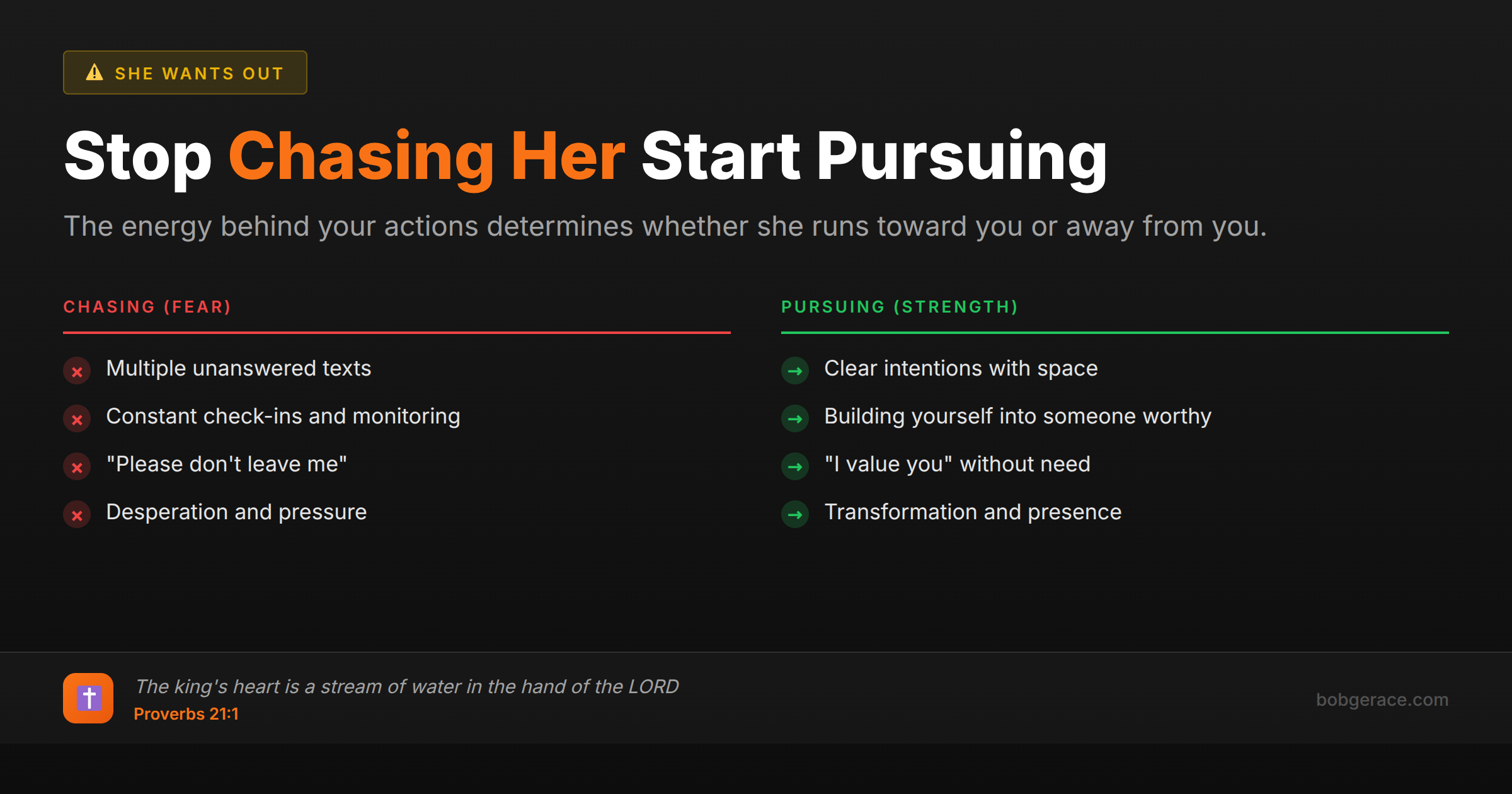
The difference between pursuing and chasing comes down to your emotional state and her response. Pursuing flows from confidence, purpose, and genuine love—it draws her closer because it feels safe and attractive. Chasing flows from desperation, fear, and neediness—it pushes her away because it feels suffocating and repulsive. When you're pursuing, you're moving toward her from a place of strength, offering something valuable. When you're chasing, you're moving toward her from a place of weakness, demanding something from her. She can feel the difference immediately. Pursuit respects her autonomy and creates space for her to respond. Chasing violates her boundaries and forces her to create distance just to breathe.
The Full Picture
Most men don't realize they've crossed the line from healthy pursuit into desperate chasing until it's too late. Here's how to tell the difference:
Pursuing looks like: • Consistent, measured efforts that respect her responses • Acting from confidence rather than fear of losing her • Giving her space to miss you and respond naturally • Focusing on becoming a better man she'd want to be with • Initiating connection without demanding immediate reciprocation
Chasing looks like: • Relentless attempts that ignore her signals to back off • Acting from panic about losing her • Suffocating her with constant contact and attention • Focusing on what you need from her rather than what you offer • Demanding responses and getting angry when she doesn't reciprocate
The cruel irony is that the more desperately you need her response, the less likely you are to get it. Women are attracted to men who want them but don't need them desperately. They're repelled by men whose emotional stability depends on their validation.
Think of it like this: pursuit is like being a magnet—you have your own magnetic field that naturally draws her toward you. Chasing is like being a vacuum cleaner—you're trying to suck her toward you, and the harder you suck, the more she resists.
The hardest part is that when you're in pain and feel her pulling away, every instinct tells you to chase harder. But that's exactly when you need to shift into pursuit mode—or sometimes, strategic withdrawal.
What's Really Happening
From a psychological perspective, the difference between pursuing and chasing reflects attachment theory and autonomy needs. When someone pursues healthily, they're operating from a secure attachment style—they can maintain their own emotional regulation while reaching toward their partner.
Chasing, however, typically emerges from anxious attachment patterns. The brain's threat detection system goes into overdrive, perceiving the partner's distance as existential danger. This triggers what we call 'protest behaviors'—increased calling, texting, gift-giving, and emotional appeals—all designed to reestablish proximity.
The problem is that these protest behaviors activate the partner's autonomy defenses. Research in Self-Determination Theory shows that humans have a fundamental need for autonomy. When someone feels their freedom is threatened, they experience 'psychological reactance'—a motivation to restore their freedom by pulling away even more.
This creates a pursue-withdraw cycle that becomes increasingly destructive. The more one partner chases, the more the other withdraws. The more the other withdraws, the more the first partner chases. It's a classic negative feedback loop that couples get stuck in.
Breaking this cycle requires the pursuing partner to regulate their own anxiety first. They need to develop what we call 'differentiation'—the ability to be emotionally connected without being emotionally dependent. This involves building self-soothing skills, challenging catastrophic thoughts about the relationship ending, and learning to tolerate the discomfort of uncertainty.
Interestingly, when the pursuing partner steps back and demonstrates they can be okay without constant reassurance, it often reduces the withdrawing partner's defensive reactions and creates space for genuine reconnection.
What Scripture Says
Scripture gives us a beautiful picture of how to pursue rightly. In Song of Songs 2:7, we read: 'Do not arouse or awaken love until it so desires.' This isn't about being passive—it's about respecting the natural timing and rhythm of love rather than forcing it.
Jesus himself modeled perfect pursuit. In Revelation 3:20, He says, 'Here I am! I stand at the door and knock. If anyone hears my voice and opens the door, I will come in and eat with that person, and they with me.' Notice that He pursues us consistently but never forces the door open. He respects our freedom to respond.
1 Peter 3:7 instructs husbands to 'live with your wives in an understanding way, showing honor to the woman as the weaker vessel, since they are heirs with you of the grace of life.' The word 'understanding' here means paying careful attention to her needs and responses. Honor means treating her as precious, not as something you're entitled to.
1 Corinthians 13:4-5 tells us that 'love is patient, love is kind... it does not demand its own way.' Real love pursues patiently, not desperately. It seeks the beloved's good, not just its own satisfaction.
In Hosea 2:14, God says, 'Therefore I am now going to allure her; I will lead her into the wilderness and speak tenderly to her.' Even when Israel was unfaithful, God pursued with tenderness, not force. He created space for her heart to turn back to Him.
The pattern is clear: godly pursuit is patient, honoring, understanding, and creates space for response. It flows from love, not fear. It seeks the beloved's good, not just its own relief from anxiety.
What To Do Right Now
-
1
Stop all desperate behaviors immediately—excessive texting, calling, gift-giving, or emotional pleading
-
2
Create a 48-hour cooling-off period where you focus only on regulating your own emotions
-
3
Identify three specific ways you've been chasing rather than pursuing and write them down
-
4
Develop a simple daily routine that builds your confidence independent of her responses
-
5
Practice one genuine act of service or love without expecting anything in return
-
6
Set boundaries around how often you'll initiate contact and stick to them consistently
Related Questions
- Should I give her space or fight for her?
- How do I fight without pushing her away?
- What is 'anxious protest behavior' and am I doing it?
- Why does my instinct to pursue backfire?
- What does healthy pursuit look like vs. desperate pursuit?
- How do I show love without activating her withdrawal?
- What is anxious attachment and am I doing it right now?
- What does 'protest behavior' look like and am I doing it?
- How do I pursue without pressuring?
- What does it mean to love without grasping?
Also find Bob on
Subscribe for weekly videos on Christian marriage.
You Don't Have to Figure This Out Alone
A coach who knows your marriage can help you see what pursuing actually looks like in your specific situation—and where you're still chasing without realizing it.
Talk to Bob →