What's the difference between trusting God and being passive?
6 min read
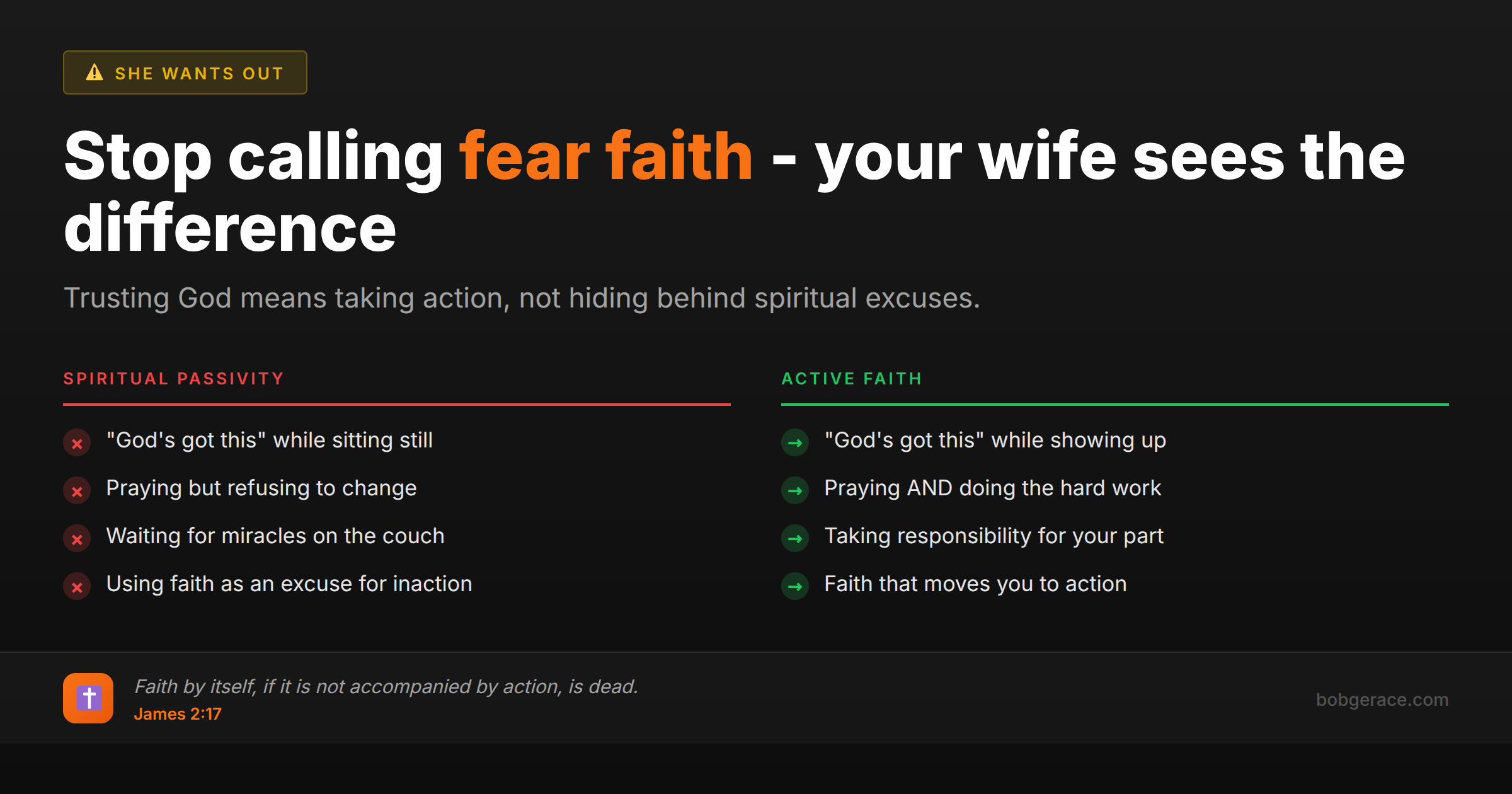
Here's the brutal truth: trusting God requires action, while being passive is just fear dressed up in spiritual language. When your marriage is in crisis, trusting God means you pray AND you change. You surrender the outcome AND you do the hard work of becoming the man your family needs. Passivity says "God's got this" while you sit on the couch waiting for a miracle. True faith says "God's got this" while you show up, take responsibility, and do everything in your power to heal what's broken. The difference is night and day - and your wife can see which one you're choosing.
The Full Picture
Most men in marriage crisis make a fatal mistake: they confuse spiritual surrender with personal abdication. They think trusting God means becoming a passenger in their own life, waiting for divine intervention while their marriage burns down around them.
True biblical trust is radically different. It's not passive - it's the most active thing you can do. It means you acknowledge God is sovereign AND you take full responsibility for your part. You pray for wisdom AND you apply what you learn. You surrender your need to control the outcome AND you control what you can control - your actions, your character, your choices.
Here's what passivity looks like in practice: • "I'll just pray about it" (while changing nothing) • "God will fix my wife's heart" (while ignoring your own) • "If it's meant to be, it will happen" (while doing nothing to make it happen) • "I'm trusting God's timing" (while avoiding hard conversations)
This isn't faith - it's fear masquerading as spirituality. Your wife doesn't see a man trusting God; she sees a man who's checked out and won't fight for his marriage.
Active trust looks different: • You pray for strength to have difficult conversations • You ask God for wisdom then apply it through action • You surrender your timeline while working urgently on yourself • You trust God's plan while being fully engaged in His process
The men who save their marriages understand this distinction. They know that God typically works through us, not around us. They trust Him completely while taking massive action.
What's Really Happening
From a psychological perspective, what many men call "trusting God" is actually learned helplessness dressed in religious language. When faced with overwhelming marital problems, the brain can default to a passive stance as a way to avoid the anxiety of taking action that might fail.
This creates a dangerous psychological pattern: The man reduces his cognitive dissonance by reframing his avoidance as faith. He's not lazy or scared - he's "trusting God." This mental framework allows him to maintain his self-image as a good Christian while avoiding the emotional labor of change.
Research on locus of control shows us something crucial: People with an internal locus of control (believing they can influence outcomes) have better relationships and lower anxiety than those with an external locus (believing outcomes are beyond their control). Healthy faith actually increases internal locus of control because it provides the security and motivation needed to take risks and make changes.
The neurological reality is that action creates confidence, not the other way around. When men take concrete steps to improve their marriage while maintaining their faith, they experience what psychologists call "self-efficacy" - the belief that they can handle challenges. This creates a positive feedback loop: faith motivates action, action builds confidence, confidence strengthens faith.
Passive men often struggle with what we call "spiritual bypassing" - using religious beliefs to avoid psychological and emotional work. They're unconsciously hoping that if they're spiritual enough, they won't have to face their fears, insecurities, or the hard work of personal growth. This pattern is both psychologically unhealthy and relationally destructive.
What Scripture Says
Scripture makes it crystal clear that faith and action are inseparable partners, not competing alternatives.
James 2:17 cuts right to the heart: *"Faith by itself, if it is not accompanied by action, is dead."* Your wife isn't seeing dead faith in your marriage - she's seeing no faith at all when you claim to trust God but refuse to change.
Proverbs 16:9 shows the perfect balance: *"In their hearts humans plan their course, but the Lord establishes their steps."* You make the plans, you take the steps, AND you trust God with the results. It's not either/or - it's both/and.
Nehemiah's example is powerful. When called to rebuild Jerusalem's walls, he didn't just pray - though he prayed constantly. Nehemiah 4:9 records: *"But we prayed to our God and posted a guard day and night to meet this threat."* Prayer AND action. Trust AND preparation.
Philippians 2:12-13 gives us the framework: *"Continue to work out your salvation with fear and trembling, for it is God who works in you to will and to act in order to fulfill his good purpose."* God works IN you, but you still do the work. He provides the power; you provide the participation.
Even Jesus modeled this balance. In Luke 22:42-44, facing the cross, He prayed *"Not my will, but yours be done"* - perfect surrender. But then He got up and walked toward Calvary. Surrender didn't mean sitting in the garden waiting for angels to carry Him. It meant trusting God's plan while actively participating in it.
The biblical pattern is clear: Trust God completely, work like it all depends on you.
What To Do Right Now
-
1
Identify one specific area where you've been passive and disguising it as "trusting God" - write it down honestly
-
2
Pray for wisdom and strength, then immediately take one concrete action in that area today
-
3
Create a daily routine that combines prayer with purposeful action toward your marriage goals
-
4
Stop using spiritual language to justify inaction - catch yourself when you do this and course-correct
-
5
Have an honest conversation with your wife about how you've confused passivity with faith and what you're changing
-
6
Set weekly goals that require both faith and action, then review your progress every Sunday
Related Questions
- How do I surrender without giving up?
- Is my desperation faith or codependency?
- How do I discern between my will and God's will?
- What's the difference between hope and presumption?
- What does faithfulness require when she won't reciprocate?
- When does standing become idolatry of the marriage?
- How do I pray through this?
- What does surrendered prayer look like?
- What is the relationship between grace and effort?
- How do I hold both my responsibility and her agency?
Also find Bob on
Subscribe for weekly videos on Christian marriage.
You Don't Have to Figure This Out Alone
A coach who knows your marriage can help you see where you're actually passive and where you're trusting God with your hands on the wheel. Bring your specific situation to someone who's been there.
Talk to Bob →