How do I address resentment before she gives up?
5 min read
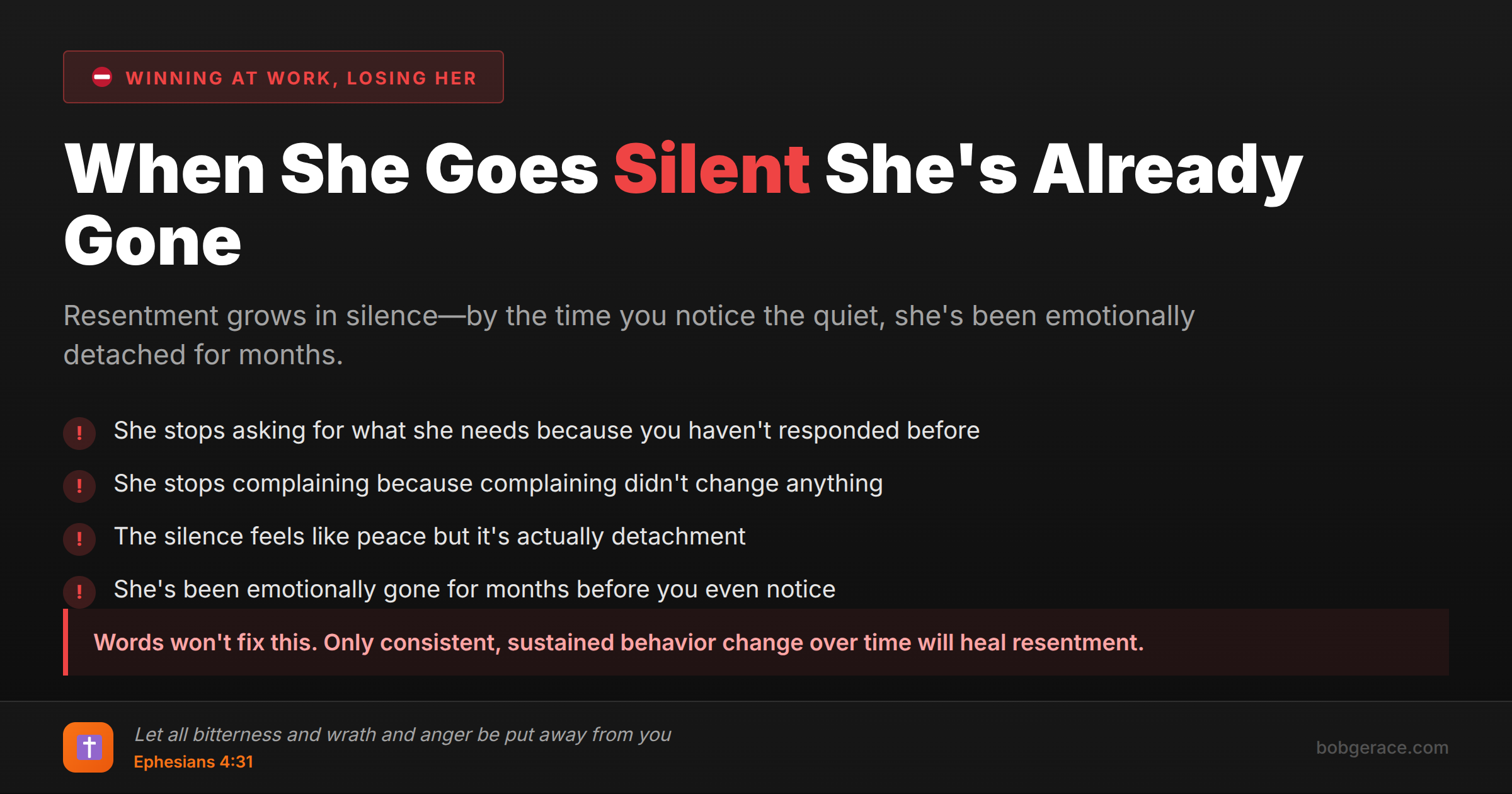
Resentment doesn't start with a fight. It starts with unmet needs, unspoken hurt, and repeated disappointment. Your wife stops saying what she needs because she's learned you won't respond. She stops complaining because complaining didn't change anything. The silence feels like peace, but it's actually detachment. By the time most men notice, their wife has been emotionally gone for months. You address resentment by naming it, owning your part, and changing your behavior—not just apologizing. She doesn't need another conversation about how you'll try harder. She needs to see you actually show up differently. Resentment fades when she experiences consistent, sustained change over time. Words won't fix this. Your actions will.
The Quiet Build: How Resentment Grows
Resentment doesn't explode. It accumulates. It starts small—a forgotten promise, a dismissed feeling, a moment when she needed you and you were unavailable. She brings it up. You defend yourself or minimize it. She learns that bringing it up costs more than it's worth. So she stops.
That's the first warning sign most men miss: when she stops complaining. You think things are better. Actually, she's given up expecting you to change. She's managing her disappointment by lowering her expectations. She's learning to need you less. That feels like peace to you. To her, it's survival.
Over time, the small moments compound. She needed you to notice she was struggling, but you were on your phone. She needed you to initiate a hard conversation, but you avoided it. She needed physical affection that wasn't a precursor to sex, but you only touched her when you wanted something. Each unmet need adds to the ledger. She's keeping score, even if she's not saying it out loud.
Eventually, resentment becomes the filter through which she sees you. You do something kind, and she questions your motive. You apologize, and she doesn't believe you. You promise to change, and she's heard it before. The trust is gone. She's not angry anymore—she's indifferent. And indifference is far more dangerous than anger. Anger means she still cares. Indifference means she's done.
The Gottman Cascade and Emotional Withdrawal
Dr. John Gottman's research identifies resentment as part of the 'Four Horsemen' that predict divorce—specifically, it shows up as contempt and stonewalling. Contempt is when she sees you as beneath her, when she rolls her eyes or speaks with disgust. Stonewalling is when she shuts down completely, when she stops engaging because engaging feels pointless.
Resentment builds when emotional bids are repeatedly ignored. Every day, your wife makes small requests for connection—a comment about her day, a question, a look. If you turn toward her, connection builds. If you turn away, resentment builds. Most men turn away without realizing it. You're distracted, tired, or mentally elsewhere. She registers it as rejection.
Attachment theory explains what happens next. When she feels consistently unseen and unheard, her nervous system moves from protest (complaints, criticism) to despair (withdrawal, silence) to detachment (indifference, independence). By the time she's detached, she's not fighting for the marriage anymore. She's planning her exit, even if she hasn't said it out loud.
The clinical reality: resentment is a secondary emotion. Underneath it is hurt, loneliness, and fear. She's hurt that you don't see her. She's lonely in the marriage. She's afraid this is as good as it gets. If you only address the resentment without addressing the underlying pain, nothing changes. You have to go deeper.
Bitterness and the Call to Repentance
Ephesians 4:31 says, 'Let all bitterness and wrath and anger and clamor and slander be put away from you, along with all malice.' Resentment is bitterness that's been given time to grow. It poisons intimacy. It hardens the heart. It makes forgiveness feel impossible. Both of you are responsible for addressing it.
But here's the part most men miss: you can't wait for her to let go of resentment before you change. You have to lead. Repentance isn't just saying sorry. It's turning around and walking a different direction. It's sustained, visible, costly change over time. She's not holding a grudge because she's unforgiving. She's protecting herself because you haven't proven you're safe yet.
James 5:16 calls us to 'confess your sins to one another and pray for one another, that you may be healed.' Most men want to move past the hurt without naming it. That's not healing. That's avoidance. You have to own specifically what you've done and how it's hurt her. Not a vague 'I'm sorry if I hurt you.' A clear 'I see that I've been emotionally unavailable, and that's left you feeling alone. That's on me.'
Proverbs 28:13 says, 'Whoever conceals his transgressions will not prosper, but he who confesses and forsakes them will obtain mercy.' Forsakes—not just confesses. She needs to see you forsake the patterns that built the resentment. She needs to see you show up differently, consistently, over months. That's how trust rebuilds.
Action Steps
-
1
Name the resentment directly—ask her, 'I sense there's distance between us. What have I done that's hurt you?' Then listen without defending.
-
2
Own your part specifically—don't say 'I'm sorry for everything'; say 'I see that I've been dismissive when you've tried to talk to me, and that's made you feel unimportant.'
-
3
Identify the pattern, not just the incident—resentment isn't about one fight; it's about repeated behavior; ask yourself what you've been doing (or not doing) consistently.
-
4
Change your behavior before asking her to forgive—she's heard apologies before; she needs to see sustained change over weeks and months, not just days.
-
5
Get help if you're stuck—if you don't know how to change the pattern or she's already detached, don't wait; talk to a coach or counselor who works with men in your situation.
Related Questions
Also find Bob on
Subscribe for weekly videos on Christian marriage.
Resentment Doesn't Wait
If your wife has stopped complaining, stopped expecting, or stopped engaging, you're closer to the end than you think. Resentment is a warning sign, not a life sentence—but only if you act now. Let's talk about what's really happening and how to turn this around.
Talk to Bob →