How do I tell if this is stress or a real marriage warning?
6 min read
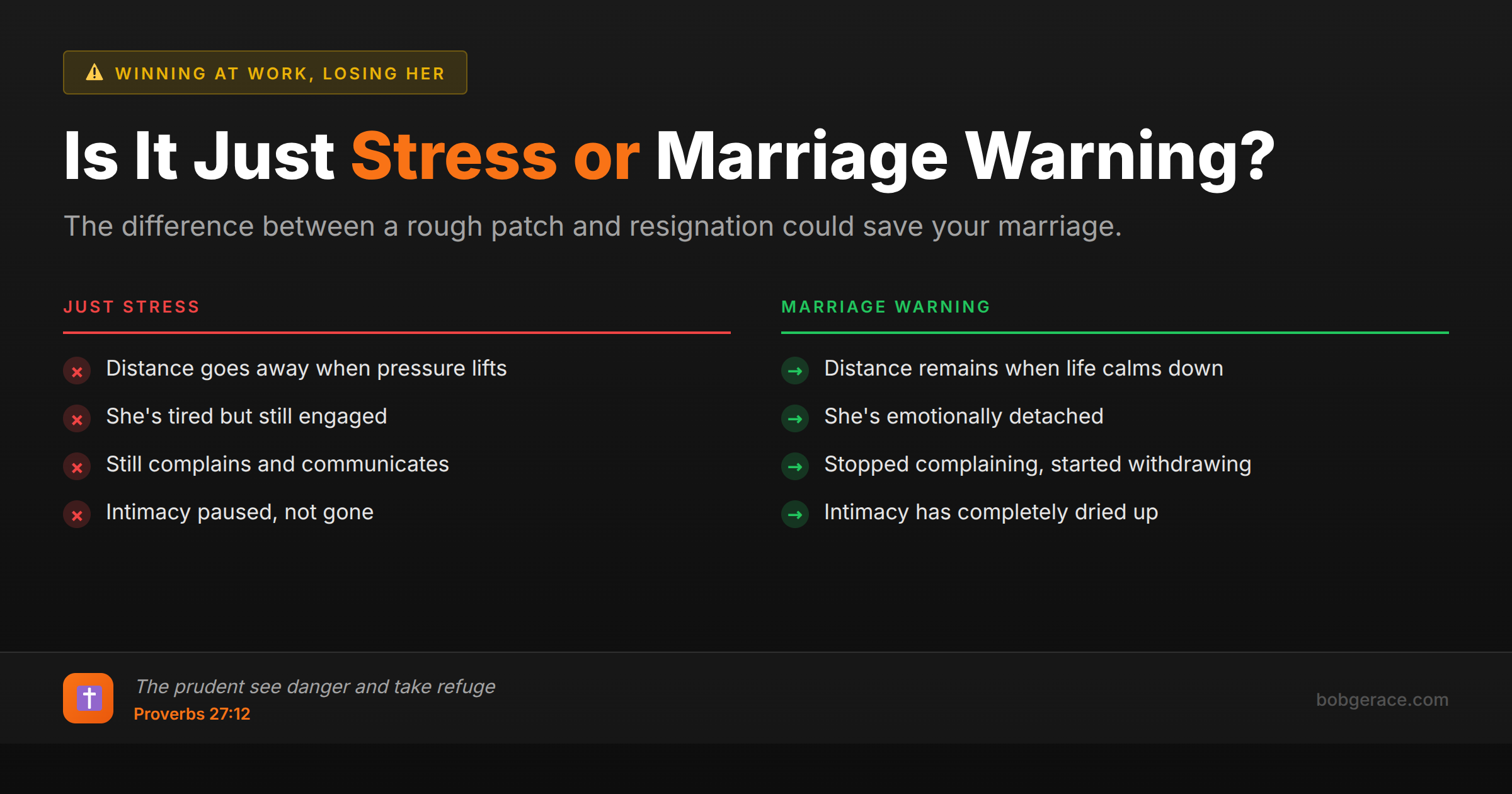
Stress is situational and temporary. A real marriage warning is relational and persistent. If the distance between you and your wife resolves when the stressor passes—a busy season at work, a sick kid, a financial crunch—it's stress. But if the distance remains even when life calms down, if she's pulling away emotionally, if intimacy has dried up, or if she's stopped complaining and started detaching, that's not stress. That's a warning. The key difference: stress affects your circumstances. A marriage warning affects your connection. Stress makes you both tired. A marriage warning makes her indifferent. If she's stopped pursuing you, stopped initiating, stopped expecting you to show up—that's not a rough patch. That's resignation. And resignation is one step away from done.
The Difference Between a Season and a Pattern
Every marriage goes through stressful seasons. New babies, job changes, financial pressure, health crises, aging parents—these are real and they take a toll. During stress, you might be short with each other, have less time for connection, or feel more distant. That's normal. The question is: does the connection return when the stress eases?
If you finish a brutal quarter at work and your wife is warm again, that was stress. If you finish the quarter and she's still cold, distant, or disengaged, that's a pattern. Patterns reveal the health of your marriage. Stress just reveals how you handle pressure.
Many men miss the warning signs because they confuse stress with the real issue. They think, 'Once this project is done, things will get better.' But the project ends and nothing changes. She's still distant. She's still uninterested. She's still living like a roommate instead of a wife. That's when you realize the problem wasn't the stress—it was the way you handled the stress, or the way you've been handling the marriage all along.
Here's what a real marriage warning looks like: less affection, less complaint, less pursuit. She stops asking you to engage. She stops bringing up issues. She stops expecting you to notice or respond. She becomes more independent, more self-sufficient, more emotionally detached. She's not angrier—she's quieter. And that quiet is dangerous.
Stress makes people reactive. A marriage warning makes people resigned. If your wife has moved from frustration to indifference, from pursuit to withdrawal, from hoping you'll change to accepting that you won't—that's not stress. That's a woman who's emotionally checking out. And once that process starts, the window to turn it around gets smaller every day.
How the Nervous System Responds to Stress vs. Relational Threat
Your nervous system responds differently to external stress than it does to relational disconnection. External stress—work pressure, financial strain, logistical chaos—activates your sympathetic nervous system. You go into fight-or-flight mode: adrenaline, cortisol, heightened alertness. That's uncomfortable, but it's manageable. Once the stressor passes, your system can return to baseline.
Relational disconnection, however, activates a deeper threat response. When your wife feels unseen, unheard, or unsafe with you, her nervous system perceives an attachment threat. That's not just stress—that's a threat to her primary bond. Her system moves through protest (pursuing, criticizing, escalating) into despair (withdrawing, shutting down, detaching). If she's in despair, stress management won't fix it. You need relational repair.
Many men misread their wife's withdrawal as her 'handling stress better' or 'finally calming down.' But withdrawal isn't calm—it's collapse. Her nervous system has moved from hyperarousal (fighting for connection) to hypoarousal (giving up on connection). That's a dorsal vagal shutdown, and it's one of the most dangerous states for a marriage.
Attachment research shows that when a partner consistently fails to respond to bids for connection, the other partner eventually stops bidding. That's called learned helplessness. Your wife tried to get your attention—through words, through emotions, through conflict. When you didn't respond, she learned that trying doesn't work. So she stopped trying. That's not stress—that's trauma.
The way to tell the difference: ask yourself, 'Is she more reactive or more resigned?' Reactive means stress. Resigned means warning. If she's stopped fighting for your attention, she's not less stressed—she's more done.
Wisdom to Discern the Season You're In
Proverbs 27:12 says the prudent see danger and take refuge, but the simple keep going and pay the penalty. Wisdom requires you to see what's really happening, not what you hope is happening. If your marriage is in trouble, minimizing it as 'just stress' is foolishness, not faith.
Ecclesiastes 3 reminds us there's a time for everything—a time to build and a time to repair. If your marriage is showing warning signs, this is the time to repair. Waiting for a better season, a less stressful month, or for her to 'get over it' is not wisdom—it's avoidance. And avoidance doesn't make problems go away. It makes them worse.
James 1:5 promises that if any of you lacks wisdom, ask God, and He will give it generously. If you're unsure whether this is stress or a real warning, ask God to show you the truth. Then ask your wife. Not in a defensive way—in a humble way. 'I want to understand what you're feeling. Are we in a stressful season, or is something deeper broken between us?'
Matthew 7:24-27 contrasts the wise man who builds on rock with the foolish man who builds on sand. The difference isn't the storm—both men face storms. The difference is the foundation. If your marriage foundation is solid—built on connection, trust, and consistent love—stress won't destroy it. But if the foundation is weak, even normal stress will expose the cracks.
Don't wait for a crisis to force your hand. Proverbs 22:3 says a prudent person foresees danger and takes precautions. If you're seeing warning signs, act now. The time to repair a marriage is before it falls apart, not after.
Action Steps
-
1
Ask your wife directly: 'Do you feel like we're just stressed, or do you feel like something deeper is broken between us?' Listen to her answer without defending.
-
2
Write down three specific changes in her behavior over the past six months: affection, communication, intimacy, engagement. Are these stress responses or withdrawal patterns?
-
3
Identify one area where you've been hoping things will get better on their own. Take one concrete action this week to engage instead of wait.
-
4
Check your calendar: when was the last time you prioritized connection with your wife—not because of a crisis, but because she matters? Schedule time this week.
-
5
Pray: 'God, give me eyes to see what's really happening in my marriage. Give me the courage to act before it's too late.'
Related Questions
Also find Bob on
Subscribe for weekly videos on Christian marriage.
Don't Wait Until She's Done to Get Help
Most men wait too long. By the time they realize it's not just stress, their wife is already emotionally gone. I help men act before it's too late.
Talk to Bob →