What if she respects my success but not my leadership?
6 min read
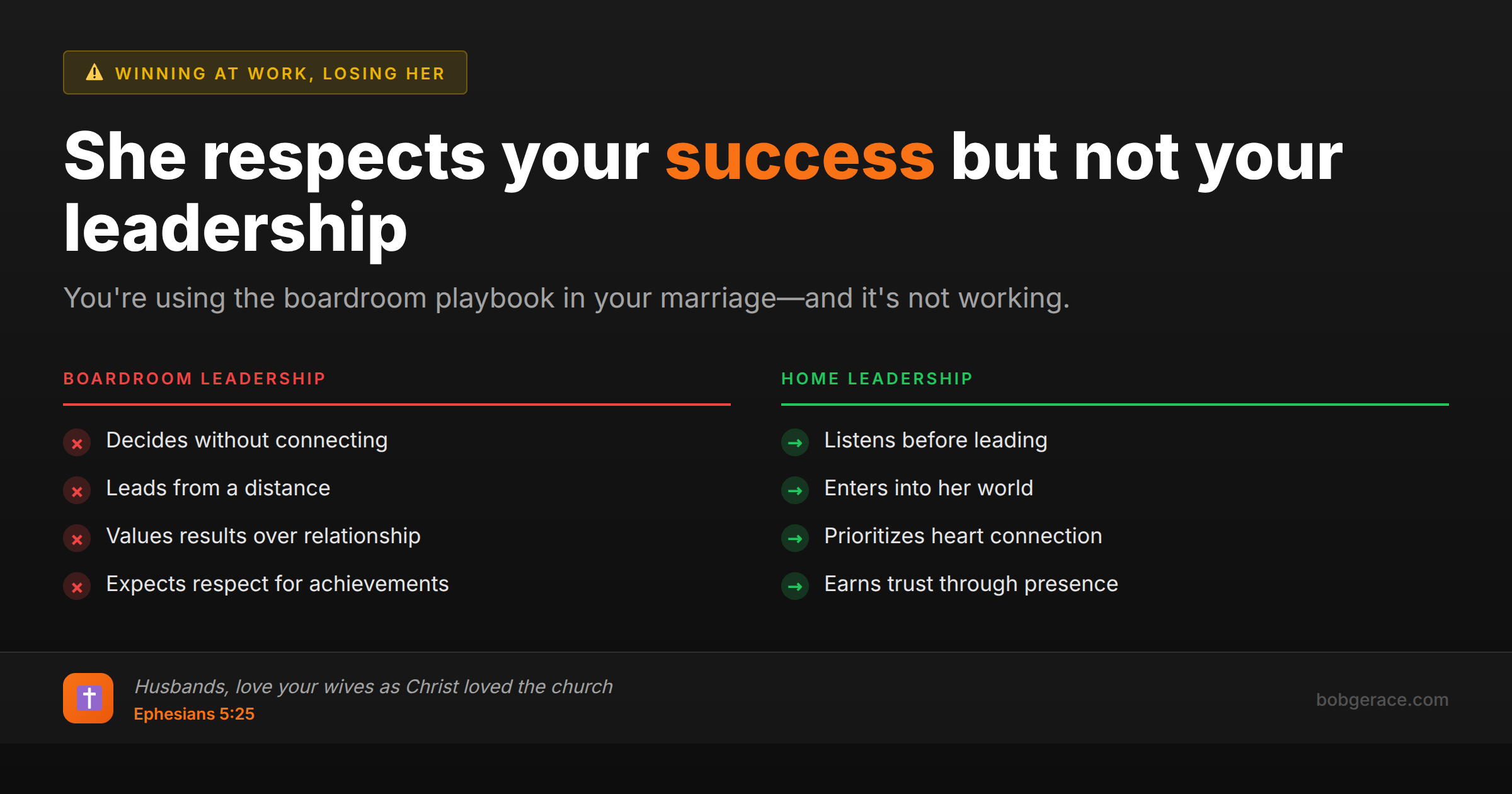
She respects what you produce but not who you are at home. That split happens when your leadership style at work—decisive, strategic, outcome-focused—doesn't translate into emotional presence, partnership, or attunement in marriage. She sees the results you deliver professionally, but at home she experiences a man who leads without listening, decides without connecting, or provides without protecting her heart. This isn't about her being difficult. It's about a leadership gap. You've built credibility in the boardroom but not in the bedroom or the kitchen. She doesn't trust your judgment in the areas that matter most to her—emotional safety, relational priorities, spiritual direction, and family decisions. Respect at home is earned differently than respect at work, and right now you're using the wrong playbook.
The Split Between Professional Credibility and Relational Trust
Most high-performing men experience this split at some point. You close deals, lead teams, solve complex problems, and generate income. People at work respect your judgment. But at home, your wife rolls her eyes when you suggest a solution, dismisses your input on parenting, or makes major decisions without consulting you.
This happens because professional leadership and marital leadership require different skill sets. At work, you lead through competence, clarity, and results. At home, you lead through presence, attunement, and emotional safety. You can't delegate intimacy. You can't outsource connection. And you can't solve her feelings with a strategy deck.
Many men make the mistake of thinking their wife should respect them because of what they provide. But provision without presence creates resentment, not respect. She doesn't need you to fix her day—she needs you to be with her in it. She doesn't need another project manager—she needs a man who can hold space for her emotions without shutting down or problem-solving.
The respect gap widens when you lead at home the same way you lead at work: transactionally, efficiently, without emotional attunement. She stops bringing things to you because you don't really listen. She stops asking your opinion because you don't really understand her world. She stops trusting your leadership because your leadership doesn't include her heart.
This isn't about becoming soft or passive. It's about becoming whole. The same strength that drives your success can be channeled into emotional presence, spiritual leadership, and relational courage. But first, you have to see the gap.
Why Professional Success Doesn't Transfer to Marital Respect
From an attachment perspective, respect in marriage is built on felt safety, not just competence. Your wife's nervous system doesn't care how many deals you closed this quarter. It cares whether you notice when she's overwhelmed, whether you respond when she's hurt, and whether you can stay present when she's emotional.
When you lead at work, you operate in your sympathetic nervous system—alert, focused, goal-driven. That's effective for performance. But at home, your wife needs you to access your ventral vagal state—calm, connected, attuned. If you stay in work mode at home, she experiences you as unavailable, even when you're physically present.
The respect split also reveals a common pattern: you've outsourced emotional labor to her while claiming leadership. You make financial decisions but expect her to manage all relational and emotional decisions. You set the direction but don't do the work of connection. That's not leadership—that's delegation without partnership.
Resentment builds when she feels like she's managing the marriage alone while you manage everything else. She respects your success because it's visible and measurable. But she doesn't respect your leadership because you're not leading in the areas that matter most to her—emotional intimacy, spiritual direction, and relational repair.
This dynamic is fixable, but it requires you to develop a new kind of strength: the strength to be emotionally present, to listen without fixing, to lead without controlling, and to prioritize connection over efficiency. That's the leadership she's longing for.
Leading Like Christ: Presence Before Performance
Ephesians 5:25 calls husbands to love their wives as Christ loved the church and gave Himself up for her. That's not transactional leadership—it's sacrificial presence. Jesus didn't lead from a distance. He entered into the mess, sat with the broken, and prioritized relationship over results.
Your professional success is a gift, but it's not the foundation of your marriage. Proverbs 4:23 says to guard your heart above all else, for everything you do flows from it. If your heart is more invested in work than in your wife, she feels it. If your identity is more tied to your title than to your covenant, she knows.
Biblical leadership in marriage isn't about being right or being in charge. It's about being present, being humble, and being willing to lay down your agenda for the sake of your wife's heart. That's what Philippians 2:3-4 means when it calls us to consider others' interests above our own.
Jesus led with authority because He led with love. He had the respect of His followers because He knew them, saw them, and served them. Your wife will respect your leadership when she experiences your love—not as a concept, but as a daily reality of being seen, heard, and prioritized.
This isn't about losing your strength. It's about using your strength for what matters most. The same discipline that built your career can rebuild your marriage—if you're willing to lead with your heart, not just your head.
Action Steps
-
1
Ask your wife this week: 'What's one area where you wish I led differently at home?' Then listen without defending or fixing.
-
2
Identify one relational decision you've been avoiding or delegating to her. Take ownership of it this week—not by deciding alone, but by initiating the conversation.
-
3
Spend 20 minutes this week in her world with no agenda: ask about her day, her feelings, or what's weighing on her. Don't problem-solve—just be present.
-
4
Audit your calendar: are you giving your best energy to work and your leftovers to her? Adjust one recurring commitment to prioritize time with your wife.
-
5
Pray daily for a week: 'God, show me where I'm leading with my head but not my heart. Give me the courage to lead like Christ.'
Related Questions
Also find Bob on
Subscribe for weekly videos on Christian marriage.
Ready to Lead at Home the Way You Lead at Work?
You've built success in your career. Now it's time to build respect in your marriage. I help men like you close the leadership gap before it's too late.
Talk to Bob →