How does wife resentment build over time?
6 min read
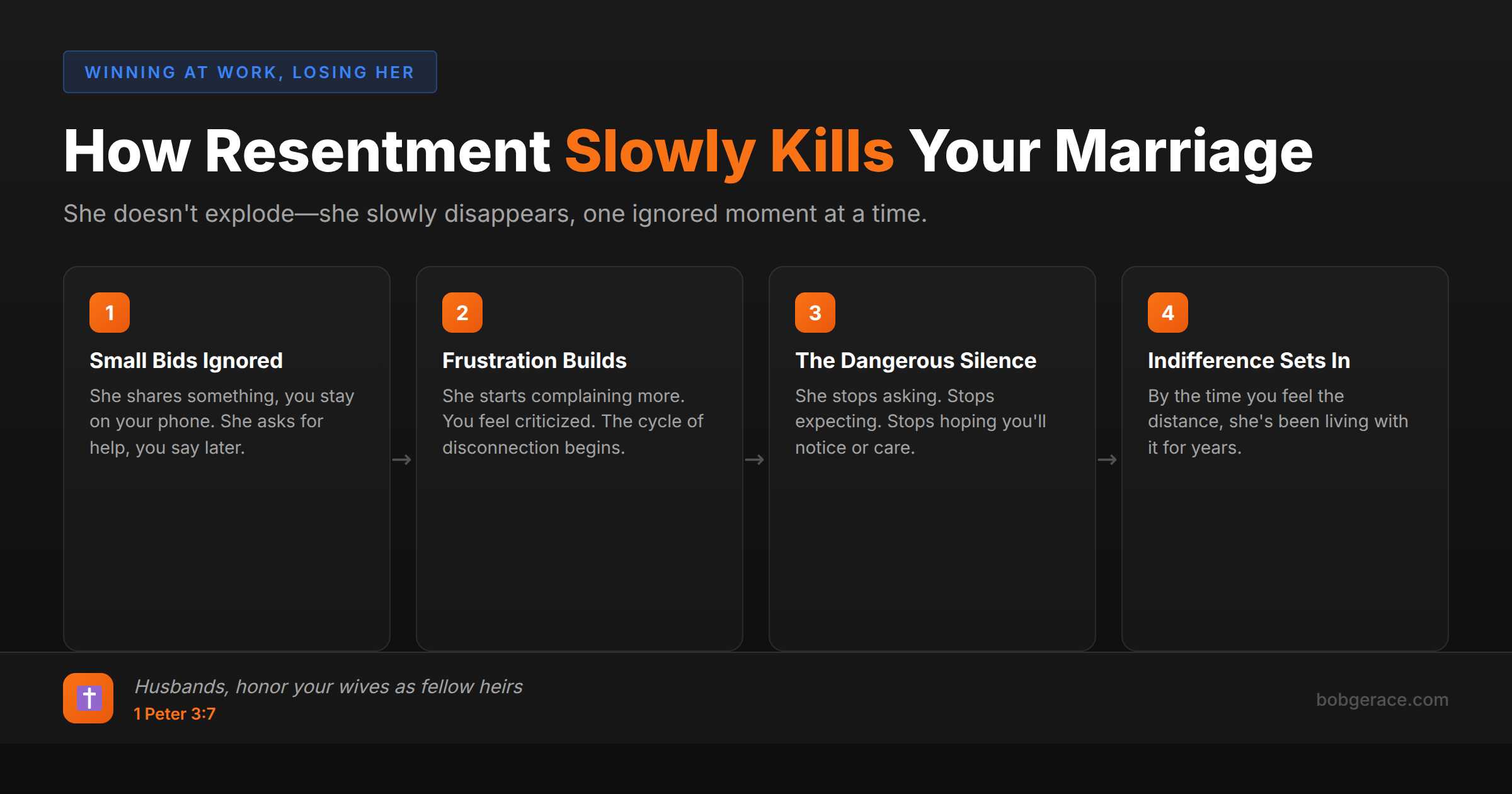
Wife resentment builds in layers, not explosions. It starts when small bids for connection go unanswered—she shares something, you stay on your phone. She asks for help, you say later. She initiates affection, you're too tired. Each moment alone feels small. But they stack. Over months and years, the stack becomes a wall. The dangerous phase is when she stops complaining. Early resentment sounds like frustration or anger. Late-stage resentment sounds like silence. She stops asking. Stops expecting. Stops hoping you'll notice. By the time you feel the distance, she's often been living with it for years. Indifference is the final stage, and it's harder to reverse than anger.
The Quiet Accumulation of Unmet Needs
Resentment doesn't announce itself. It accumulates in the gap between what your wife needs emotionally and what she actually receives. Early on, she tells you. She says she feels alone. She mentions you're always on your phone. She asks if you can talk after the kids are down. You hear it as complaint or nagging, so you defend, minimize, or promise to do better later.
But later doesn't come. The pattern repeats. She learns that bringing it up doesn't change anything—it just creates tension. So she adapts. She stops asking. She finds other ways to meet her needs: friends, work, kids, hobbies, sometimes emotional connection elsewhere. You interpret her independence as her being fine. You think the conflict is over. In reality, she's just stopped expecting you to show up.
This is the part most men miss. You think things are stable because she's not upset anymore. But what you're seeing isn't peace—it's resignation. She's not fighting because she's already emotionally moved on. The resentment isn't loud. It's the growing space between you. It's her face when you walk in the room. It's the way she doesn't reach for you anymore. It's the flatness in her voice when you ask about her day.
By the time she says, 'I'm done,' or 'I don't know if I love you anymore,' the resentment has been building for years. You're shocked. She's exhausted. The gap between your two experiences of the marriage is massive, and that gap is made of all the moments she needed you and you weren't there.
The Neurobiology of Resentment and Emotional Shutdown
Resentment is what happens when repeated relational injuries go unrepaired. In attachment terms, your wife makes bids for connection—small moments where she reaches for emotional safety, presence, or reassurance. When those bids are consistently missed or dismissed, her nervous system learns that you are not a safe place to turn.
Early on, unmet bids trigger protest behavior: she gets angry, pursues you, criticizes, or tries harder to get your attention. This is her attachment system fighting for connection. If the pattern continues and nothing changes, her nervous system shifts into despair and eventually detachment. She stops protesting. Her system decides that reaching for you is more painful than not reaching at all.
This is where resentment crystallizes. It's not just hurt—it's the story she tells herself about why the hurt keeps happening. 'He doesn't care. I'm not a priority. He'll never change. I'm alone in this.' These narratives become the lens through which she interprets everything you do. Even positive gestures get filtered through resentment: 'He's only being nice because he wants sex. He'll go back to ignoring me tomorrow.'
Neurologically, resentment keeps her in a low-grade state of threat around you. Her brain has learned to expect disappointment. That's why she seems guarded, distant, or emotionally flat. She's not withholding to punish you—she's protecting herself from another injury. The tragedy is that by the time you notice and want to change, her system is so defended that your efforts feel too late or insincere. Breaking through that requires more than good intentions. It requires consistent, sustained, emotionally attuned presence over time.
Love Keeps No Record—But Patterns Do
Scripture says love keeps no record of wrongs (1 Corinthians 13:5). That's the goal. But resentment is what happens when the same wrong keeps repeating and there's no repentance, no repair, no change. Your wife isn't supposed to be a doormat. She's your partner, made in God's image, worthy of honor (1 Peter 3:7).
When you consistently fail to see her, hear her, or prioritize her, you're not just neglecting a relationship—you're dishonoring the person God gave you to steward. Resentment builds because she experiences a gap between your words and your actions. You say she matters, but your calendar, attention, and energy say otherwise. That gap is a credibility problem, and it erodes trust.
The Bible also warns against provoking bitterness. Colossians 3:19 tells husbands, 'Do not be harsh with your wives, or they will become discouraged.' Harshness isn't just yelling. It's chronic emotional unavailability. It's dismissing her concerns. It's prioritizing everything else and expecting her to be fine with the leftovers of your time and attention.
Repentance means change, not just apology. If you've been emotionally absent, you can't just say sorry and expect resentment to vanish. You have to rebuild trust through sustained presence. That takes time. It takes humility. It takes letting her see that you're actually different now, not just saying the right things until the heat dies down. God is patient with you. You need to be patient with the process of her heart softening again.
Action Steps
-
1
Ask her directly: 'What are three ways I've made you feel unseen or unimportant?' Then listen without defending.
-
2
Identify one recurring pattern where you've been unavailable—phone use, work hours, emotional shutdown—and commit to changing it for 30 days.
-
3
Initiate non-sexual affection daily: a hug when you get home, holding her hand, a kiss before bed. Let her feel wanted, not just needed for sex.
-
4
Repair past injuries: name a specific time you let her down, own it, and ask what she needed from you then. Don't explain it away.
-
5
Track your emotional presence: at the end of each day, ask yourself, 'Did I make her feel like a priority today, or did I just coexist?'
Related Questions
Also find Bob on
Subscribe for weekly videos on Christian marriage.
Stop the Drift Before It's Too Late
Resentment doesn't reverse itself. If you're seeing the signs—distance, silence, indifference—you need a plan, not hope. I help men rebuild trust and emotional connection before it's too late.
Talk to Bob →