What if I do not know how to talk about feelings?
5 min read
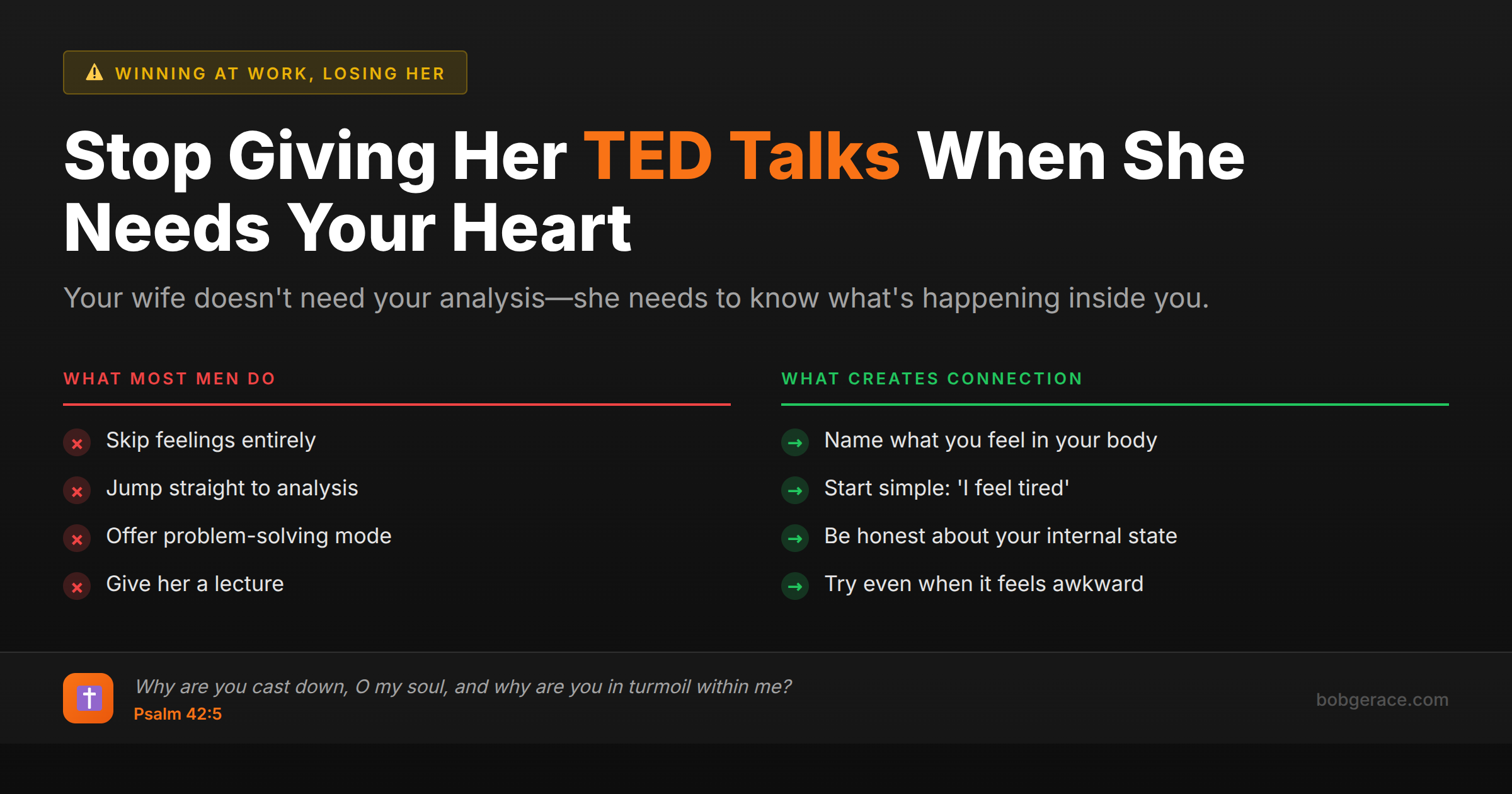
You start by naming what you feel in your body, not what you think about the situation. Most men skip feelings entirely and go straight to analysis, problem-solving, or blame. That is not connection. Your wife does not need a TED Talk. She needs to know what is happening inside you. Start simple: 'I feel tired. I feel frustrated. I feel overwhelmed. I feel disconnected.' You do not need a psychology degree. You need honesty. If you genuinely cannot identify what you are feeling, that is alexithymia, and it is common in high-performing men. You have spent years overriding your internal experience to get things done. The skill atrophied. You can rebuild it. It takes practice, patience, and willingness to feel awkward. You will not be good at it immediately. That is fine. Your wife does not need you to be eloquent. She needs you to try.
Why You Were Never Taught This Language
You were raised in a world that rewarded you for doing, not feeling. Your father probably did not model emotional vocabulary. Your coaches told you to push through pain. Your peers mocked vulnerability. Your early romantic experiences taught you that women wanted confidence, not confusion. So you learned to suppress, ignore, or intellectualize anything that felt uncomfortable. You became excellent at achieving and terrible at articulating your inner world.
This worked fine until you got married. Now your wife is asking you to do something you have no training for. She wants to know how you feel, not just what you think. She wants access to your heart, not just your strategy. And when you cannot give her that, she feels shut out. She interprets your silence as rejection. Your logic as dismissal. Your competence as coldness. She does not understand that you are not withholding. You genuinely do not know how to do what she is asking.
Meanwhile, you feel like you are failing a test you were never taught to study for. You love her. You provide for her. You are faithful. You show up. But she keeps saying she feels alone, and you have no idea how to fix it. The problem is not that you are broken. The problem is that you are trying to speak a language you were never taught. The good news is that language can be learned. It just requires you to admit you do not know it yet and start practicing like a beginner.
What Happens When You Cannot Name Your Emotions
Alexithymia is the clinical term for difficulty identifying and describing emotions. It is not a disorder. It is a learned pattern, often rooted in childhood environments where feelings were ignored, punished, or overwhelming. If you grew up in a home where emotions were not discussed, you likely never developed the neural pathways to recognize and label your internal states. Your brain learned to bypass the feeling and go straight to the action or the thought.
This creates a gap in your marriage. Your wife experiences emotion as information. When she feels sad, she knows it. She can name it. She can talk about it. When you feel sad, you might experience it as fatigue, irritability, or numbness. You do not connect it to an emotion. You just know something is off. So when she asks how you feel, you say, 'Fine,' or 'I do not know,' and she hears, 'I do not care enough to tell you.' That is not what you mean. But that is what she receives.
The gap widens over time. She stops asking. You stop trying. The emotional intimacy dies. But here is the truth: emotional vocabulary is a skill, not a personality trait. You can build it the same way you built any other skill. You start with the basics. You notice sensations in your body. You connect them to simple feeling words. You practice out loud, even when it feels clumsy. You get feedback. You improve. It is not mystical. It is mechanical. And it is absolutely learnable if you are willing to do the work.
God Made You With Emotions, Not Despite Them
The Psalms are full of raw emotion. David does not just report facts. He laments. He rages. He celebrates. He despairs. Psalm 42:5 says, 'Why are you cast down, O my soul, and why are you in turmoil within me?' That is emotional self-awareness. David is naming what he feels and bringing it before God. He is not stuffing it. He is not intellectualizing it. He is feeling it and speaking it.
Jesus wept. He was deeply moved. He was troubled in spirit. He expressed anger, compassion, sorrow, and joy. The Son of God did not bypass His emotions. He integrated them into His mission. He felt fully and loved fully. That is the model. Emotional availability is not unmasculine. It is human. It is how God designed you. The idea that real men do not feel is a cultural lie, not a biblical truth.
Proverbs 20:5 says, 'The purpose in a man's heart is like deep water, but a man of understanding will draw it out.' Your wife is trying to draw out what is deep in you. She is not doing it to emasculate you. She is doing it because she wants to know you. And you cannot be fully known if you cannot name what you feel. Learning to talk about your emotions is not weakness. It is obedience to the design. It is stewarding the heart God gave you. And it is essential to the one-flesh intimacy God intended for your marriage.
Action Steps
-
1
Download a feelings wheel or print a list of emotion words. Keep it on your phone. When your wife asks how you feel, look at it and pick the word that fits best, even if it feels awkward.
-
2
Set a timer for two minutes each morning. Sit quietly and ask yourself: 'What do I feel in my body right now?' Name the sensation first (tight chest, heavy shoulders), then try to name the emotion (anxious, sad, frustrated).
-
3
Practice this sentence out loud: 'I feel [emotion] because [simple reason].' Example: 'I feel overwhelmed because I have too much on my plate.' Do not explain. Do not justify. Just name it.
-
4
Tell your wife once this week: 'I am not good at this yet, but I want to learn. Can you help me?' Then when she asks how you feel, try. Even if you get it wrong, the effort matters.
-
5
Read Psalm 13 or Psalm 88. Notice how David brings his full emotional experience to God. Practice doing the same in prayer. Say out loud what you feel, even if it is messy or angry.
Related Questions
- How can my wife feel neglected when I work so hard for her?
- How do I know if I am an emotionally unavailable husband?
- Why does my success not make her feel secure?
- What is emotional neglect in marriage?
- How do I become trustworthy after years of not showing up?
- Why does she remember small moments I forgot?
Also find Bob on
Subscribe for weekly videos on Christian marriage.
Learn the Language Your Marriage Needs
Building emotional vocabulary is not something you figure out from a book. You need practice, feedback, and a guide who understands how high-performing men are wired. That is what Wingman and one-on-one coaching provide.
Talk to Bob →