Why is my wife no longer affectionate?
5 min read
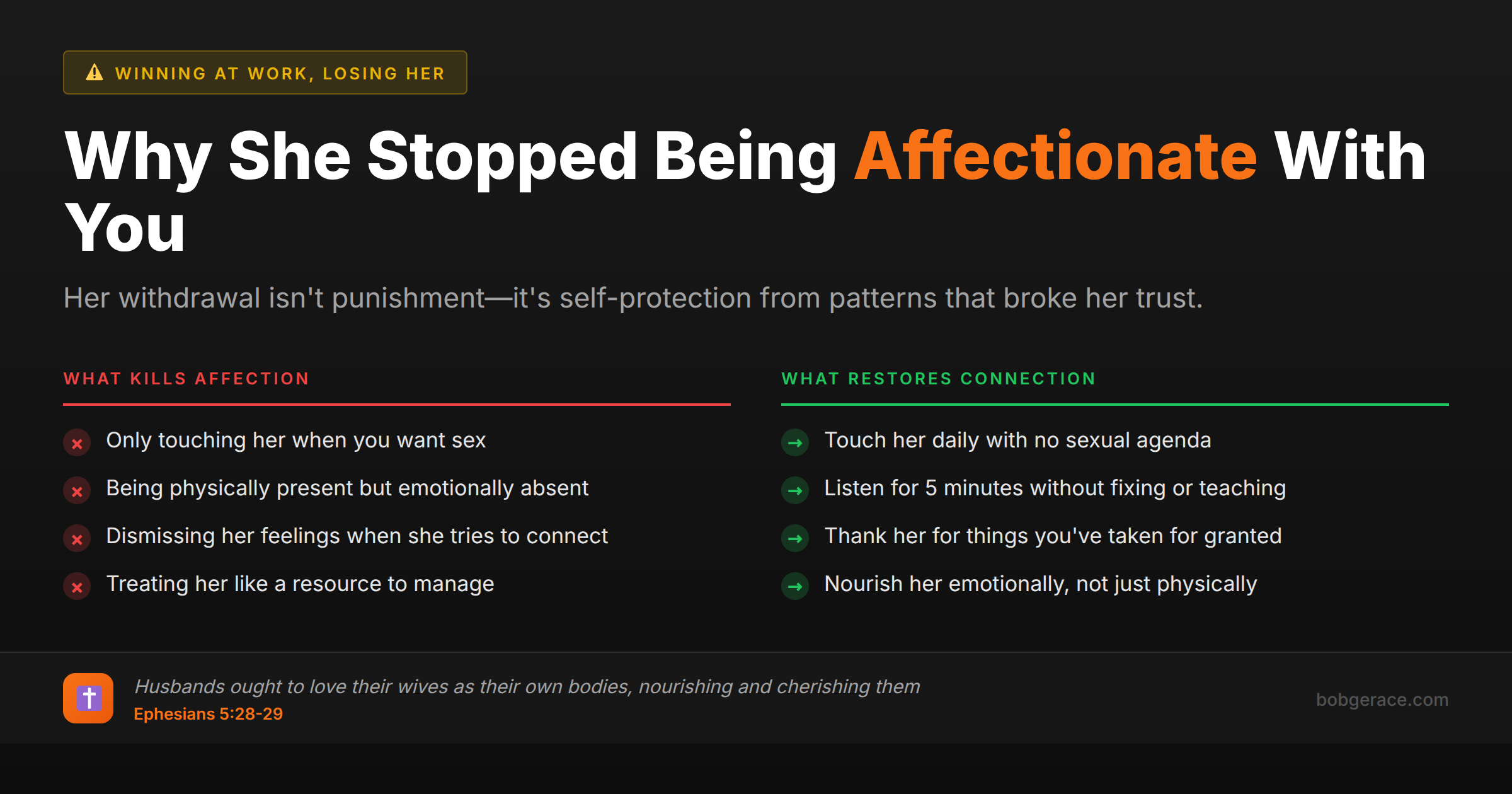
Your wife stopped being affectionate because she no longer feels safe being close to you. Somewhere along the way, affection became a setup. Maybe you only touched her when you wanted sex. Maybe you dismissed her feelings when she tried to connect. Maybe you were present physically but absent emotionally. Her body learned that closeness leads to disappointment, so she shut down. This isn't about you being a bad guy. It's about patterns. She reached out and didn't feel met. She tried to talk and felt unheard. She wanted presence and got performance. Over time, her nervous system moved into self-protection mode. Withdrawing affection isn't punishment. It's survival. She's conserving energy she no longer believes will be returned.
The Slow Erosion of Affection
Affection doesn't disappear in one fight. It fades through a thousand small moments where she felt alone while you were right there. She tells you about her day and you half-listen while scrolling. She reaches for your hand and you pull away to check a work message. She initiates a hug and you turn it sexual within seconds. Each time, her system registers: he's not really here.
At first, she tries harder. She initiates more. She asks for your attention. She tells you she feels disconnected. But if you dismiss it, minimize it, or promise to change without changing, she stops asking. She stops expecting. And eventually, she stops reaching.
When a woman withdraws affection, she's not playing games. She's protecting herself. Her body has learned that opening up leads to being let down. So she closes. She becomes independent. She finds emotional connection elsewhere—with friends, kids, work, or just inside herself. You're still in the house, but she's no longer looking to you for warmth.
Most men notice when it's already late. They see the distance and try to fix it with more attention, more compliments, more touch. But if the underlying dynamic hasn't changed—if she still feels unseen, used, or unheard—the affection won't return. She doesn't need you to try harder. She needs you to show up differently.
What Happens in Her Nervous System
When affection dies, it's often because her nervous system has moved out of social engagement and into a protective state. Polyvagal theory describes this shift: she's no longer in ventral vagal (safe and connected) but in sympathetic (anxious and hypervigilant) or dorsal vagal (shutdown and numb).
This happens when affection becomes unpredictable or conditional. If she can't trust that your touch is just touch—if it always leads to a request for sex, a criticism, or emotional unavailability—her system stays on guard. She can't relax into closeness because she's bracing for disappointment.
Attachment research shows that adults need consistent, attuned responsiveness to feel secure. When you're emotionally unavailable, dismissive, or only present when you want something, she develops an insecure attachment to you. She learns that reaching for you is risky. So she stops reaching.
Over time, this creates a pursue-withdraw cycle. You want more affection, so you pursue. She feels pressured, so she withdraws. You pursue harder. She shuts down more. The cycle reinforces itself until both of you are stuck in patterns neither of you wanted.
Breaking this requires you to stop pursuing and start being present. You have to prove to her nervous system that you're safe again. That means showing up without an agenda, listening without fixing, touching without expecting, and staying consistent even when she's cold. It's slow work. But it's the only way her system will down-regulate and let you back in.
The Call to Sacrificial Presence
Ephesians 5:28-29 says, "Husbands ought to love their wives as their own bodies. He who loves his wife loves himself. For no one ever hated his own flesh, but nourishes and cherishes it." To nourish and cherish means to be present, attentive, and tender—not just when it's convenient, but consistently.
If your wife has withdrawn, ask yourself: have you nourished her emotionally? Have you cherished her presence, or have you treated her like a resource to manage? Have you been present in body but absent in spirit? Christ's love for the church is not distant or transactional. It's intimate, sacrificial, and attentive. You're called to the same.
First Peter 3:7 tells husbands to live with their wives in an understanding way, showing honor. Understanding requires attention. It requires you to notice when she's struggling, when she's tired, when she's pulling away. It requires you to ask why instead of assuming. It requires humility to admit you may have missed her for months or years.
This doesn't mean her withdrawal is your fault alone. But it does mean you're responsible for how you respond. You can't control whether she opens back up. But you can control whether you show up as a man who is safe, present, and consistent. You can stop demanding affection and start offering the kind of presence that makes affection possible again.
Action Steps
-
1
Stop asking why she's not affectionate. The question itself adds pressure. Instead, focus on becoming someone she wants to be close to.
-
2
Touch her in non-sexual ways daily: a hand on her back, a kiss on her forehead, holding her hand while watching TV. No agenda.
-
3
Listen to her for five minutes without fixing, teaching, or redirecting. Just reflect back what you hear and validate her feelings.
-
4
Notice one thing she does every day that you've taken for granted. Thank her specifically for it.
-
5
Pray for the patience to rebuild trust slowly and the humility to see where you've been emotionally absent.
Related Questions
- What does roommate marriage mean?
- Why does she light up for everyone but me?
- What are the six-month warning signs before she leaves?
- How do I become her husband again, not her roommate?
- Why do emotionally unavailable men often think they are calm?
- Why does she say I am emotionally unavailable when I never left?
Also find Bob on
Subscribe for weekly videos on Christian marriage.
Stop the Drift Before It's Too Late
If your wife has pulled away and you're not sure how to reach her, you need a clear plan. Bob helps men understand what happened and how to rebuild safety and connection.
Talk to Bob →