How do I forgive when I'm still hurt?
6 min read
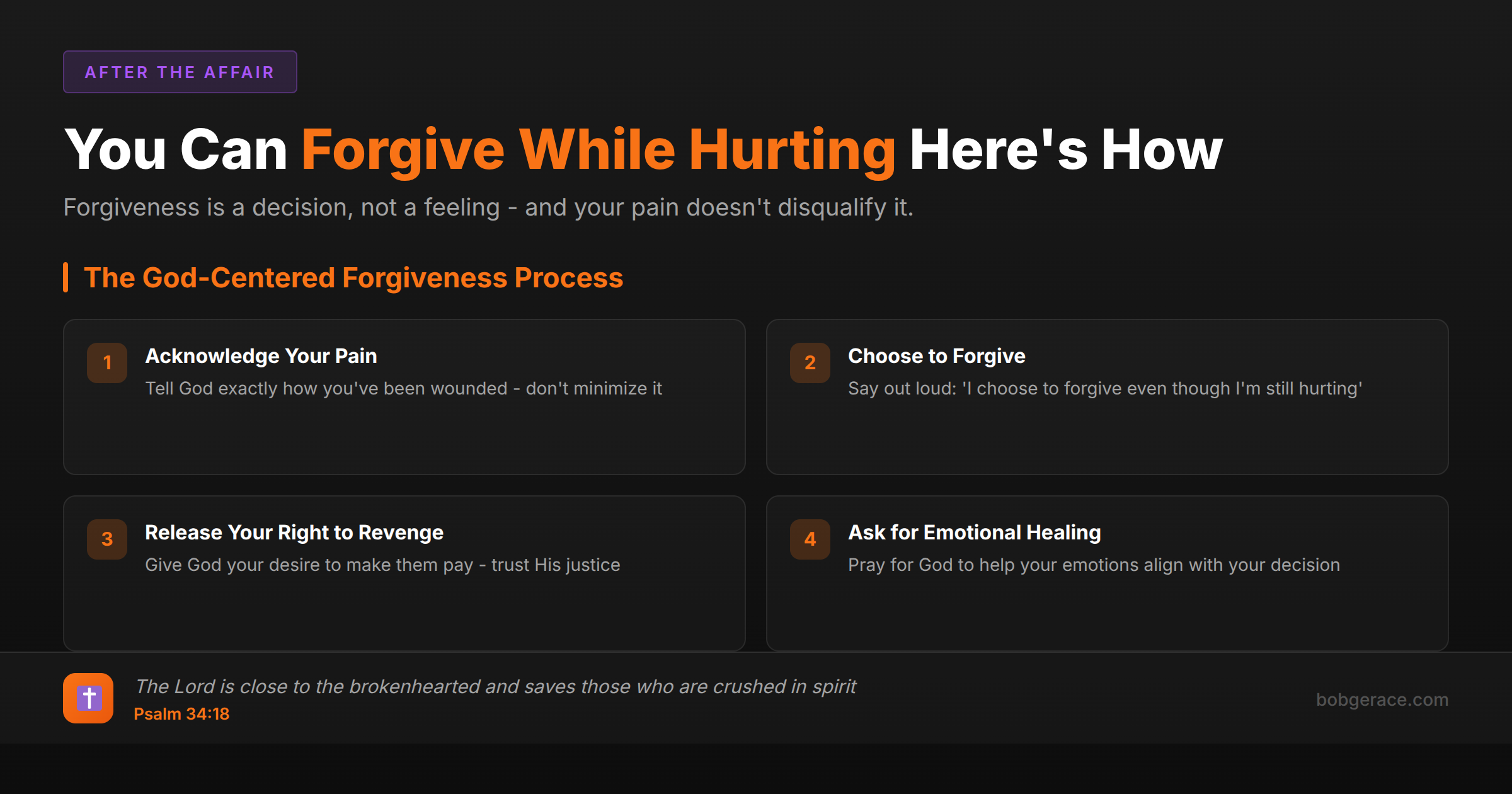
Forgiveness doesn't require you to stop hurting or pretend the pain doesn't exist. God designed forgiveness as a process, not an instant emotional switch. You can choose to forgive while still feeling hurt - in fact, that's exactly what real forgiveness looks like. It's a decision to release your right to revenge and trust God with the outcome, even when your emotions are still catching up. The key is understanding that forgiveness is an act of obedience to God, not a feeling you manufacture. Start by choosing to forgive in your will, then ask God to help your emotions align with that decision over time. Your hurt validates that real harm occurred - don't rush to dismiss it. Instead, let God use your pain as part of the healing process.
The Full Picture
Here's what I've learned after years of helping couples navigate deep wounds: forgiveness and hurt can coexist. In fact, they must. If you weren't truly hurt, forgiveness wouldn't be necessary. The pain you're feeling isn't evidence that you're failing at forgiveness - it's proof that forgiveness is needed.
Most people get stuck because they think forgiveness means feeling good about what happened or instantly trusting again. That's not biblical forgiveness. Forgiveness is a choice to release someone from the debt they owe you, even when you're still counting the cost of their actions.
I've seen too many spouses try to shortcut this process. They either stuff their hurt down and pretend to forgive, or they use their ongoing pain as justification to withhold forgiveness indefinitely. Both approaches keep you stuck. Real forgiveness acknowledges the hurt while choosing to respond with grace.
The process looks different for everyone, but it always involves three crucial elements: naming the hurt honestly, choosing to release your right to revenge, and trusting God to handle justice. You don't have to do this perfectly or all at once. God honors your sincere attempt to obey His command to forgive, even when your heart is still bleeding.
Your hurt matters to God. He doesn't minimize it or rush you past it. But He also doesn't want you enslaved by it. Forgiveness is how you break free from the prison of resentment while still honoring the reality of your pain. This isn't about letting your spouse off the hook - it's about getting yourself off the hook of carrying their debt.
What's Really Happening
Neurologically, forgiveness and //blog.bobgerace.com/emotional-regulation-christian-marriage-biology-betrayal/:emotional pain activate different brain systems, which explains why they can exist simultaneously. When you're hurt, your amygdala triggers threat responses, flooding your system with stress hormones. These chemicals don't disappear the moment you decide to forgive - they need time to metabolize.
The prefrontal cortex, responsible for decision-making and values-based choices, can override the amygdala's emotional responses. This is why you can choose forgiveness while still feeling hurt. Your rational brain is choosing to forgive while your emotional brain is still processing the trauma.
Research shows that genuine forgiveness actually requires acknowledging hurt first. Studies indicate that people who skip the grief process and jump straight to 'forgiveness' often experience incomplete healing and recurring resentment. Your brain needs to process the full reality of what happened before it can truly release it.
The healing happens gradually as your brain creates new neural pathways associated with compassion and release, while the old pain pathways slowly weaken. This is why forgiveness often feels like a daily choice rather than a one-time event. Each time you choose forgiveness over revenge fantasies, you're literally rewiring your brain for healing.
What Scripture Says
Scripture never suggests that forgiveness requires the absence of pain. In fact, the Bible validates both our hurt and our call to forgive. Psalm 34:18 reminds us that 'The Lord is close to the brokenhearted and saves those who are crushed in spirit.' God acknowledges your pain and draws near to you in it.
Yet Jesus clearly commands us to forgive: 'Be kind and compassionate to one another, forgiving each other, just as in Christ God forgave you' (Ephesians 4:32). Notice this doesn't say 'when you feel better' or 'after you've healed.' It's a present-tense command that applies even in your hurt.
Matthew 18:21-22 shows us forgiveness is a repeated choice: 'Then Peter came to Jesus and asked, "Lord, how many times shall I forgive my brother or sister who sins against me? Up to seven times?" Jesus answered, "I tell you, not seven times, but seventy-seven times."' This suggests ongoing hurt requiring ongoing forgiveness.
Perhaps most powerfully, Jesus Himself forgave from a place of pain. On the cross, while experiencing ultimate betrayal and agony, He said, 'Father, forgive them, for they do not know what they are doing' (Luke 23:34). He didn't wait until His wounds healed to forgive - He forgave through them.
1 Peter 2:23 describes Jesus' approach: 'When they hurled their insults at him, he did not retaliate; when he suffered, he made no threats. Instead, he entrusted himself to him who judges justly.' This is your model - releasing your spouse to God's justice while you're still wounded.
What To Do Right Now
-
1
Acknowledge your hurt honestly before God - Don't minimize or spiritualize away your pain. Tell God exactly how you've been wounded.
-
2
Make the choice to forgive in your will - Say out loud: 'I choose to forgive [spouse's name] for [specific offense], even though I'm still hurting.'
-
3
Release your right to revenge - Pray: 'God, I give you my desire to make them pay. I trust you to handle justice in your way and timing.'
-
4
Ask God to help your emotions catch up - 'Lord, I've chosen to forgive, but my heart is still wounded. Please heal my emotions and help me feel what I've decided.'
-
5
Set appropriate boundaries while you heal - Forgiveness doesn't mean immediate full trust or vulnerability. Protect yourself wisely as you recover.
-
6
Repeat daily as needed - When hurt resurfaces, return to steps 2-4. Forgiveness is often a daily choice, not a one-time event.
Related Questions
- What does biblical forgiveness require of me?
- Can I forgive without trusting?
- What's the difference between forgiveness and reconciliation?
- How do I forgive when she hasn't fully repented?
- What does real forgiveness look like?
- What does forgiveness feel like when it's real?
- I can't control my anger
- How do I not lose my mind right now?
- How do I deal with intrusive images?
- What does trauma recovery look like?
Also find Bob on
Subscribe for weekly videos on Christian marriage.
Stuck Between Forgiving and Still Hurting?
A coach who knows your specific story can help you navigate this tension without rushing either side. You don't have to figure out the timing alone.
Talk to Bob →