What does real forgiveness look like?
6 min read
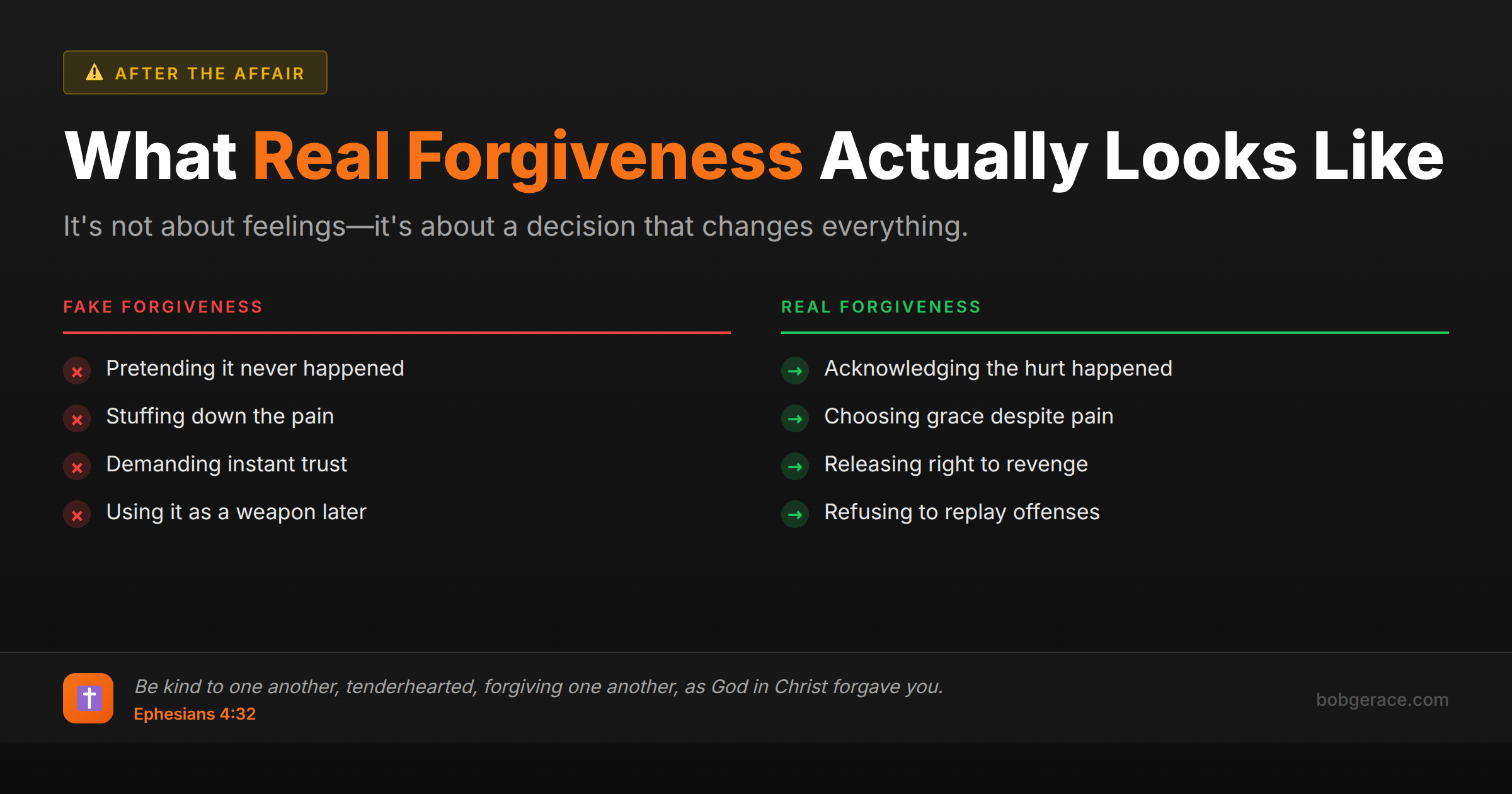
Real forgiveness isn't a feeling—it's a decision followed by action. Biblical forgiveness means choosing to release your right to revenge and refusing to use past hurts as weapons. It doesn't mean pretending the offense didn't happen or that it didn't hurt. True forgiveness acknowledges the pain while choosing to respond with grace. In marriage, real forgiveness looks like stopping the mental replay of offenses, refusing to bring up past hurts during arguments, and actively working toward restoration. It's not a one-time event but an ongoing choice, especially for deeper wounds. Forgiveness creates space for healing, but it doesn't automatically restore trust—that requires time and consistent changed behavior from the offending spouse.
The Full Picture
Let's get something straight: forgiveness isn't about being a doormat or pretending everything's fine when it's not. Real forgiveness is one of the most powerful and difficult choices you'll make in your marriage.
What forgiveness IS: - A conscious decision to release resentment - Choosing not to seek revenge or payback - Refusing to use past offenses as ammunition - Opening the door for potential reconciliation - Following God's example of grace toward us
What forgiveness is NOT: - Forgetting what happened (that's often impossible and unwise) - Automatically trusting again (trust must be rebuilt) - Excusing or minimizing the offense - Eliminating all consequences - A feeling that makes everything better instantly
The confusion happens when we think forgiveness means we have to feel warm and fuzzy about what happened. That's not biblical. You can forgive someone while still feeling hurt, angry, or disappointed. Those emotions are valid and often protective.
Real forgiveness creates space for healing to begin. It stops the poison of bitterness from destroying your heart and your marriage. But here's what many people miss: forgiveness is often a process, not a one-time event. For significant betrayals, you might need to choose forgiveness repeatedly as memories surface or new details emerge.
The goal isn't to erase the past but to prevent it from controlling your future. When you truly forgive, you're not saying the offense was okay—you're saying you refuse to let it define your marriage moving forward.
What's Really Happening
From a psychological standpoint, forgiveness is a complex process that involves both //blog.bobgerace.com/christian-marriage-teamwork-stop-fighting-alone/:emotional regulation-for-her/what-should-change-in-his-emotional-regulation) and cognitive restructuring. When we hold onto resentment, our brains literally rehearse the offense repeatedly, strengthening those neural pathways and keeping us stuck in a cycle of pain.
True forgiveness involves what we call 'decisional forgiveness'—the conscious choice to let go of revenge—and 'emotional forgiveness,' which is the gradual replacement of negative emotions with more neutral or positive ones. The decision often comes first, and the emotions follow over time.
Research shows that people who practice forgiveness experience lower levels of cortisol (stress hormone), improved immune function, and better cardiovascular health. In relationships, forgiveness breaks the destructive cycle of attack and defend that keeps couples trapped in negative patterns.
However, it's crucial to understand that forgiveness doesn't mean immediate reconciliation. Healthy boundaries may still be necessary, especially in cases of abuse or ongoing harmful behavior. The forgiver can choose grace while still protecting themselves and requiring genuine change from their partner.
The most successful marriages I work with understand that forgiveness is a skill that must be developed. Couples who learn to forgive quickly for minor offenses and work through a structured process for major ones create resilient relationships that can weather significant storms.
What Scripture Says
Scripture is crystal clear about the importance and nature of forgiveness, especially in marriage relationships.
The Command to Forgive: *"Be kind to one another, tenderhearted, forgiving one another, as God in Christ forgave you."* - Ephesians 4:32
God doesn't suggest forgiveness—He commands it. The standard isn't human fairness but God's grace toward us.
The Frequency of Forgiveness: *"Then Peter came up and said to him, 'Lord, how often will my brother sin against me, and I forgive him? As many as seven times?' Jesus said to him, 'I do not say to you seven times, but seventy-seven times.'"* - Matthew 18:21-22
Jesus makes it clear that forgiveness isn't a limited resource we ration out.
The Heart Behind Forgiveness: *"If you forgive others their trespasses, your heavenly Father will also forgive you."* - Matthew 6:14
Our willingness to forgive reflects our understanding of God's forgiveness toward us.
Forgiveness in Marriage Specifically: *"Above all, keep loving one another earnestly, since love covers a multitude of sins."* - 1 Peter 4:8
Love doesn't ignore sin, but it provides the motivation and strength to work through offenses.
The Process of Restoration: *"If your brother sins against you, go and tell him his fault, between you and him alone."* - Matthew 18:15
Forgiveness works alongside accountability and truth-telling, not instead of it.
Scripture shows us that forgiveness is both a gift we give and a discipline we practice. It's rooted in God's character and empowered by His grace working in us.
What To Do Right Now
-
1
Make the decision to forgive, even if you don't feel it yet—forgiveness starts with your will, not your emotions
-
2
Stop rehearsing the offense in your mind and refuse to share the story with others unless seeking appropriate counsel
-
3
Identify what consequences or boundaries are appropriate while still extending forgiveness to your spouse
-
4
Communicate your forgiveness clearly to your spouse, but don't demand immediate trust or relationship restoration
-
5
Pray for your spouse and ask God to help you see them through His eyes of love and grace
-
6
Seek professional help if the offense involves abuse, addiction, or betrayal that requires specialized intervention
Related Questions
- What does biblical forgiveness require of me?
- Can I forgive without trusting?
- What's the difference between forgiveness and reconciliation?
- How do I forgive when she hasn't fully repented?
- How do I know if I've actually forgiven?
- What does forgiveness feel like when it's real?
- How do I not lose my mind right now?
- How do I become emotionally intelligent?
- What does humility in conflict look like?
- How do I pray when I'm angry at God?
Also find Bob on
Subscribe for weekly videos on Christian marriage.
Forgiveness in Your Actual Marriage
You know what forgiveness is. The question is how to do it when you're still hurt, still triggered, still replaying what happened. A coach helps you work through your specific situation—not theory.
Talk to Bob →