What distinguishes marriages that make it from those that don't?
5 min read
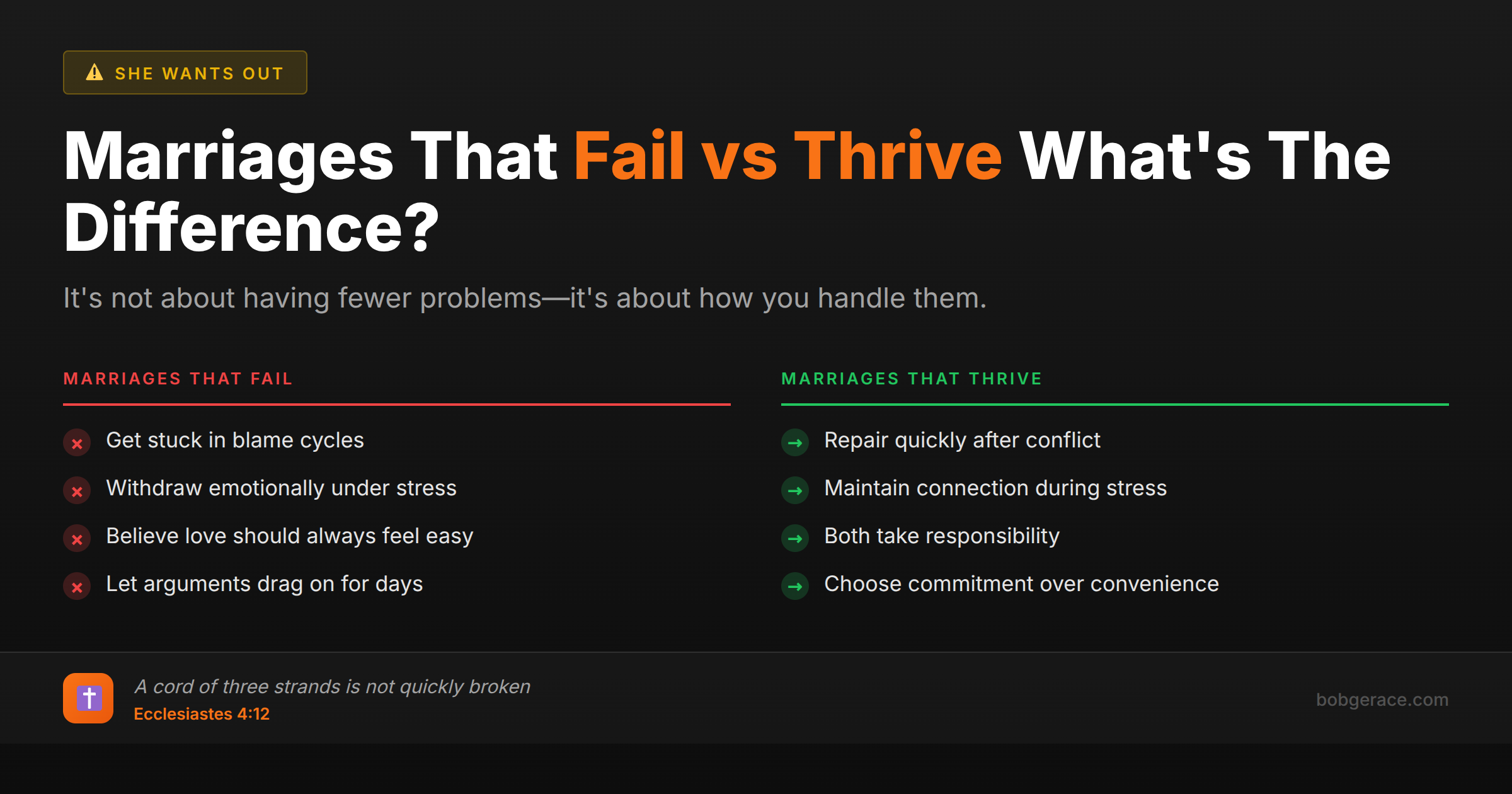
After studying thousands of couples, researchers have identified clear patterns that separate marriages that thrive from those that fail. It's not about having fewer problems—successful couples face the same challenges as everyone else. The difference lies in how they handle conflict, maintain connection, and choose commitment over convenience. The marriages that make it share three crucial characteristics: they repair quickly after arguments, they maintain emotional intimacy even during stress, and both partners take responsibility for their part in problems. Failed marriages, meanwhile, get stuck in blame cycles, emotional withdrawal, and the dangerous belief that love should always feel easy. The good news? These are learnable skills, not personality traits you're born with.
The Full Picture
Dr. John Gottman's landmark research following couples for decades reveals that successful marriages aren't defined by the absence of conflict, but by how couples navigate it. The marriages that last demonstrate what he calls "emotional intelligence" in their relationship.
The Four Horsemen of Marriage Failure: • Criticism - Attacking your partner's character instead of addressing specific behaviors • Contempt - Rolling eyes, sarcasm, name-calling, or treating your spouse as inferior • Defensiveness - Playing victim and refusing to take responsibility • Stonewalling - Shutting down emotionally and refusing to engage
What Successful Couples Do Instead: They master the art of repair attempts—small gestures that de-escalate tension during conflict. A touch, a joke, or even saying "I'm getting too heated, can we pause?" These couples also maintain a 5:1 ratio of positive to negative interactions. For every criticism or complaint, there are five instances of affection, humor, or appreciation.
Successful couples also understand that influence flows both ways. The husband doesn't make unilateral decisions, and the wife doesn't manage all emotional labor alone. They create what researchers call "we-ness"—a shared identity that's stronger than individual preferences.
Most importantly, thriving marriages embrace growth over comfort. Instead of avoiding difficult conversations, these couples lean into them. They see conflict as information about what needs attention, not evidence that their marriage is failing.
What's Really Happening
From a clinical perspective, the marriages that survive demonstrate what we call secure attachment patterns even when individual partners may have insecure attachment histories. They create what I term a "corrective emotional experience" within their relationship.
Neurologically, successful couples literally rewire their brains for connection. When we feel safe with our partner, our nervous system remains regulated even during stress. Failed marriages, however, trigger chronic activation of the threat-detection system. Partners begin to see each other as dangers to avoid rather than safe harbors to approach.
The research on emotional regulation is particularly revealing. Couples who thrive have learned to self-soothe when triggered, rather than immediately reacting. They understand that their partner's behavior often reflects their own pain, not intentional harm. This creates space for empathy instead of retaliation.
Attachment repair is crucial. Successful couples don't avoid ruptures—they actively repair them. They understand that disconnection is inevitable, but reconnection is a choice. They develop rituals of repair: checking in after arguments, taking responsibility for their part, and actively choosing vulnerability over self-protection.
The couples who struggle often display trauma responses disguised as relationship problems. Emotional flooding, hypervigilance, and defensive strategies that once protected them now sabotage intimacy. The key difference? Successful couples recognize these patterns and work together to create new ones, while struggling couples remain trapped in reactive cycles.
What Scripture Says
Scripture provides a clear blueprint for marriages that endure, emphasizing covenant commitment over contemporary feelings. Ecclesiastes 4:12 reminds us that "a cord of three strands is not quickly broken"—successful marriages include God as the binding element that strengthens human love.
Ephesians 4:26-27 instructs us to "be angry and do not sin; do not let the sun go down on your anger, and give no opportunity to the devil." This isn't about avoiding conflict, but about resolving it quickly and righteously. Marriages that make it follow this biblical pattern of addressing issues promptly rather than letting resentment fester.
1 Corinthians 13:4-7 defines love not as a feeling but as a series of choices: "Love is patient and kind; love does not envy or boast; it is not arrogant or rude. It does not insist on its own way; it is not irritable or resentful; it does not rejoice at wrongdoing, but rejoices with the truth. Love bears all things, believes all things, hopes all things, endures all things." Successful couples practice this love as action, not emotion.
Galatians 6:2 calls us to "bear one another's burdens," which thriving marriages do naturally. They see their spouse's struggles as shared challenges rather than individual problems.
Finally, Matthew 18:15 provides the model for conflict resolution: addressing issues directly with the person involved. Successful Christian marriages follow this principle, speaking truth in love rather than complaining to others or avoiding difficult conversations. They understand that covenant commitment provides the security needed for honest communication.
What To Do Right Now
-
1
Track your interaction ratio for one week—count positive vs. negative exchanges with your spouse and aim for 5:1
-
2
Practice repair attempts during your next disagreement by saying 'I care about you and want to understand' when tension rises
-
3
Schedule a weekly 15-minute check-in to address small issues before they become major problems
-
4
Identify your personal triggers and develop a self-soothing strategy you can use before reacting defensively
-
5
Replace criticism with specific requests—instead of 'you never help' say 'I need help with dishes after dinner'
-
6
Commit to resolving conflicts within 24 hours, following the biblical principle of not letting the sun go down on your anger
Related Questions
- What percentage of marriages recover from this point?
- What factors predict successful reconciliation?
- What is the average timeline for marriages that do recover?
- Is there research on how long to stand?
- What's the success rate of marriage intensives?
- What indicators should I watch for?
- Can a marriage survive infidelity?
- What's the success rate of marriages that survive affairs?
- What does real transformation look like?
- What makes change sustainable vs. temporary?
Also find Bob on
Subscribe for weekly videos on Christian marriage.
Apply This to Your Actual Marriage
Knowing the patterns is one thing. Building them into your specific relationship—with your history, your conflicts, your wife—is different work. Bob coaches men through exactly that.
Talk to Bob →