What percentage of marriages recover from this point?
6 min read
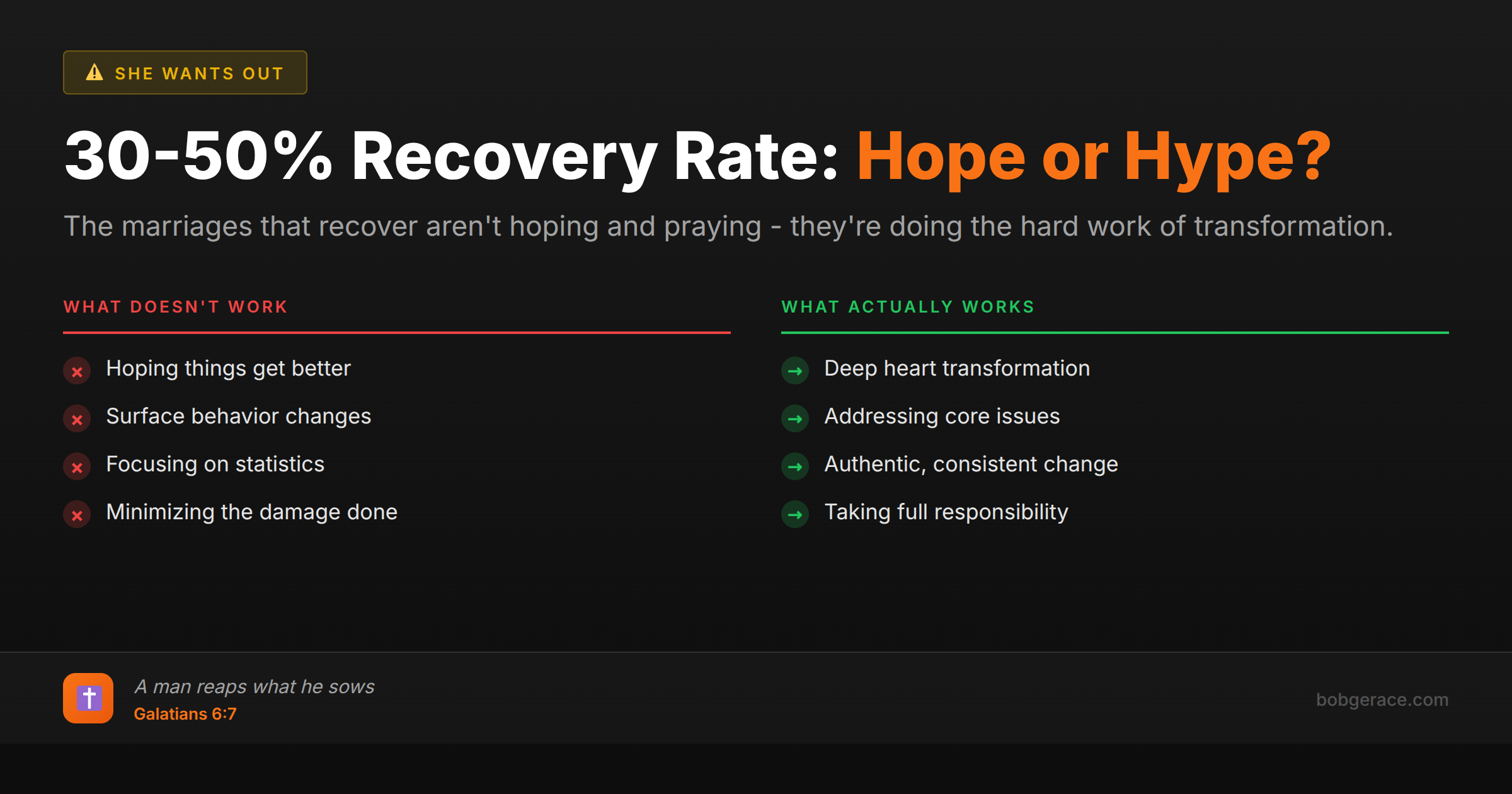
Here's the hard truth: research shows that 30-50% of marriages can recover even when one spouse has seriously checked out or filed for divorce. But that statistic comes with massive caveats. The marriages that make it aren't the ones where the husband just hopes and prays things get better. They're the ones where he fundamentally changes how he shows up - not just behavior modification, but deep heart transformation. The research is clear: surface-level changes don't move the needle. Your wife has been watching you for years. She needs to see authentic change that addresses the core issues that drove her away.
The Full Picture
The recovery statistics vary significantly based on which studies you examine and how they define "recovery." The Gottman Institute found that marriages showing the "Four Horsemen" (contempt, criticism, defensiveness, stonewalling) have about a 20% natural recovery rate without intervention. However, when couples engage in intensive work, that number jumps to 40-50%.
What separates the marriages that make it: • The husband takes full ownership of his contribution to the breakdown • Both spouses commit to at least 6-12 months of consistent work • There's no active affair or addiction derailing progress • The emotional damage hasn't crossed the "point of no return" threshold
The brutal reality most men miss: Your wife didn't arrive at "wanting out" overnight. Research from Dr. John Gottman shows the average wife thinks about leaving for two years before saying anything. By the time she verbalizes it, she's often emotionally divorced already.
The biggest mistake I see is men focusing on convincing their wife to stay instead of becoming the man worth staying for. Statistics show that marriages recover when the husband addresses his own issues first - not when he manages his wife's feelings or timeline.
Timeline matters enormously. Marriages have the highest recovery rate when intensive work begins within 90 days of the crisis point. After six months of separation, the success rate drops to below 25%. Your window isn't infinite.
What's Really Happening
From a clinical perspective, what we're really asking is whether a marriage can recover from what researchers call "emotional disengagement" or "marital dissolution cascade." The data suggests recovery is absolutely possible, but it requires understanding the psychological stages involved.
When a wife says she "wants out," she's typically moved through what Dr. Diane Vaughan calls "uncoupling" - a process where she's gradually redefined herself as separate from the marriage. This doesn't happen overnight. Research shows the average spouse considers leaving for 18-24 months before taking action.
The neurological reality is significant. Chronic marital stress actually changes brain chemistry. The wife's brain has likely developed protective patterns - decreased oxytocin, increased cortisol, and heightened threat detection around her husband. These aren't conscious choices; they're neurobiological adaptations to perceived emotional danger.
Recovery requires what we call "earned security" - consistent, authentic changes that allow her nervous system to recalibrate. This typically takes 6-18 months of sustained behavioral change before the brain begins forming new neural pathways associated with safety and connection.
The marriages that recover successfully show specific patterns: the husband demonstrates genuine insight into impact (not just intent), implements changes without expecting immediate credit, and maintains consistency even when progress feels invisible. Clinical observation suggests that when these elements align, recovery rates approach 60-70% within two years.
What Scripture Says
Scripture gives us both sobering reality and incredible hope about restoration. God's heart is always toward reconciliation, but His Word also acknowledges the serious damage sin causes in relationships.
Galatians 6:7-8 reminds us: "Do not be deceived: God cannot be mocked. A man reaps what he sows. Whoever sows to please their flesh, from the flesh will reap destruction; whoever sows to please the Spirit, from the Spirit will reap eternal life." The consequences of our choices are real - but so is the possibility of sowing differently.
Joel 2:25 offers profound hope: "I will restore to you the years that the swarming locust has eaten." God specializes in restoration that seems impossible. But notice - restoration comes after repentance and turning.
Ezekiel 36:26 speaks to the heart change required: "I will give you a new heart and put a new spirit in you; I will remove from you your heart of stone and give you a heart of flesh." Surface changes won't save your marriage. You need God to transform you at the heart level.
1 Peter 3:7 gives specific direction: "Husbands, in the same way be considerate as you live with your wives, and treat them with respect as the weaker partner and as heirs with you of the gracious gift of life, so that nothing will hinder your prayers." God takes how we treat our wives seriously.
The biblical pattern is clear: genuine repentance + heart transformation + consistent action = the possibility of restoration. God's desire is always reconciliation, but it requires us to align with His ways.
What To Do Right Now
-
1
Stop asking her for recovery statistics and start focusing on your own transformation
-
2
Document specifically what led to this crisis without blaming or minimizing
-
3
Engage a qualified marriage coach or counselor within the next two weeks
-
4
Read 'His Needs, Her Needs' and 'Love and Respect' to understand relationship dynamics
-
5
Begin daily prayer and scripture reading focused on your character, not your circumstances
-
6
Give her space to process while demonstrating consistent, authentic change in your behavior
Related Questions
- How long do I wait before giving up?
- When is it actually over?
- What factors predict successful reconciliation?
- What is the average timeline for marriages that do recover?
- What distinguishes marriages that make it from those that don't?
- What's the success rate of marriage intensives?
- Can a marriage survive infidelity?
- How long does recovery take?
- What's the success rate of marriages that survive affairs?
- What does real transformation look like?
Also find Bob on
Subscribe for weekly videos on Christian marriage.
Your Marriage Isn't a Statistic
The question isn't whether marriages can recover. It's whether yours will. A coach who knows your specific story helps you see what needs to change—and whether you're actually changing it.
Talk to Bob →