What factors predict successful reconciliation?
5 min read
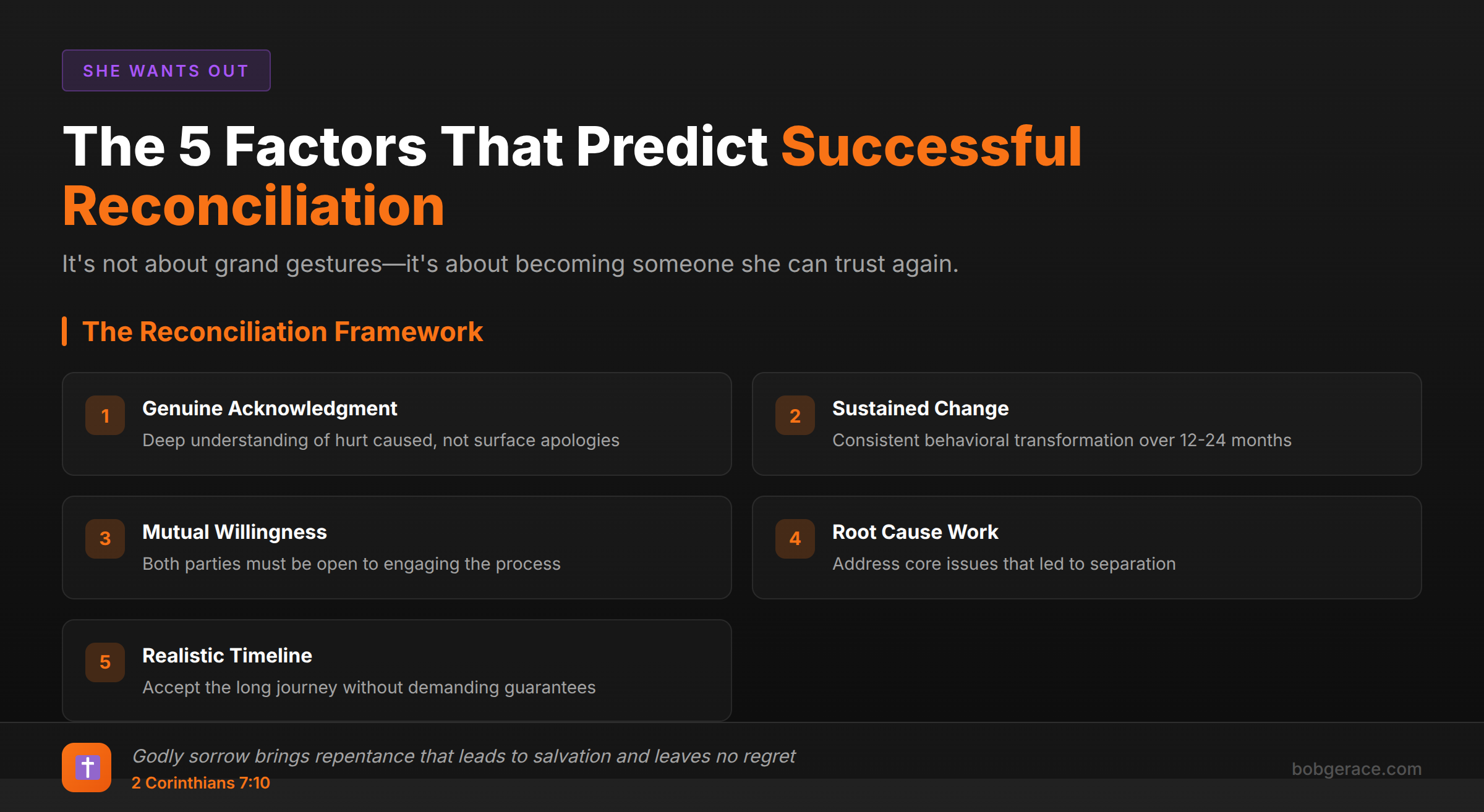
Research shows that successful reconciliation depends on five critical factors: genuine acknowledgment of problems (not just surface-level apologies), sustained behavioral change over time, both parties' willingness to engage in the process, addressing the root causes that led to separation, and having realistic timelines—typically 12-24 months minimum. Here's what matters most: Your wife needs to see consistent change, not just hear promises. The couples who make it back together are those where the pursuing partner does deep personal work while respecting boundaries, and the distancing partner remains open to evaluating progress over time. It's not about grand gestures—it's about becoming a fundamentally different person she can trust again.
The Full Picture
The Hard Truth About Reconciliation Statistics
Most couples who separate don't reconcile—research shows only 10-15% successfully reunite long-term. But those numbers don't tell the whole story. The couples who beat the odds share specific characteristics that you can develop.
The Five Research-Backed Predictors
• Genuine Problem Recognition: Successful reconcilers don't minimize or deflect. They own their contribution fully and specifically. Saying "I'm sorry for hurting you" doesn't work. Saying "I'm sorry I dismissed your feelings about finances and made unilateral decisions that left you feeling unheard" does.
• Sustained Change Over Time: The magic number is typically 6-12 months of consistent new behavior before the distancing spouse begins to believe change is real. Most men give up after 2-3 months when they don't see immediate results.
• Both Parties Remain Engaged: Even if she's not actively working on the relationship, she needs to be observing your changes without constant pressure from you. The moment she completely shuts down all observation, reconciliation becomes nearly impossible.
• Root Cause Resolution: Surface changes don't create lasting reconciliation. If the core issue was emotional unavailability, you can't just start bringing flowers. You need to develop genuine emotional intelligence and intimacy skills.
• Realistic Timeline Expectations: Research shows successful reconciliation typically takes 12-24 months minimum. Couples who rush the process or set unrealistic deadlines almost always fail.
The men who succeed understand that reconciliation isn't about winning her back—it's about becoming the man she fell in love with, plus the growth she needed you to have all along.
What's Really Happening
From a clinical perspective, successful reconciliation requires what we call "earned secure attachment." When a marriage reaches separation, there's been a fundamental breakdown in attachment security—one or both partners no longer feel safe in the relationship.
The research by Dr. John Gottman reveals that couples who successfully reconcile demonstrate specific repair mechanisms. They show genuine remorse (not just regret at consequences), take full responsibility without defensiveness, and most importantly, maintain these changes even when their spouse isn't reciprocating immediately.
Neurologically, trust rebuilding requires consistent positive experiences over time to override the brain's threat detection system. Your wife's brain has likely categorized the relationship as "unsafe." Overriding this requires approximately 5-7 positive interactions for every negative memory—and this process can't be rushed.
The concept of "emotional labor" is crucial here. Many men focus on behavioral changes while missing the emotional attunement component. Successful reconciliation requires developing genuine empathy and emotional intelligence, not just modifying actions.
Clinically, we see that men who succeed in reconciliation typically engage in individual therapy to address their own patterns, rather than focusing primarily on couple's work initially. They understand that personal transformation must precede relational healing.
The timing factor is also neurologically based—it takes the brain approximately 12-18 months to form new neural pathways and truly believe in sustained change. This is why rushing the process or expecting quick forgiveness typically backfires.
What Scripture Says
Scripture provides clear guidance on the elements that predict successful restoration in relationships.
Genuine Repentance: "Godly sorrow brings repentance that leads to salvation and leaves no regret, but worldly sorrow brings death" (2 Corinthians 7:10). True reconciliation requires godly sorrow—grief over the hurt caused, not just regret over consequences. This means understanding how your actions affected her heart, not just lamenting that your marriage is in trouble.
Consistent Character Change: "Therefore, if anyone is in Christ, the new creation has come: The old has gone, the new is here!" (2 Corinthians 5:17). God calls for transformation, not just behavior modification. The predictive factor isn't whether you can act differently temporarily, but whether you've become different at your core.
Patient Endurance: "Love is patient, love is kind" (1 Corinthians 13:4). The research shows 12-24 months for reconciliation because love requires patience. Scripture consistently calls men to lead with patient, persistent love even when it's not immediately reciprocated.
Humble Service: "Husbands, love your wives as Christ loved the church and gave himself up for her" (Ephesians 5:25). Christ's love wasn't dependent on the church's response. Successful reconciliation requires loving service without guarantee of return.
Fruit-Bearing Time: "By their fruit you will recognize them" (Matthew 7:16). Scripture teaches that true change produces lasting fruit over time. Your wife needs to see sustained fruit, not just blossoms of temporary effort.
Restoration Process: "Brothers and sisters, if someone is caught in a sin, you who live by the Spirit should restore that person gently" (Galatians 6:1). Even restoration requires gentleness and time—forced reconciliation isn't biblical reconciliation.
What To Do Right Now
-
1
Assess honestly whether you've addressed root causes or just surface behaviors—write down the core issues that led to separation
-
2
Commit to a 12-month minimum timeline for demonstrating change without expecting reciprocation or reconciliation guarantees
-
3
Begin individual counseling or coaching to work on your personal growth and patterns, not just marriage techniques
-
4
Document your changes in a journal to track consistency over time rather than relying on feelings or intentions
-
5
Respect her boundaries completely while remaining available for observation of your growth—no pressure or manipulation
-
6
Develop genuine empathy by regularly asking yourself how your historical actions affected her emotionally, not just practically
Related Questions
- What percentage of marriages recover from this point?
- What distinguishes marriages that make it from those that don't?
- What is the average timeline for marriages that do recover?
- How long does it take to save a marriage?
- When is it actually over?
- Is there a point of no return?
- What's the success rate of marriages that survive affairs?
- What predicts whether she'll leave the affair?
- What are markers of genuine remorse vs. guilt?
- What does real transformation look like?
Also find Bob on
Subscribe for weekly videos on Christian marriage.
Your Marriage Isn't a Statistic
Knowing what predicts reconciliation doesn't tell you what to do Tuesday morning when she's still cold. A coach who knows your specific situation can.
Talk to Bob →