We've tried before and failed — is this time different?
6 min read
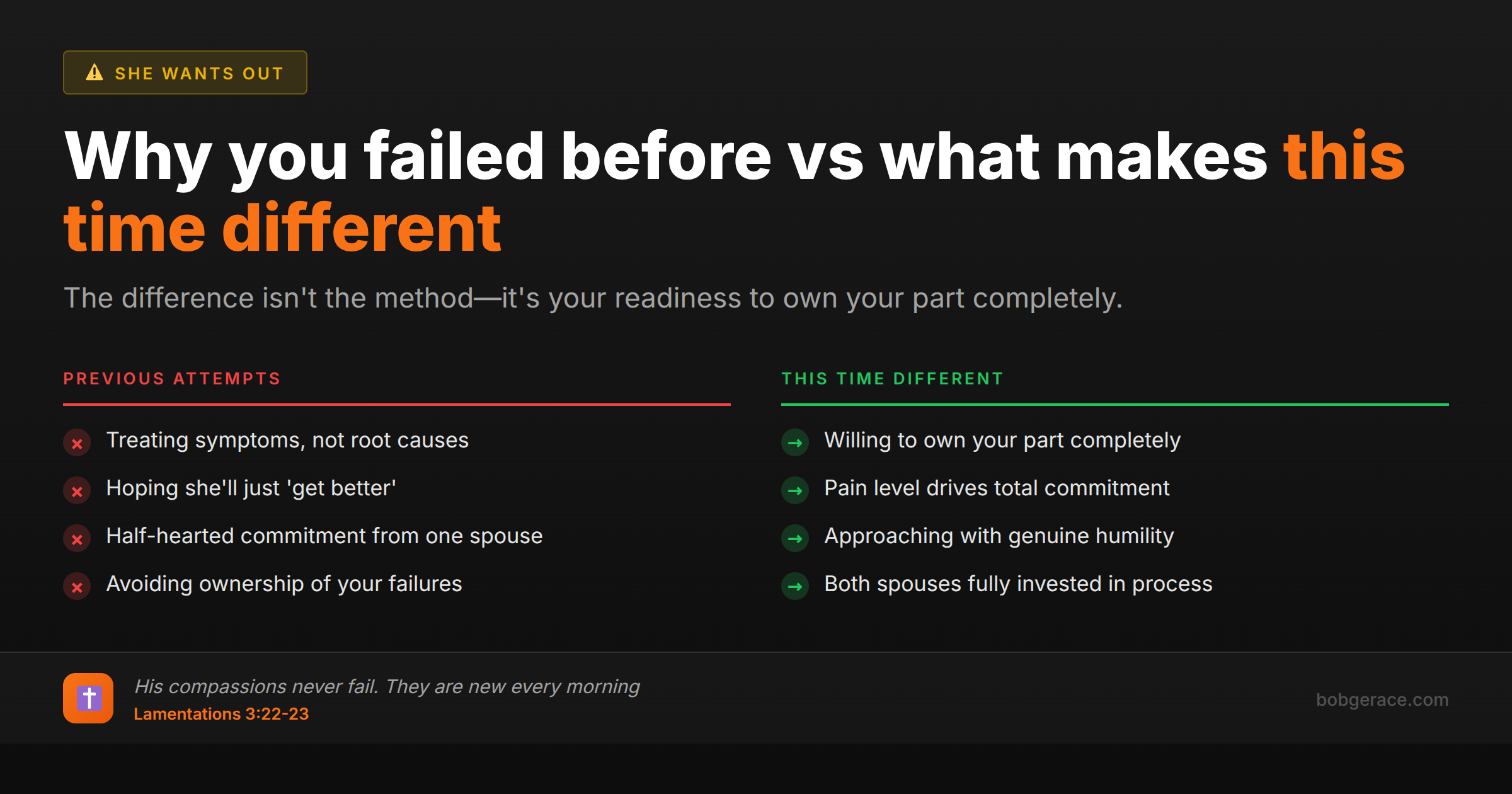
Yes, this time can be different—but only if you understand why previous attempts failed and what's changed now. Most couples fail in their first attempts because they're treating symptoms instead of root causes, or they're not both fully committed to the process. The difference isn't in the method or the counselor—it's in your readiness. Are you finally willing to own your part completely? Has the pain reached a level where you'll do whatever it takes? Are you approaching this with humility instead of hoping she'll just "get better"? If you can answer yes to these questions, then yes, this time is fundamentally different from your previous attempts.
The Full Picture
Previous failures don't doom future attempts—they actually increase your chances of success if you learn from them. Most first attempts fail because couples aren't ready yet. They're still operating from a place of blame, hoping the other person will change, or trying to avoid the deep work required.
Here's what typically happens: You go to counseling, learn some communication techniques, maybe have a few better weeks, then fall back into old patterns. Why? Because you were treating the surface issues, not the underlying dynamics. It's like putting a band-aid on a broken bone.
What makes this time different: • Desperation breeds readiness - You've hit rock bottom and are finally willing to look at yourself honestly • You've learned what doesn't work - Previous failures eliminate ineffective approaches • The stakes are clearer - You understand the real cost of not changing • You're done with half-measures - You're ready for total transformation, not just improvement
The most successful second attempts happen when men stop asking "How do I fix her?" and start asking "How do I become the husband she needs?" This shift in focus changes everything. You're no longer trying to manage her responses—you're taking full ownership of your transformation.
Previous counselors might have been wrong for you, or you might not have been ready for the right counselor. Timing matters more than technique. The same advice that bounced off you two years ago might be exactly what transforms you today.
What's Really Happening
From a therapeutic standpoint, previous "failures" are often necessary steps in the change process. Research shows that successful behavior change rarely happens on the first attempt. The Transtheoretical Model identifies that people must move through stages: precontemplation, contemplation, preparation, action, and maintenance.
Most first attempts occur during the contemplation stage—you're aware there's a problem but not fully committed to the painful work of change. You're still hoping for easier solutions. Previous failures often move you into the preparation stage, where you're finally ready to do whatever it takes.
Neurologically, repeated exposure to therapeutic concepts creates familiarity. Ideas that seemed foreign or threatening initially become more acceptable. Your brain has had time to process and integrate previous insights, even if you didn't act on them immediately.
The key difference in successful second attempts is what we call "authentic motivation" versus "compliance motivation." Initially, you might attend counseling to appease your wife or avoid divorce. Success comes when your motivation shifts to genuine desire for personal growth and relationship health.
Research on couples therapy shows that 70% of couples see improvement, but only 60% maintain it long-term. The couples who maintain progress share common factors: both partners take responsibility, they address underlying attachment injuries, and they commit to ongoing growth rather than expecting a "quick fix."
Previous failures also provide valuable diagnostic information. What triggered your reversion to old patterns? What support systems were missing? What beliefs or fears sabotaged your progress? This self-knowledge is crucial for success.
What Scripture Says
Scripture is full of second chances and God's faithfulness despite our repeated failures. Lamentations 3:22-23 reminds us: "Because of the Lord's great love we are not consumed, for his compassions never fail. They are new every morning; great is your faithfulness."
God doesn't give up on us after our first, second, or even seventieth failure. Matthew 18:21-22 shows this when Peter asks if forgiving seven times is enough, and Jesus responds: "Not seven times, but seventy-seven times." This applies to your marriage and to your own journey of growth.
Philippians 1:6 offers hope: "Being confident of this, that he who began a good work in you will carry it on to completion until the day of Christ Jesus." God's work in your life doesn't end because of previous setbacks. He's still committed to your transformation.
The key biblical principle is genuine repentance versus mere regret. 2 Corinthians 7:10 distinguishes between "godly sorrow" that leads to repentance and "worldly sorrow" that leads to death. Previous attempts might have been motivated by worldly sorrow—regret over consequences. True change comes from godly sorrow—genuine grief over how your actions have hurt your wife and dishonored God.
Romans 8:28 promises that "all things work together for good for those who love God." Your previous failures aren't wasted if they bring you to true humility and dependence on God. Sometimes God allows us to fail in our own strength so we'll finally rely on His.
What To Do Right Now
-
1
Write down specifically why your previous attempts failed—be brutally honest about your role
-
2
Identify what's different in your heart and mindset now compared to before
-
3
Commit to complete ownership of your transformation, regardless of her response
-
4
Find a coach or counselor who specializes in your specific situation, not general marriage counseling
-
5
Establish accountability systems that weren't present in previous attempts
-
6
Pray daily for genuine heart change, not just behavior modification or better outcomes
Related Questions
- How long do I wait before giving up?
- When is it actually over?
- Is there a point of no return?
- What factors predict successful reconciliation?
- What distinguishes marriages that make it from those that don't?
- What if I change and she still leaves?
- Can a marriage survive infidelity?
- What does real transformation look like?
- How long does recovery take?
- What makes change sustainable vs. temporary?
Also find Bob on
Subscribe for weekly videos on Christian marriage.
You Don't Have to Keep Guessing
A coach who knows your specific marriage can see what you can't—and calibrate the work to where you actually are, not where you think you should be.
Talk to Bob →