How long do I wait before giving up?
6 min read
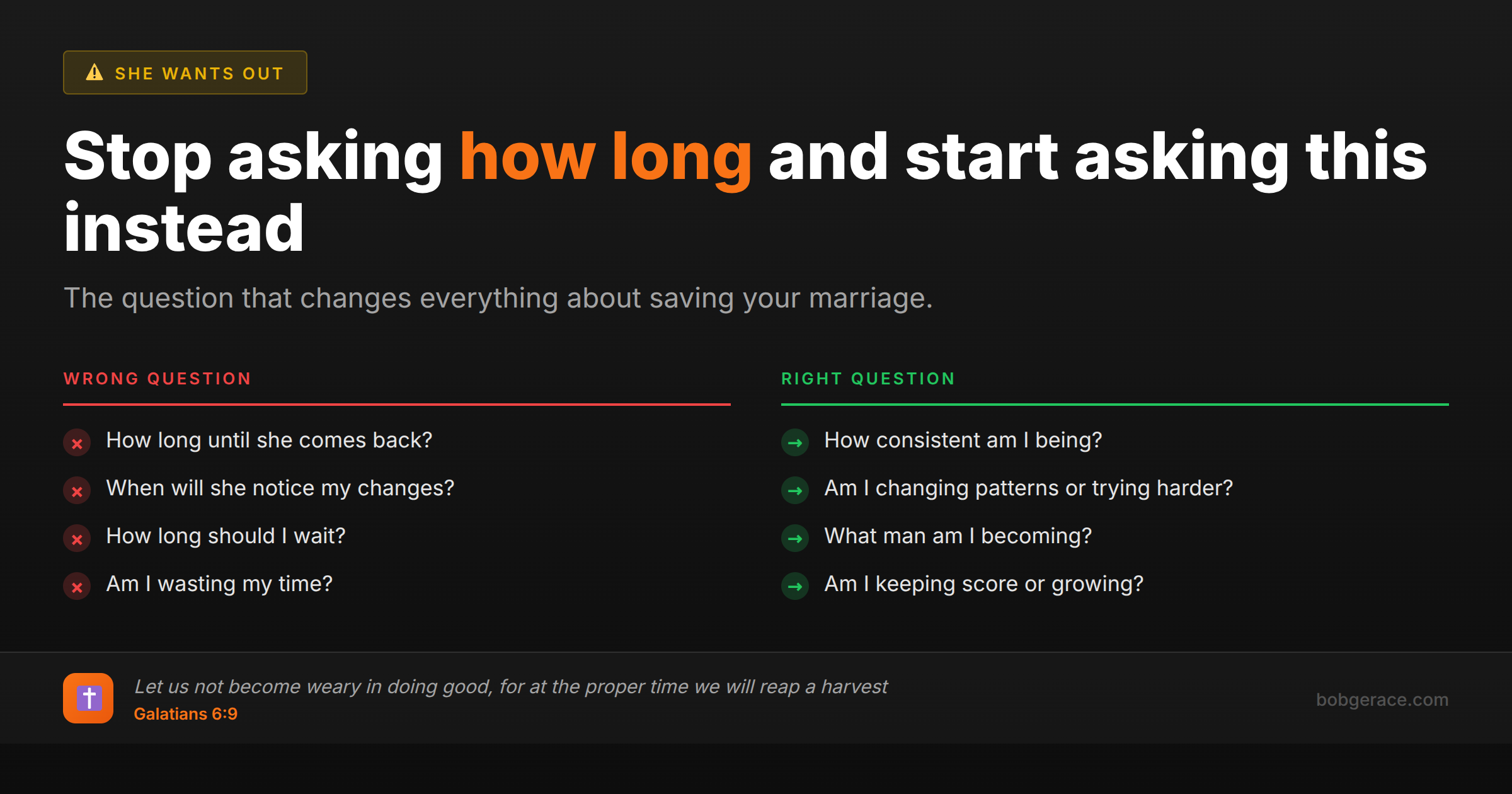
There's no magic timeline, but here's what I tell every man I work with: You don't wait to give up - you wait to see if your consistent, intentional changes create space for something new to grow. Most men think in terms of 'how long until she comes back,' but that's the wrong question. The right question is: 'How long am I willing to become the man my marriage needs, regardless of her response?' If you've been consistently doing the work - not just trying harder at the same failed approaches, but actually changing your patterns, responses, and character - then six months to a year of sustained change is a reasonable timeframe to evaluate progress. But here's the hard truth: if you're still keeping score and waiting for her to notice, you're not really doing the work yet.
The Full Picture
The question of timing reveals something crucial about where you are mentally. When you're asking 'how long to wait,' you're still thinking like a passenger in your own life. You're waiting for her to change, waiting for things to get better, waiting for some external shift that will solve your problems.
But here's what actually happens in marriages that turn around: The man stops waiting and starts leading. Not controlling, not manipulating - leading through consistent character change and emotional maturity.
Most men cycle through three phases:
• The Panic Phase (0-3 months): Trying everything frantically - flowers, promises, grand gestures. This usually makes things worse because it's still focused on getting her to respond rather than addressing root issues.
• The Resentment Phase (3-6 months): 'I've tried everything and nothing works.' But 'everything' usually means the same strategies with more intensity.
• The Ownership Phase (6+ months): Finally focusing on becoming the man the marriage needs, regardless of immediate results.
The brutal truth: If your wife wants out, she's been unhappy for years, not months. Your timeline for change needs to match her timeline of disappointment. Most women don't just wake up one day and decide they're done - they've been slowly detaching while you were unaware.
Real change takes 6-12 months of consistent, intentional work. Not trying harder, but becoming different. And even then, she may need additional time to trust that the change is real and lasting.
What's Really Happening
From a therapeutic standpoint, the question 'how long to wait' often indicates what we call external locus of control - placing the power for change outside yourself. Research shows that sustainable relationship improvement requires what Gottman calls 'turning toward' behaviors consistently over time, typically 6-18 months for significant trust repair.
Attachment theory helps us understand the timeline. If your wife has moved into what we call 'protest behavior' (fighting, criticizing, demanding) or worse, 'despair/detachment' (withdrawal, emotional numbness), her nervous system is in protective mode. Neurologically, it takes consistent positive experiences over months, not weeks, for her brain to shift from threat-detection back to connection-seeking.
The trauma perspective is crucial here. Many wives experience what I call 'relationship trauma' - repeated disappointments, unmet needs, feeling unseen or unheard. This creates hypervigilance around their partner's behavior. Even genuine change can initially be met with skepticism because her brain is wired to expect disappointment.
Therapeutic research suggests that meaningful behavioral change requires approximately 200 repetitions of new neural pathways before they become automatic. In relationship terms, this means consistent new responses to old triggers for 6-12 months minimum.
The clinical reality: If you're counting days, you're not ready for the work. True change happens when you stop monitoring her response and start monitoring your own growth and consistency.
What Scripture Says
Scripture gives us a framework that's both hopeful and realistic about timing and perseverance in covenant relationships.
Galatians 6:9 reminds us: *'Let us not become weary in doing good, for at the proper time we will reap a harvest if we do not give up.'* Notice it says 'proper time' - God's timing, not ours. This isn't about waiting passively, but about consistent faithfulness while trusting God's timeline.
Ephesians 4:22-24 speaks to the change process: *'You were taught, with regard to your former way of life, to put off your old self... and to put on the new self, created to be like God in true righteousness and holiness.'* Biblical change is about becoming new, not just trying harder at being old.
1 Corinthians 13:4-7 defines love as patient, kind, not self-seeking, keeping no record of wrongs, always protecting, always trusting, always hoping, always persevering. This love doesn't operate on our timeline - it perseveres because it's the right thing to do, not because it guarantees specific outcomes.
Hosea's story with Gomer shows us God's heart for pursuing relationship even when the other person has checked out. But notice - Hosea didn't just wait around hoping. He took specific actions, set boundaries, and allowed consequences while maintaining covenant love.
James 1:4 teaches us to *'let perseverance finish its work so that you may be mature and complete, not lacking anything.'* The waiting isn't passive - it's active perseverance that produces character maturity.
Biblically, the question isn't 'how long to wait' but 'how faithful will you be to becoming the man God designed you to be, regardless of her response?'
What To Do Right Now
-
1
Stop asking 'how long' and start asking 'how consistent' - commit to 90 days of daily character work without monitoring her response
-
2
Identify the top 3 patterns that damaged your marriage and create specific alternatives you'll practice daily
-
3
Establish non-negotiable daily practices: prayer, exercise, emotional regulation work, and one specific marriage-building action
-
4
Set a realistic evaluation date 6-9 months out where you'll assess progress based on your growth, not her response
-
5
Find an accountability partner or coach who will call you out when you slip back into waiting mode instead of leading mode
-
6
Document your changes weekly in writing - what you did differently, how you handled triggers, where you grew
Related Questions
- How long does it take to save a marriage?
- When is it actually over?
- Is there a point of no return?
- How long should I 'stand' for my marriage?
- At what point am I just torturing myself?
- How do I know if I'm in denial or in faith?
- Can a marriage survive infidelity?
- How long does recovery take?
- What does real transformation look like?
Also find Bob on
Subscribe for weekly videos on Christian marriage.
You Don't Have to Figure This Out Alone
A coach who knows your specific marriage can tell you what's actually happening in your situation—and what to do next. You're not guessing anymore.
Talk to Bob →