When is it actually over?
6 min read
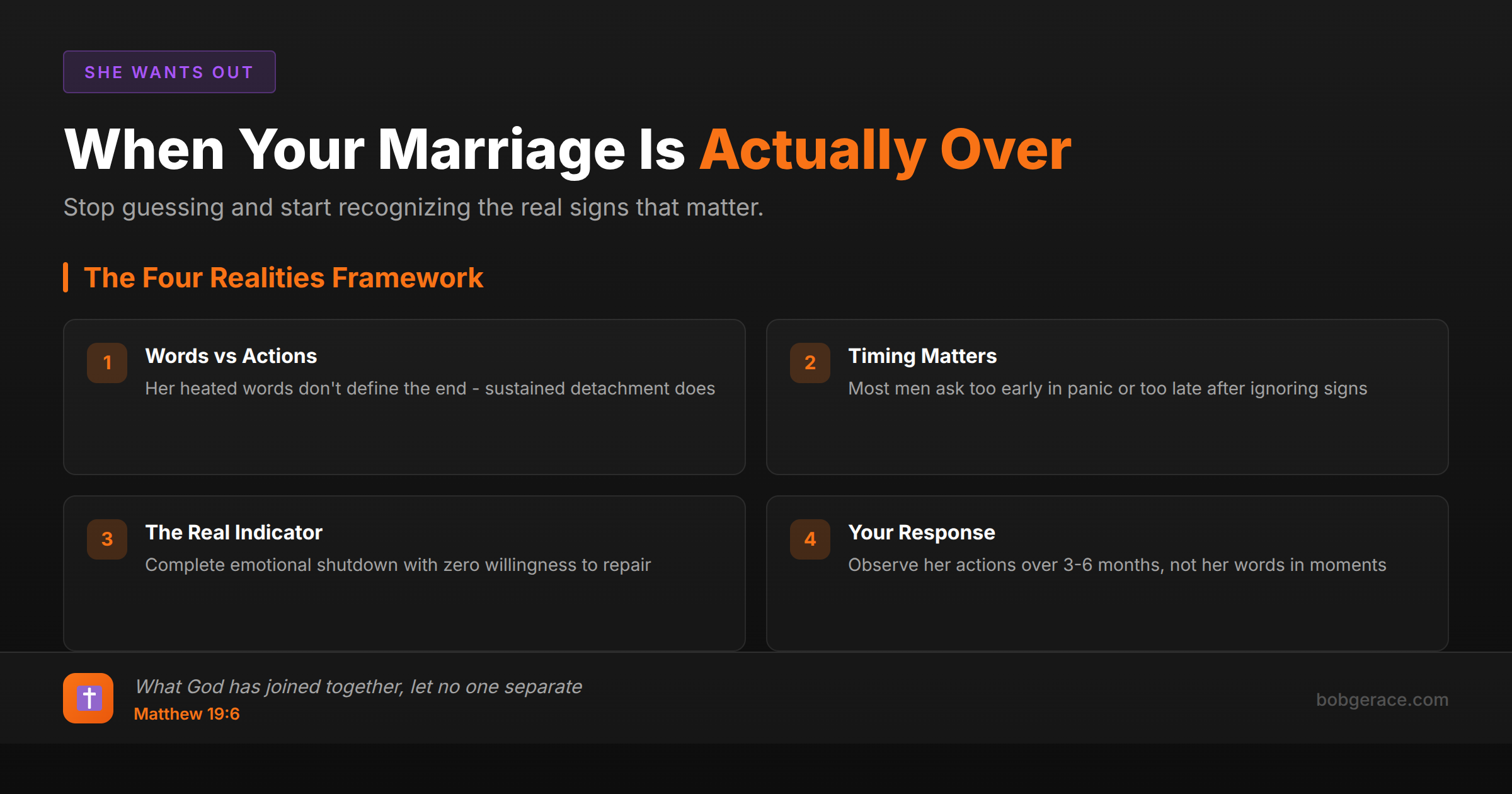
It's actually over when one of you has completely shut down emotionally and refuses to engage in any meaningful way toward repair. Not when she says she's done - words spoken in anger or exhaustion don't always reflect final decisions. It's over when there's consistent, sustained rejection of all attempts at connection, communication, or counseling over an extended period. The brutal truth? Most men ask this question too early, when they're panicking, or too late, when they've been ignoring obvious signs for months. The real indicator isn't her words in heated moments - it's her sustained actions over time. If she's completely emotionally detached, refuses professional help, and shows no willingness to work on anything, you're likely looking at the end.
The Full Picture
There's a massive difference between "I'm done" said in frustration and actual emotional finality. Most wives will express feeling "done" multiple times before they actually are. The key is understanding what you're really looking at.
Signs it might actually be over: • Complete emotional shutdown - no anger, no tears, no engagement • Refusal to attend counseling or work on issues despite repeated requests • She's already mentally moved on - making plans that don't include you • Zero physical or emotional intimacy for extended periods with no willingness to address it • She's actively pursuing separation or has consulted attorneys
Signs there's still hope: • She's still fighting with you (anger means she still cares) • She expresses frustration about specific issues • She's willing to set boundaries or make demands • She mentions what needs to change • She shows occasional moments of softness or connection
Here's what most men miss: the marriage often dies long before anyone says it's over. You might be asking this question after months or years of neglecting clear warning signs. She may have been trying to tell you it was dying, but you weren't listening.
The hardest part? Sometimes it's over in her heart while she's still physically present. She might be staying for kids, finances, or fear, but emotionally she's already gone. That's when you see the roommate dynamic - polite, functional, but completely disconnected.
Don't confuse her exhaustion with finality. Exhausted wives can recover with the right changes. But completely detached wives rarely come back.
What's Really Happening
From a therapeutic perspective, marital death rarely happens suddenly. Research shows that marriages typically deteriorate through predictable stages: initial complaints, increasing criticism, contempt, defensiveness, stonewalling, and finally emotional detachment. By the time someone asks "Is it over?", they're usually in the final stages.
The key clinical indicator is what we call "emotional divorce" - when one partner has psychologically disengaged from the relationship. This manifests as emotional flatness, lack of investment in conflicts (they stop fighting because they stop caring), and mental energy being directed elsewhere.
John Gottman's research identifies the "Four Horsemen" - criticism, contempt, defensiveness, and stonewalling - as predictors of divorce. But the most dangerous is when these patterns lead to what he calls "flooding" - when stress hormones make productive communication impossible.
However, even in late stages, intervention can work if both parties are willing. The critical factor is what therapists call "collaborative alliance" - both partners agreeing to work toward change. Without this mutual commitment, therapeutic intervention rarely succeeds.
Neurologically, when someone reaches complete emotional detachment, their brain literally stops processing their partner as significant. The attachment bonds that created love and connection have been severed through repeated negative interactions. Rebuilding requires significant time and consistent positive experiences.
The most important clinical insight: timing matters enormously. Early intervention has a much higher success rate than crisis intervention when emotional divorce has already occurred.
What Scripture Says
Scripture gives us clear guidance on marriage permanence and the conditions that might end it. Matthew 19:6 reminds us: *"So they are no longer two, but one flesh. Therefore what God has joined together, let no one separate."* This establishes God's heart for marriage permanence.
However, Jesus acknowledges that hardness of heart can destroy what God intended. Matthew 19:8 says: *"Moses permitted you to divorce your wives because your hearts were hard. But it was not this way from the beginning."* Sometimes human hardness makes God's design impossible.
1 Corinthians 7:15 addresses when an unbelieving spouse wants to leave: *"But if the unbeliever leaves, let it be so. The brother or the sister is not bound in such circumstances; God has called us to live in peace."* This suggests that when someone is determined to end the marriage, forcing it to continue may not honor God.
Malachi 2:16 tells us that God *"hates divorce,"* but the context shows God's hatred is toward treachery and unfaithfulness that destroys covenant love. God hates divorce because He hates what causes it - the betrayal of sacred promises.
1 Corinthians 7:11 gives instruction for separated couples: *"But if she does leave, she must remain unmarried or else be reconciled to her husband."* This suggests that even separation doesn't immediately end the covenant obligation.
The biblical framework calls us to fight for marriage while recognizing that covenant requires two willing hearts. Your job is to pursue reconciliation with integrity and humility, while accepting you cannot force someone to love you or stay committed.
What To Do Right Now
-
1
Stop asking her if it's over and start observing her sustained actions over the past 3-6 months
-
2
Write down specific behaviors that indicate emotional engagement versus complete detachment
-
3
Request professional marriage counseling one clear time - if she refuses, you have important information
-
4
Focus on your own changes rather than trying to convince her to stay or work on things
-
5
Set a private timeline for how long you'll pursue reconciliation without reciprocal effort
-
6
Consult with a counselor or coach individually to get objective perspective on what you're actually facing
Related Questions
- Is there a point of no return?
- How long do I wait before giving up?
- How long should I 'stand' for my marriage?
- At what point am I just torturing myself?
- What factors predict successful reconciliation?
- How do I know if I'm in denial or in faith?
- Can a marriage survive infidelity?
- Will I ever get over this?
- What does real forgiveness look like?
- How do I discern God's will for my marriage?
Also find Bob on
Subscribe for weekly videos on Christian marriage.
Get a Coach Who Knows Your Story
You're not guessing about generic signs anymore—you're living a specific marriage with specific history. A coach helps you see what's actually salvageable in your situation, not just theory.
Talk to Bob →