How long should I 'stand' for my marriage?
6 min read
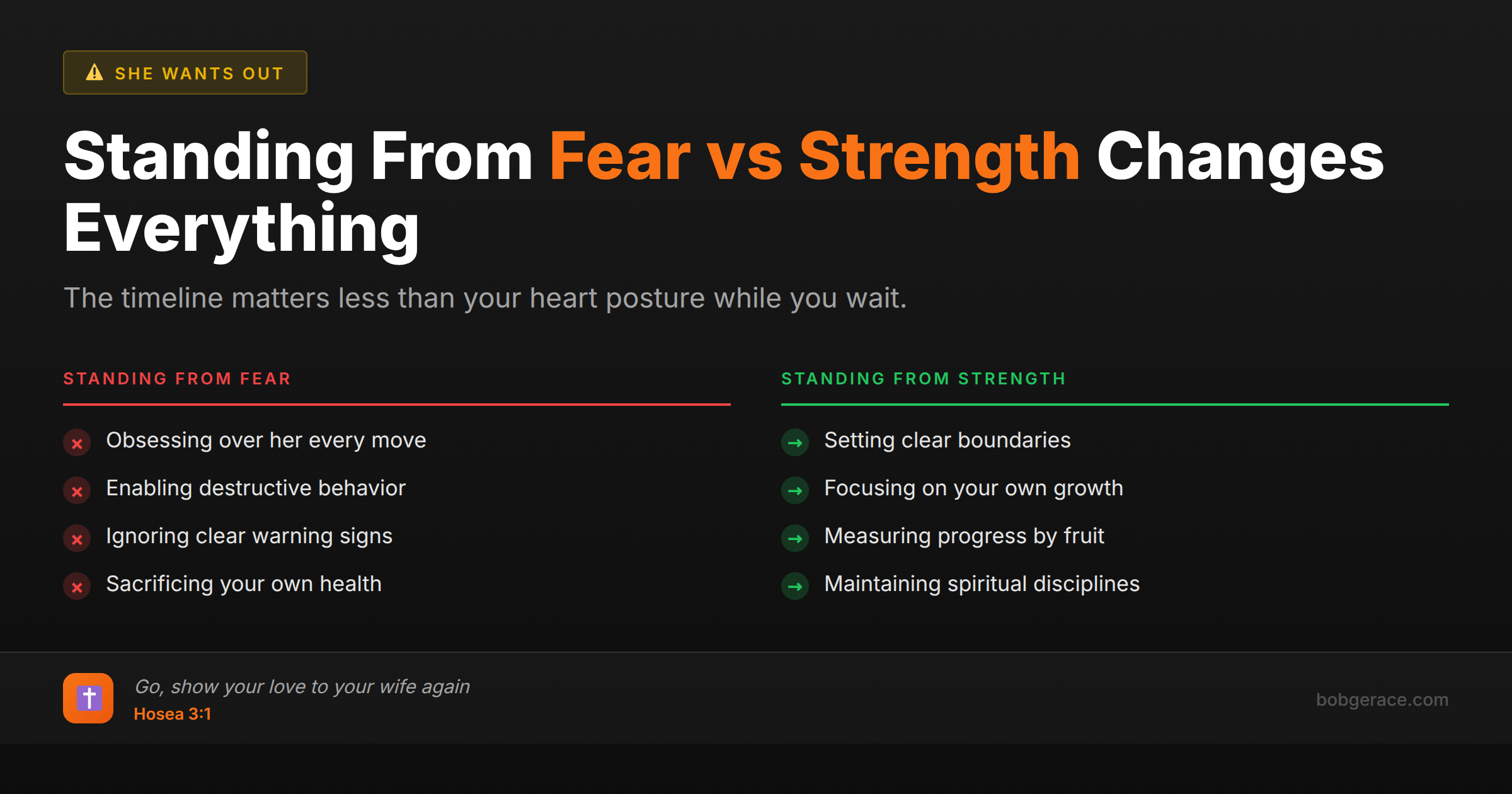
There's no magic timeline for standing for your marriage, but there are clear markers that should guide your decision. I've seen men stand effectively for 6 months and see breakthrough, while others have stood for years without real change. The key isn't duration—it's whether you're seeing genuine progress, maintaining your own spiritual and emotional health, and operating from wisdom rather than desperation. Here's what I tell the men I coach: Stand as long as you can do it from a place of strength, hope, and clear boundaries. The moment you're standing from fear, codependency, or denial of reality, you've shifted from biblical standing to unhealthy obsession. Your timeline should be determined by fruit, not feelings.
The Full Picture
Standing for your marriage isn't about endlessly waiting while life passes you by. It's about active, purposeful engagement in restoration while maintaining healthy boundaries and realistic expectations.
Real standing involves several key elements:
• Personal transformation - You're actively working on yourself, not just waiting for her to change • Clear boundaries - You're not accepting destructive behavior in the name of 'love' • Spiritual grounding - Your hope is anchored in God's character, not just your desired outcome • Practical wisdom - You're making decisions based on reality, not fantasy
I've worked with men who stood for 18 months and saw complete restoration because they did the hard work of change. I've also counseled men who wasted five years in pseudo-standing—essentially enabling destructive patterns while calling it faithfulness.
The difference is always fruit. Is your standing producing positive change in you? Is it creating space for genuine repentance and healing? Are you growing in wisdom, strength, and spiritual maturity? Or are you stuck in a cycle of pleading, pursuing, and hoping she'll just 'come around'?
Common mistakes that extend timelines unnecessarily: • Confusing standing with pursuing • Ignoring destructive patterns • Making her comfort your priority over her growth • Operating from fear rather than faith • Refusing to set necessary boundaries
The men who see the best outcomes understand that standing has seasons. There's a season for active pursuit, a season for patient waiting, and yes, sometimes a season for stepping back and allowing consequences to do their work.
What's Really Happening
From a therapeutic standpoint, the question of 'how long' often reveals deeper issues about attachment anxiety and control. Research in marriage recovery shows that outcomes are more correlated with the quality of change efforts than their duration.
Neurologically, prolonged high-stress 'standing' can actually work against you. When you're in chronic fight-or-flight mode, your prefrontal cortex—responsible for wise decision-making—becomes compromised. This leads to reactive rather than responsive behavior patterns.
The most successful marriage restoration cases involve: • Clear differentiation between spouses (you can love her without losing yourself) • Consistent boundaries that create safety for both parties • Focus on personal growth rather than spouse modification • Regular reality-testing with trusted advisors
Trauma bonding is a critical factor many men don't recognize. If your standing is driven by intermittent reinforcement (occasional positive responses followed by rejection), you may be caught in an addictive cycle that feels like faithfulness but is actually codependency.
The therapeutic timeline for genuine change in deeply troubled marriages typically ranges from 12-36 months, assuming both parties are actively engaged. However, if one spouse is completely disengaged or actively destructive, unilateral change efforts rarely succeed beyond the 18-24 month mark without significant boundary interventions.
Attachment theory suggests that secure individuals know when to persist and when to pivot. They can hold hope while simultaneously accepting reality. This isn't contradictory—it's mature love.
What Scripture Says
Scripture gives us a framework for standing that balances persistence with wisdom, and hope with reality. God himself models both faithful pursuit and necessary boundaries.
Hosea 3:1-3 shows us God's heart: "Go, show your love to your wife again, though she is loved by another man and is an adulteress. Love her as the Lord loves the Israelites." But notice—Hosea set clear boundaries. He didn't enable Gomer's destructive choices.
Matthew 18:15-17 provides the process for dealing with unrepentant behavior: "If your brother or sister sins, go and point out their fault... But if they will not listen, take one or two others along... If they still refuse to listen, tell it to the church; and if they refuse to listen even to the church, treat them as you would a pagan or a tax collector." This isn't abandonment—it's loving accountability.
1 Corinthians 7:15 acknowledges reality: "But if the unbeliever leaves, let it be so. The brother or the sister is not bound in such circumstances; God has called us to live in peace." Sometimes standing means releasing.
Ecclesiastes 3:1-8 reminds us there are seasons: "A time to embrace and a time to refrain from embracing... a time to keep and a time to throw away." Wisdom discerns the season.
Galatians 6:9 encourages persistence: "Let us not become weary in doing good, for at the proper time we will reap a harvest if we do not give up." But verse 7 warns: "Do not be deceived: God cannot be mocked. A man reaps what he sows." Your standing must allow space for natural consequences.
Biblical standing isn't endless tolerance of sin—it's faithful love with wise boundaries.
What To Do Right Now
-
1
Define what 'success' looks like beyond just her return—include your own growth and spiritual health
-
2
Set a formal review date (3, 6, or 12 months out) to honestly assess progress and fruit
-
3
Identify 3-5 trusted advisors who can speak truth to you about your standing approach
-
4
Create clear, non-negotiable boundaries around destructive behavior—and stick to them
-
5
Establish daily spiritual disciplines that ground your hope in God's character, not outcomes
-
6
Document patterns of behavior (both yours and hers) to avoid emotional decision-making based on recent events
Related Questions
- How long do I wait before giving up?
- When is it actually over?
- Is there a point of no return?
- At what point am I just torturing myself?
- What factors predict successful reconciliation?
- What's the difference between standing and stagnating?
- What does faithfulness require when she won't reciprocate?
- How do I discern God's will for my marriage?
- Can I forgive and still have boundaries?
- How do I know if he's really changing?
Also find Bob on
Subscribe for weekly videos on Christian marriage.
Get a Coach Who Knows Your Marriage
You're not standing in a vacuum. A coach who hears your actual story can tell you if you're standing from strength or fear—and when the timeline needs to shift.
Talk to Bob →