Is there a point of no return?
6 min read
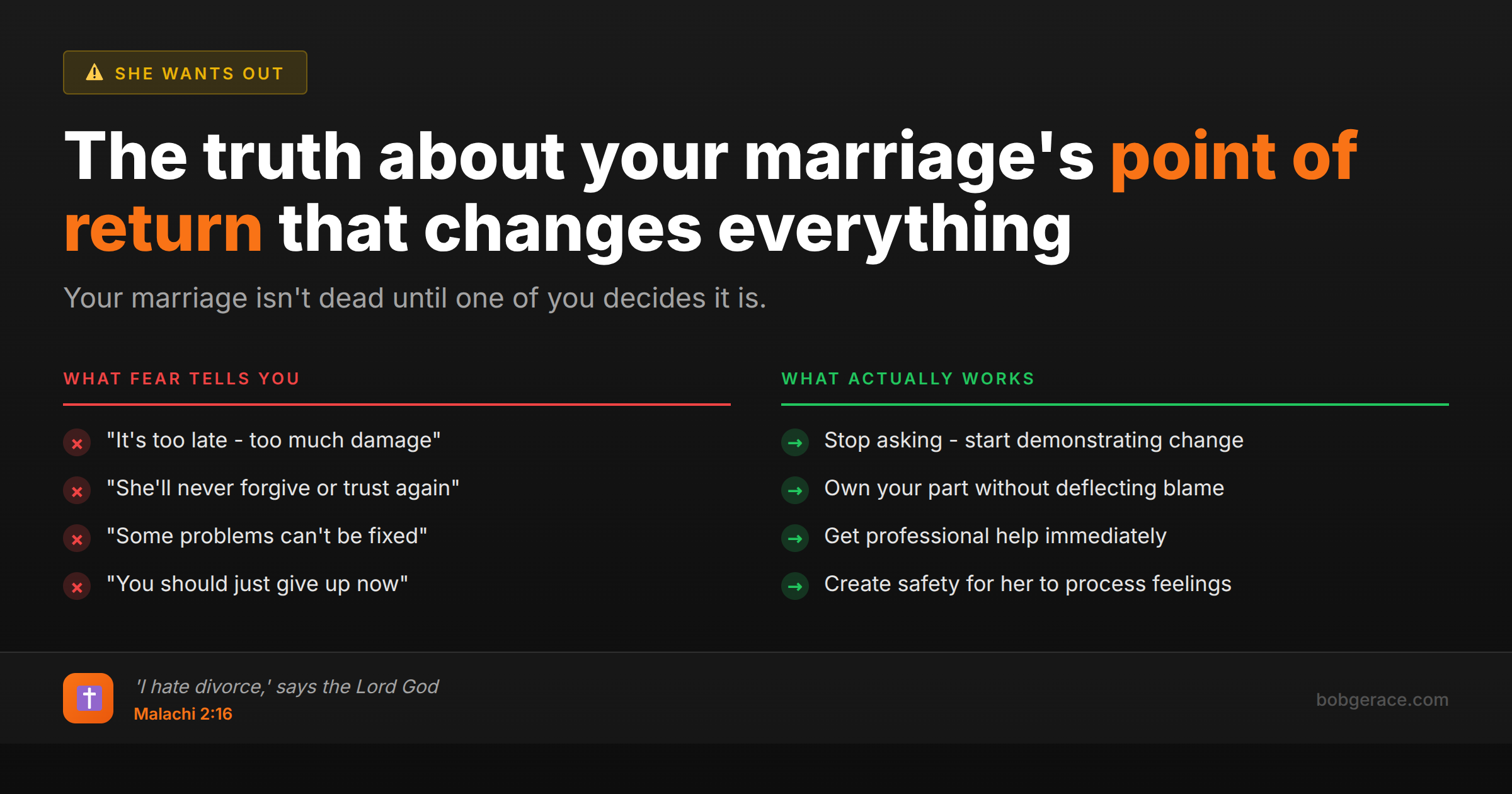
Here's the truth most marriage experts won't tell you: there's almost never a true point of no return, but there are definitely points where the path back becomes exponentially harder. The real question isn't whether it's possible - it's whether you're willing to do what it actually takes. I've seen marriages come back from affairs, addiction, years of neglect, and even divorce papers being filed. But I've also seen couples throw in the towel over issues that could have been resolved in months. The difference isn't the severity of the problems - it's the willingness of both people to do the deep, uncomfortable work of genuine change. Your marriage isn't dead until one of you decides it is.
The Full Picture
The concept of a "point of no return" is more about emotional capacity than actual possibility. What creates this feeling isn't usually one catastrophic event - it's the slow erosion of trust, connection, and hope over time.
The real danger zones include: • When your wife stops fighting and goes completely quiet • When she begins making concrete exit plans (financial, legal, living arrangements) • When she's emotionally invested in someone else • When you've repeatedly promised change but never followed through • When contempt has replaced anger in her responses to you
But here's what I've learned from working with hundreds of men: the point where she stops caring isn't necessarily the end - it's often the beginning of real work. When someone hits rock bottom, there's nowhere to go but up.
The biggest mistake men make is thinking they can negotiate, convince, or charm their way back. You can't reason someone into loving you again. Real recovery requires fundamental changes in who you are, not just what you do.
I've seen marriages recover from: • Multiple affairs • Financial betrayal • Addiction and recovery relapses • Years of emotional neglect • Physical separation • Filed divorce papers
The common thread in successful recoveries isn't the absence of damage - it's the presence of authentic transformation in the man, usually combined with professional help and a wife who's willing to cautiously re-engage when she sees genuine change.
What's Really Happening
From a therapeutic standpoint, the "point of no return" is less about objective relationship damage and more about what we call attachment injury and repair capacity. When someone repeatedly experiences betrayal or disappointment, their attachment system begins to shut down as a protective mechanism.
Research by Dr. Sue Johnson shows that even severely damaged relationships can recover when three conditions are met: safety is established, the injured partner's pain is truly acknowledged, and the injuring partner demonstrates consistent, reliable change over time. The key factor isn't the severity of the original wounds - it's whether new, positive experiences can override the negative emotional patterns.
Neurologically, relationships can be rebuilt because our brains maintain plasticity. However, the process becomes more complex when someone has developed what we call "protective detachment." This is when the emotional system essentially goes offline to prevent further hurt.
The clinical indicators I watch for aren't about specific behaviors but about emotional availability. When someone completely numbs out or becomes indifferent, recovery is still possible but requires much more intensive work. The brain needs to be convinced it's safe to hope again.
What often looks like a point of no return is actually a protective freeze response. The person isn't incapable of connection - they're protecting themselves from further injury. This means the path forward requires rebuilding safety before attempting to rebuild intimacy. Most couples try to skip the safety phase and wonder why nothing changes.
What Scripture Says
Scripture presents a powerful tension: God's heart for restoration alongside the reality of human choice and consequence. Malachi 2:16 tells us "'I hate divorce,' says the Lord God of Israel," revealing God's desire for marriage restoration even in difficult circumstances.
The story of Hosea provides the most compelling picture of pursuing a seemingly hopeless relationship. Hosea 3:1 says, "Go, show your love to your wife again, though she is loved by another man and is an adulteress. Love her as the Lord loves the Israelites." This demonstrates that even when betrayal seems final, God's call is toward redemption.
1 Corinthians 13:7 reminds us that love "always protects, always trusts, always hopes, always perseveres." This doesn't mean being naive about real problems, but it does mean maintaining hope for transformation when others have given up.
However, Scripture also acknowledges human hardness of heart. Matthew 19:8 shows Jesus explaining that Moses permitted divorce "because your hearts were hard," indicating that while God's design is restoration, human choice can create genuine barriers.
2 Corinthians 5:17 offers hope: "Therefore, if anyone is in Christ, the new creation has come: The old has gone, the new is here!" This suggests that no one is beyond the possibility of genuine transformation.
The biblical framework isn't naive optimism - it's hope grounded in God's power to transform hearts. While we cannot control another person's choices, we can trust that God can work in impossible situations when we align ourselves with His character and purposes.
What To Do Right Now
-
1
Stop asking her if the marriage can be saved - your actions will demonstrate your answer
-
2
Get professional help immediately, both individually and as a couple if she's willing
-
3
Identify and own the specific ways you've contributed to the relationship breakdown without deflecting
-
4
Make concrete changes in your daily behavior that she can observe, not just promises of future change
-
5
Create physical and emotional safety for her to process her feelings without trying to manage her responses
-
6
Commit to the long game - real trust rebuilding takes 18-24 months minimum, not weeks
Related Questions
- When is it actually over?
- How long do I wait before giving up?
- What factors predict successful reconciliation?
- What distinguishes marriages that make it from those that don't?
- How do I know if I'm in denial or in faith?
- What does healthy hope look like vs. fantasy?
- Can a marriage survive infidelity?
- Is some damage too deep to repair?
- What does real transformation look like?
- Can I actually become a different man?
Also find Bob on
Subscribe for weekly videos on Christian marriage.
Your Marriage Isn't Generic. Neither Is This.
If you're staring down divorce papers or an affair, you need a coach who knows your specific story and can tell you what to do Monday morning.
Talk to Bob →