Is the affair fog real?
6 min read
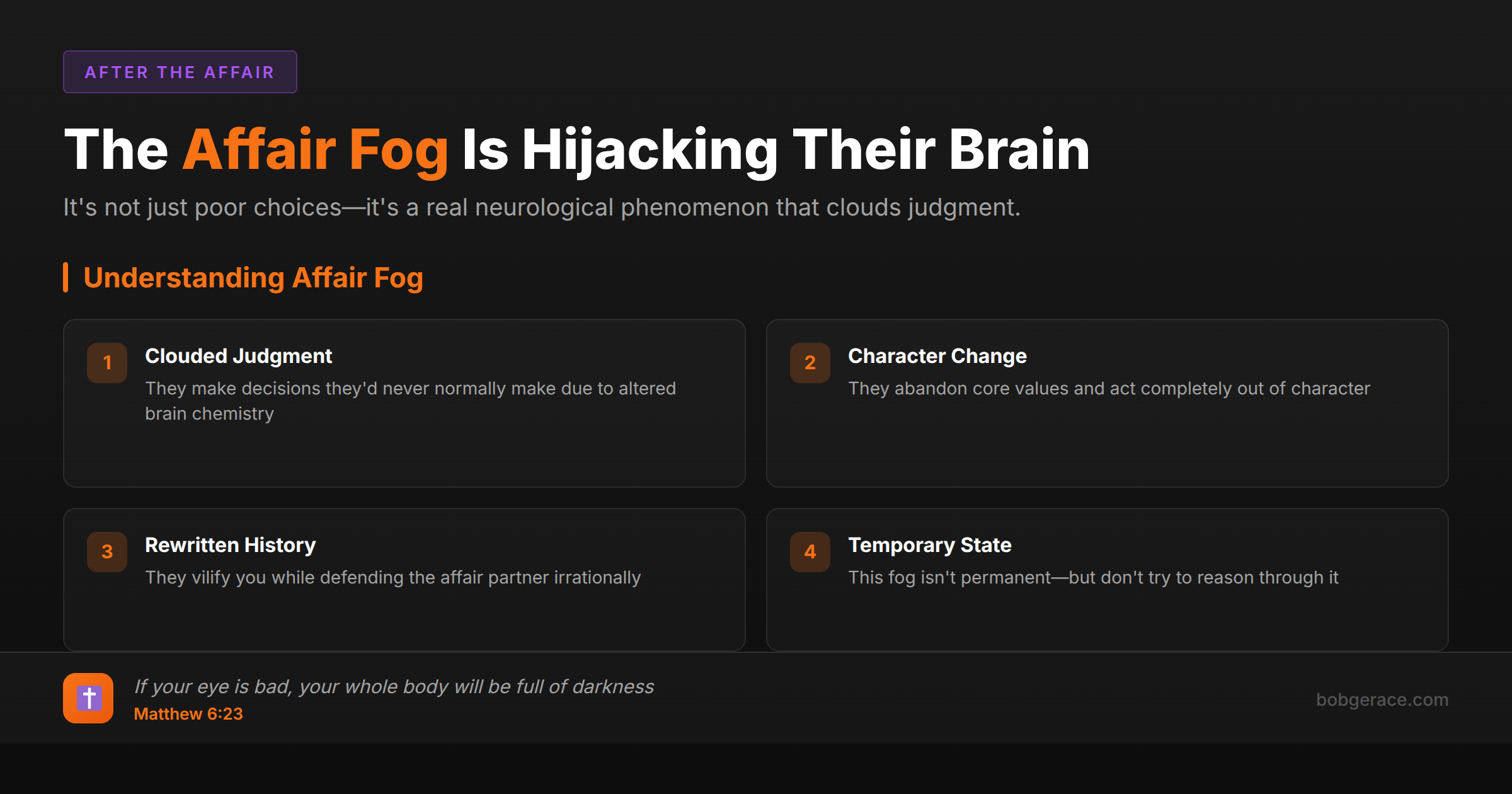
Yes, affair fog is absolutely real. It's a psychological state where someone involved in an affair experiences severely clouded judgment, making decisions they would never normally make. Think of it as an altered state of consciousness driven by powerful neurochemical changes in the brain. During affair fog, people often exhibit behavior that seems completely out of character - abandoning their values, making irrational choices, and being unable to think clearly about consequences. They may defend the affair partner while vilifying their spouse, rewrite marital history, or make statements like "I never loved you" that contradict years of shared experiences. This isn't just poor decision-making; it's a genuine neurological and psychological phenomenon that temporarily hijacks rational thinking.
The Full Picture
Affair fog is one of the most misunderstood aspects of infidelity, yet it's crucial for both spouses to understand what's happening. When someone enters into an affair, their brain chemistry literally changes. The combination of dopamine, norepinephrine, and decreased serotonin creates a cocktail similar to what we see in addiction.
The neurochemical reality is that the unfaithful spouse is experiencing what researchers call "intrusive thinking" - obsessive thoughts about the affair partner that can occupy up to 85% of their waking hours. Their brain is flooded with feel-good chemicals every time they think about, text, or see their affair partner. Meanwhile, anything associated with "normal life" - including their spouse and children - feels flat and colorless by comparison.
This creates several predictable behaviors: They may claim they "never loved" their spouse, rewrite the entire history of their marriage as unhappy, exhibit extreme mood swings, make impulsive decisions about finances or living situations, show decreased empathy for their spouse's pain, and defend the affair partner while attacking their spouse's character.
The fog typically intensifies during the early stages of an affair and can persist for months or even years if the affair continues. However, it's important to understand that affair fog doesn't excuse the choices being made - it explains them. The person is still responsible for their actions, but they're operating from a severely compromised mental state.
For the betrayed spouse, understanding affair fog can be both validating and devastating. Validating because it confirms that the person they're dealing with isn't really their spouse - not mentally or emotionally. Devastating because it means traditional reasoning, pleading, or appealing to shared history often won't work until the fog begins to lift.
What's Really Happening
From a clinical perspective, affair fog represents a perfect storm of neurochemical changes, cognitive distortions, and psychological defense mechanisms. When someone begins an affair, their brain essentially hijacks their rational decision-making processes.
The neurochemistry mirrors what we see in both new love and addiction. Elevated dopamine creates intense pleasure and motivation to pursue the affair partner. Increased norepinephrine heightens energy, focus, and memory formation around the affair relationship. Simultaneously, decreased serotonin leads to obsessive thinking patterns.
Cognitively, the unfaithful spouse develops what we call "confirmation bias on steroids." They selectively remember negative aspects of their marriage while idealizing the affair relationship. This isn't conscious manipulation - their brain is literally filtering information to support their current emotional state.
Psychologically, several defense mechanisms activate to protect their fragile emotional state. Projection causes them to blame their spouse for problems they've created. Rationalization helps them justify clearly wrong behavior. Minimization allows them to downplay the severity of their choices.
The fog typically follows predictable stages: initial excitement and secrecy, followed by increasing boldness and risk-taking, then either escalation toward leaving the marriage or eventual reality-//blog.bobgerace.com/marriage-testing-christian-wife-pass-tests-grace/:testing that can lead to the fog lifting. Understanding these patterns helps both spouses recognize that the current state isn't permanent, though professional intervention significantly improves outcomes.
What Scripture Says
Scripture speaks directly to the spiritual and psychological dynamics at work in affair fog, though it uses different language. The Bible describes how sin affects our thinking and decision-making processes in ways that align perfectly with what we observe clinically.
Sin creates spiritual blindness: "But if your eye is bad, your whole body will be full of darkness. If then the light that is in you is darkness, how great is the darkness!" (Matthew 6:23). This describes exactly what happens in affair fog - the person's ability to see clearly becomes compromised, affecting their entire perspective.
The heart becomes deceitful: "The heart is more deceitful than all else and is desperately sick; who can understand it?" (Jeremiah 17:9). During affair fog, people often say they're "following their heart," not realizing their heart is leading them into deception and destruction.
Temptation follows predictable patterns: "But each one is tempted when he is carried away and enticed by his own lust. Then when lust has conceived, it gives birth to sin; and when sin is accomplished, it brings forth death" (James 1:14-15). The progression from temptation to obsession to destructive action mirrors the affair fog journey perfectly.
Spiritual warfare intensifies: "Be of sober spirit, be on the alert. Your adversary, the devil, prowls around like a roaring lion, seeking someone to devour" (1 Peter 5:8). The enemy exploits vulnerable moments and clouded thinking to maximum advantage.
Yet hope remains through truth: "And you will know the truth, and the truth will make you free" (John 8:32). The fog can lift when truth penetrates the deception.
God can restore sound thinking: "For God has not given us a spirit of timidity, but of power and love and discipline" (2 Timothy 1:7). Recovery requires returning to God's design for clear thinking and sound judgment.
What To Do Right Now
-
1
Recognize the fog for what it is - don't try to reason with someone whose thinking is compromised; instead, focus on your own clarity and healing
-
2
Stop pursuing or pleading - these behaviors often push the foggy spouse further away and deeper into their distorted thinking patterns
-
3
Implement strong boundaries - protect yourself emotionally, financially, and physically while they're in this altered state
-
4
Build your support network - surround yourself with people who can think clearly since your spouse currently cannot
-
5
Focus on your own healing - use this time to address your own issues, grow stronger, and become the healthiest version of yourself
-
6
Pray for the fog to lift - ask God to break through the spiritual and psychological barriers that are keeping your spouse trapped in deception
Related Questions
- What is limerence?
- Is she in love or in limerence?
- How long does limerence last?
- Why does she seem like a different person?
- She says she's never felt this way before
- What is the neuroscience of limerence?
- She says she loves me but isn't 'in love'
- What is 'negative sentiment override' and does she have it?
Also find Bob on
Subscribe for weekly videos on Christian marriage.
You Need a Coach Who Knows Your Story
Affair fog in your marriage isn't textbook. It's your wife, your history, your specific situation. A coach calibrates to what's actually happening in your home.
Talk to Bob →