What actions from me help vs. hurt limerence dissipation?
6 min read
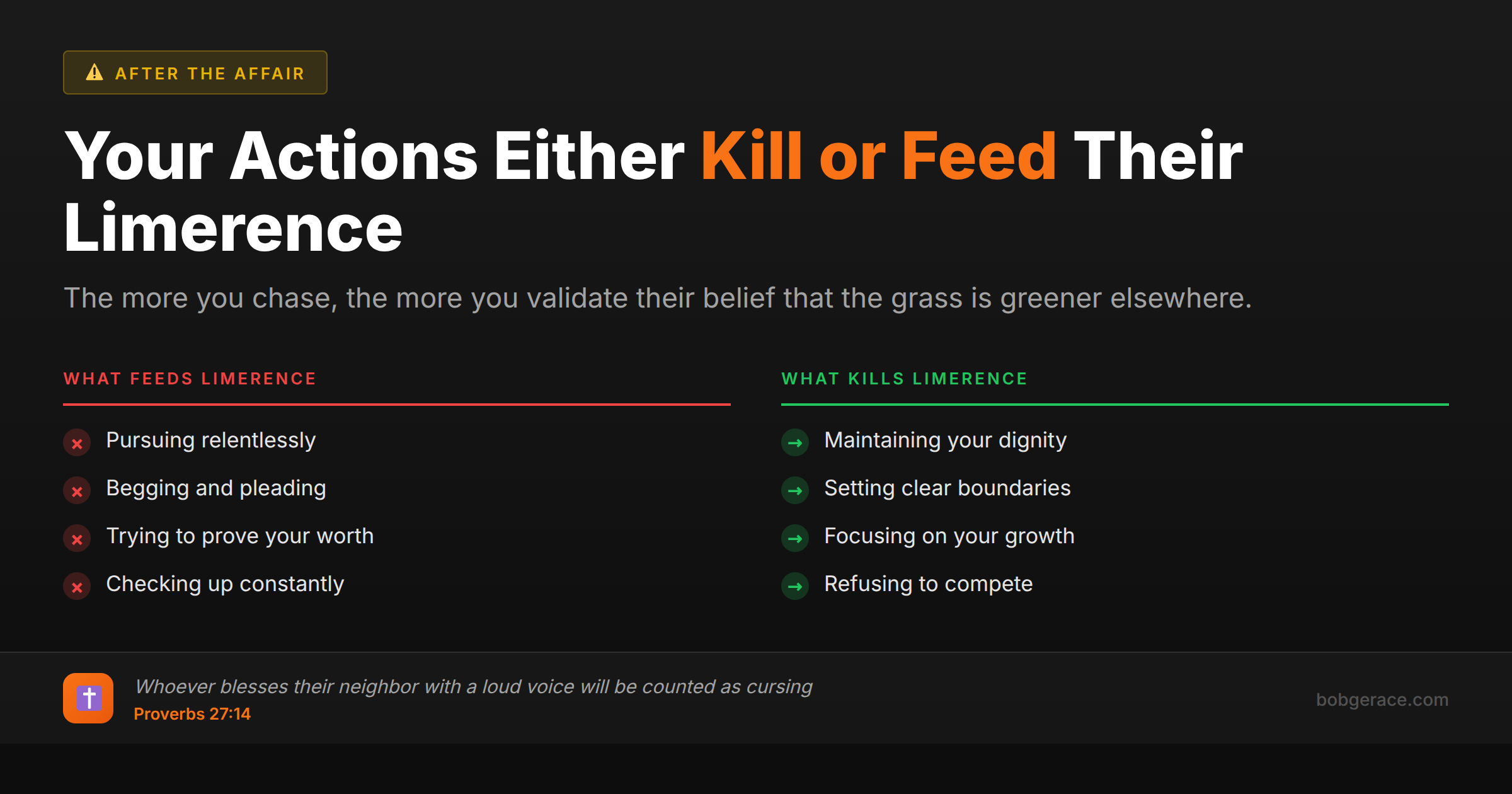
Your actions can either accelerate or prolong your spouse's limerence dissipation. Behaviors that help: Maintaining your dignity, setting clear boundaries, focusing on your own growth, and refusing to compete with the affair partner. Behaviors that hurt: Pursuing relentlessly, begging, trying to prove your worth, checking up constantly, or making desperate attempts to win them back. The counterintuitive truth is that the more you chase, the more you validate their belief that the grass is greener elsewhere. Limerence thrives on drama and uncertainty. When you remove yourself as a source of drama and instead become a stable, self-respecting person, you eliminate much of the emotional fuel that keeps limerence burning. This doesn't guarantee they'll return, but it gives the best chance for the fog to lift naturally.
The Full Picture
Understanding limerence dissipation requires grasping a fundamental truth: limerence is a temporary neurochemical state that eventually burns itself out. The question isn't whether it will end, but how long it takes and what role your behavior plays in that timeline.
Actions that accelerate dissipation work by removing the emotional fuel that keeps limerence burning. When you maintain dignity, set boundaries, and focus on your own life, you accomplish several things: First, you stop providing the drama and chaos that limerence feeds on. Second, you begin to embody the attractive qualities your spouse fell in love with originally. Third, you force them to experience the full weight of their choices without your emotional interference.
The 180-degree approach - where you completely reverse typical pursuing behaviors - often produces remarkable results. Instead of calling constantly, you go silent. Instead of professing your love, you focus on yourself. Instead of fighting for the relationship, you let natural consequences unfold.
Actions that prolong limerence typically involve anything that increases drama, provides attention, or removes consequences. Pick-me dancing, constant contact, emotional outbursts, and attempts to compete with the affair partner all serve to validate the limerent person's belief that they must be pretty special to have two people fighting over them.
The emotional thermostat effect explains why desperate behaviors backfire. When you're constantly pursuing, you raise the emotional temperature and keep the limerent high active. When you step back, the temperature drops, and reality begins to seep in. This doesn't happen overnight, but it's the most reliable path forward.
What's Really Happening
From a clinical perspective, limerence operates much like an addiction, complete with dopamine surges, withdrawal symptoms, and tolerance building. Your spouse's brain is literally hijacked by neurochemicals that create an altered state of consciousness.
The pursuit-distance dynamic is crucial to understand. Limerence thrives on uncertainty and intermittent reinforcement. When you pursue desperately, you actually strengthen the neural pathways that keep them focused on the affair partner. Your emotional intensity validates their unconscious belief that leaving must be the right choice because look how much drama it's creating.
Therapeutic research shows that limerence dissipates fastest when the limerent person experiences natural consequences without interference. This means allowing them to fully experience life with their affair partner - the good and the bad - without you as a buffer or distraction.
The paradox of letting go often confuses betrayed spouses. It feels like giving up, but it's actually the most powerful psychological move you can make. When you //blog.bobgerace.com/christian-marriage-patience-stop-demanding-trust-timeline/:stop being predictably available, you force their brain to recalibrate. The affair partner, who was once the exciting alternative, now becomes the only option - and that changes everything.
Neuroplasticity research indicates that sustained periods without reinforcement (your emotional reactions) allow the brain to begin forming new neural pathways. This process typically takes 60-90 days of consistent non-pursuit behavior to show significant impact.
What Scripture Says
Scripture provides profound wisdom about responding to betrayal and unfaithfulness with dignity and self-control. Proverbs 27:14 warns us: *"Whoever blesses their neighbor with a loud voice in the early morning will be counted as cursing."* Even good intentions can backfire when delivered with desperate intensity.
1 Peter 3:1-2 offers specific guidance for dealing with an unresponsive spouse: *"Wives, in the same way submit yourselves to your own husbands so that, if any of them do not believe the word, they may be won over without words by the behavior of their wives, when they see the purity and reverence of your lives."* This principle applies to both genders - sometimes our behavior speaks louder than our pleas.
Proverbs 25:17 provides another crucial insight: *"Seldom set foot in your neighbor's house—too much of you, and they will hate you."* Constant pursuit and overwhelming presence often produce the opposite of what we intend.
Matthew 10:14 shows us Jesus' own model for non-pursuit: *"If anyone will not welcome you or listen to your words, leave that home or town and shake the dust off your feet."* There's a time to walk away with dignity rather than continuing to pursue someone who has rejected you.
Romans 12:18-19 reminds us: *"If it is possible, as far as it depends on you, live at peace with everyone. Do not take revenge, my dear friends, but leave room for God's wrath."* Sometimes the most faithful response is stepping back and allowing God to work rather than trying to control the outcome through our own efforts.
Scripture consistently teaches that dignity, self-control, and trust in God's timing are more powerful than desperate human effort.
What To Do Right Now
-
1
Implement the 180 immediately - Stop all pursuing behaviors, reduce communication to logistics only, and begin focusing entirely on your own healing and growth
-
2
Remove yourself as entertainment - No more emotional conversations about the relationship, no checking up, no driving by locations, no social media stalking
-
3
Let natural consequences unfold - Stop protecting them from the results of their choices; let them experience the full weight of their decisions
-
4
Invest in your own transformation - Use this time for counseling, spiritual growth, physical fitness, and rediscovering who you are outside this crisis
-
5
Establish firm boundaries - Decide what behavior you will and won't accept, then enforce those boundaries consistently without explanation or negotiation
-
6
Find your community - Connect with people who can support your healing journey and hold you accountable to dignified behavior rather than desperate pursuit
Related Questions
Ready to Stop the Pursuing and Start Healing?
Learning to respond with dignity while your spouse is in limerence requires expert guidance and a clear strategy.
Get Help Now →