What did Emily Brown find about affair types?
6 min read
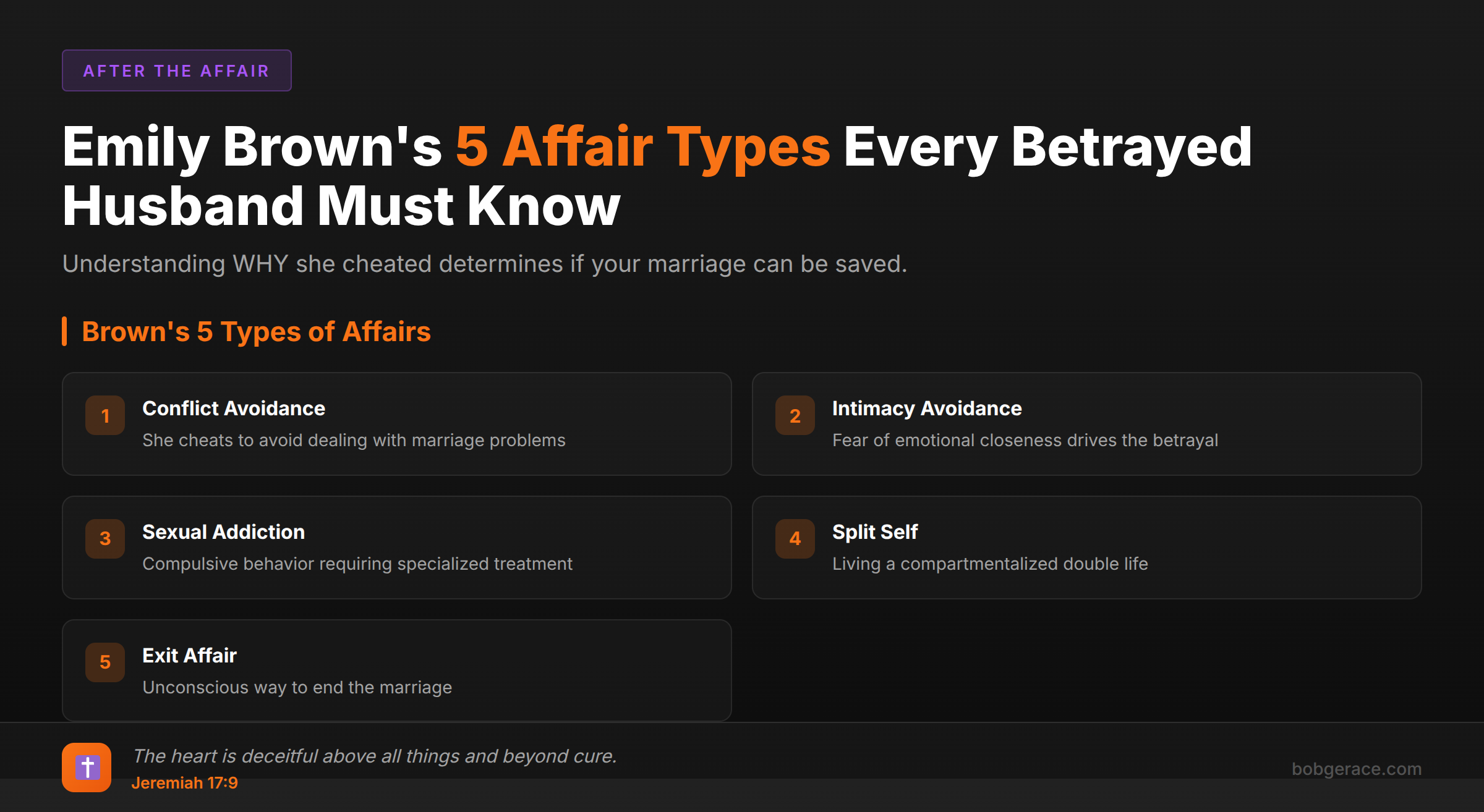
Emily Brown, a pioneering marriage therapist and researcher, identified five distinct types of affairs in her groundbreaking work. Her research revealed that not all affairs are the same - they stem from different motivations, follow different patterns, and require different approaches for healing. Brown's five types are: Conflict Avoidance Affairs (where partners avoid dealing with marital issues), Intimacy Avoidance Affairs (fear of emotional closeness drives the betrayal), Sexual Addiction Affairs (compulsive sexual behavior), Split Self Affairs (compartmentalized double life), and Exit Affairs (unconscious way to end the marriage). This classification revolutionized how therapists approach affair recovery because it showed that understanding the 'why' behind the affair is crucial for effective healing and preventing future betrayals.
The Full Picture
Emily Brown's research fundamentally changed how we understand infidelity. Before her work, most people viewed affairs as simple moral failures or relationship problems. Brown discovered that affairs are actually complex behavioral patterns with distinct motivations and characteristics.
The Five Affair Types:
1. Conflict Avoidance Affairs - These happen when spouses can't handle disagreement or difficult conversations. Instead of working through problems, one partner seeks comfort elsewhere. The affair partner often represents peace and understanding.
2. Intimacy Avoidance Affairs - Paradoxically, these occur when the marriage is going well. The betraying spouse gets scared of emotional closeness and sabotages the relationship through infidelity.
3. Sexual Addiction Affairs - These involve compulsive sexual behavior, often with multiple partners. The betraying spouse feels out of control and uses sex to manage emotional pain.
4. Split Self Affairs - The betraying spouse lives two completely separate lives. They genuinely love their spouse but maintain a secret relationship that fulfills different needs.
5. Exit Affairs - Unconsciously, the betraying spouse wants out of the marriage but can't face it directly. The affair becomes the catalyst for divorce.
Brown's research showed that each type requires different therapeutic approaches. A conflict avoidance affair needs communication skills training, while sexual addiction affairs require specialized addiction treatment. This insight explains why generic marriage counseling often fails after affairs - you're treating the wrong problem.
What's Really Happening
Brown's typology is clinically invaluable because it moves us beyond moral judgment into understanding behavioral patterns. In my practice, I see couples waste months in therapy because they're addressing surface issues instead of the underlying affair type.
The Conflict Avoidance pattern is most common in my experience. These couples have never learned healthy conflict resolutionn. The betraying spouse literally doesn't know how to voice dissatisfaction, so they seek validation elsewhere. Recovery requires intensive communication training.
Intimacy Avoidance affairs are the most confusing for betrayed spouses. Everything seemed fine, even great, then suddenly there's an affair. The betraying spouse often grew up in chaotic homes and unconsciously fears happiness won't last. They create drama to feel 'normal.'
Sexual Addiction affairs are the most devastating for betrayed spouses because of the multiple partners and high-risk behaviors. These require specialized addiction treatment alongside marriage therapy.
Split Self affairs often involve the most 'unlikely' people - pastors, devoted parents, community leaders. They compartmentalize so effectively that they genuinely believe they're still good spouses while maintaining the affair.
Exit Affairs are relationship enders disguised as relationship problems. The betraying spouse has already emotionally divorced but lacks courage to leave directly.
Understanding the type determines everything - from safety protocols to therapeutic interventions to realistic //blog.bobgerace.com/marriage-expectations-christian-reasonable-unreasonable/:expectations for recovery. Brown's work prevents therapists from applying one-size-fits-all approaches to fundamentally different problems.
What Scripture Says
While Emily Brown's research provides valuable clinical insights, Scripture gives us the ultimate framework for understanding and responding to adultery. God's Word addresses the heart issues behind all affair types.
The Root Issue - Heart Rebellion: *"The heart is deceitful above all things and beyond cure. Who can understand it?"* - Jeremiah 17:9
All affair types stem from the same spiritual root - a rebellious heart that chooses self over covenant commitment. Whether avoiding conflict or seeking exit, the betraying spouse prioritizes their desires over their sacred vows.
God's Design for Marriage Conflict: *"Be angry and do not sin; do not let the sun go down on your anger."* - Ephesians 4:26
Conflict Avoidance Affairs violate God's design for healthy marriage communication. Scripture doesn't tell us to avoid difficult conversations - it tells us how to have them righteously.
The Call to Faithfulness: *"Let marriage be held in honor among all, and let the marriage bed be undefiled, for God will judge the sexually immoral and adulterous."* - Hebrews 13:4
Regardless of affair type, Scripture's standard remains absolute. No psychological explanation excuses adultery - it calls for repentance and radical change.
Hope for Restoration: *"If we confess our sins, he is faithful and just to forgive us our sins and to cleanse us from all unrighteousness."* - 1 John 1:9
*"Therefore, if anyone is in Christ, he is a new creation. The old has passed away; behold, the new has come."* - 2 Corinthians 5:17
*"And after you have suffered a little while, the God of all grace, who has called you to his eternal glory in Christ, will himself restore, confirm, strengthen, and establish you."* - 1 Peter 5:10
God offers genuine transformation that addresses the heart issues behind every affair type. Clinical insight helps us understand patterns, but only Christ can create the new heart necessary for true change.
What To Do Right Now
-
1
Identify which of Brown's five affair types most closely matches your situation - this determines your recovery strategy
-
2
Stop generic marriage counseling if you're in it - find a therapist who specializes in your specific affair type
-
3
Address the underlying issue, not just the affair symptoms (communication skills, addiction treatment, etc.)
-
4
Set appropriate boundaries based on affair type - sexual addiction requires stricter protocols than conflict avoidance
-
5
Get individual therapy for the betraying spouse to address their specific psychological patterns
-
6
Establish realistic timeline expectations - different affair types have different recovery trajectories
Related Questions
- What does Shirley Glass research say about affair recovery?
- What does Esther Perel observe about limerence?
- What are the most common reasons women have affairs?
- What is 'attachment affair' vs. 'exit affair'?
- What's the 'affair bubble' and how does it pop?
- What percentage of affair relationships last?
- What is limerence?
- Why did she cheat?
- What does real transformation look like?
- How long does recovery take?
Also find Bob on
Subscribe for weekly videos on Christian marriage.
Your affair has a pattern. Let's name it.
Brown's types matter because the work changes depending on which one you're dealing with. A coach who knows your specific story can help you see which pattern fits—and what that means for the next 90 days.
Talk to Bob →