What is 'mind movies' and how do I stop them?
6 min read
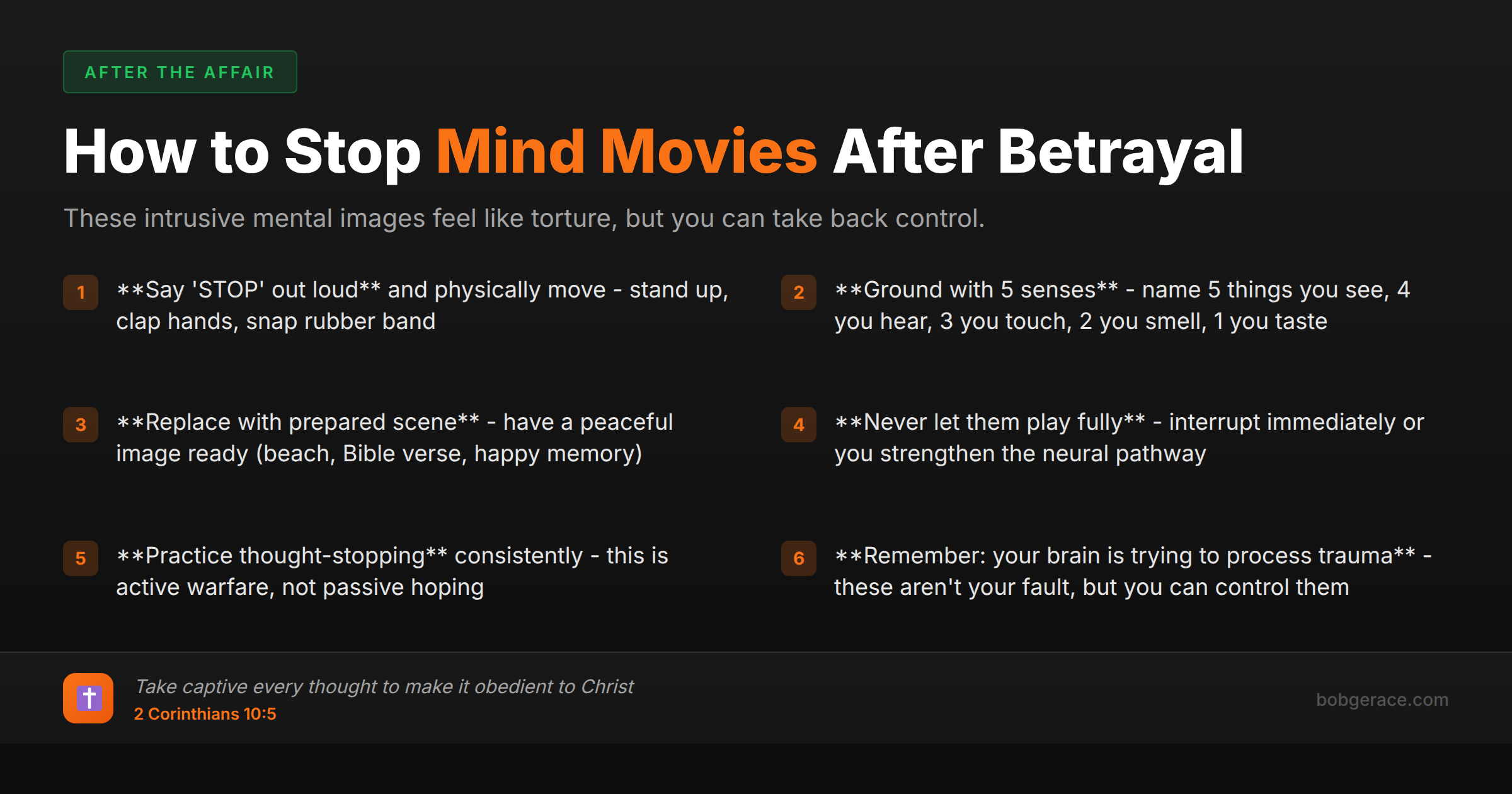
Mind movies are the involuntary, vivid mental images that play in your head about your spouse's affair - visualizing them together, imagining conversations, or replaying details you've learned. These intrusive thoughts feel like torture because your brain is trying to process trauma by creating mental scenarios, often filling in gaps with your worst fears. You can stop mind movies through specific techniques: interrupt the thought immediately when it starts, engage your senses with grounding exercises, replace the image with a predetermined positive scene, and practice thought-stopping methods. The key is consistent intervention - don't let these movies play to completion, as this reinforces the neural pathway and makes them stronger.
The Full Picture
Mind movies are one of the most torturous aspects of discovering infidelity. They're the vivid, unwanted mental images that play like films in your mind - showing your spouse with their affair partner, imagining intimate moments, conversations, or scenarios that may or may not have happened.
Why do mind movies happen? Your brain is desperately trying to make sense of betrayal trauma. When faced with incomplete information about the affair, your mind fills in the blanks - usually with your worst fears. It's your brain's misguided attempt to prepare you for future threats by obsessively reviewing potential scenarios.
The cruel irony is that these mental rehearsals don't actually protect you - they retraumatize you repeatedly. Every time you allow a mind movie to play to completion, you're essentially experiencing the betrayal again, flooding your system with stress hormones and deepening the trauma response.
Common triggers include being alone, seeing locations connected to the affair, certain times of day, or even random reminders. The movies often feel more real than reality because trauma memories are stored differently in the brain, with heightened emotional intensity.
The good news? Mind movies are a symptom, not a life sentence. They're evidence that your brain is processing trauma, and with the right tools, you can learn to interrupt these patterns and reclaim your mental space. Recovery isn't about never having another intrusive thought - it's about not being controlled by them.
What's Really Happening
From a clinical perspective, mind movies represent hypervigilance - a core symptom of betrayal trauma. When your fundamental assumptions about safety and trust are shattered, the brain shifts into survival mode, constantly scanning for threats and trying to predict future betrayals.
These intrusive images activate the same neural pathways as actual traumatic memories. Your amygdala can't distinguish between imagined and real threats, so each mind movie triggers a full stress response - elevated cortisol, increased //blog.bobgerace.com/holy-spirit-conviction-marriage-transform-heart/:heart rate, and emotional flooding.
The phenomenon involves what we call 'cognitive rehearsal' - your brain's attempt to prepare for similar future scenarios. Unfortunately, this process becomes maladaptive when it's compulsive and distressing rather than protective.
Effective intervention requires interrupting the neural pathway before it completes. Think of it like stopping a record player mid-song rather than letting it play through. Each time you successfully interrupt a mind movie, you weaken that particular neural connection.
Cognitive Behavioral Therapy techniques, particularly thought-stopping and cognitive restructuring, are highly effective. EMDR can also help process the underlying trauma that fuels these intrusive images. The key is understanding that you're not 'going crazy' - you're experiencing a normal trauma response that requires specific therapeutic intervention.
What Scripture Says
Scripture provides powerful truth about taking control of our thought life, especially during seasons of intense mental anguish.
2 Corinthians 10:5 commands us to 'take captive every thought to make it obedient to Christ.' This isn't passive wishful thinking - it's active warfare against thoughts that torment and destroy. Mind movies are exactly the kind of thoughts we must capture and redirect.
Philippians 4:8 gives us a replacement strategy: 'Finally, brothers and sisters, whatever is true, whatever is noble, whatever is right, whatever is pure, whatever is lovely, whatever is admirable—if anything is excellent or praiseworthy—think about such things.' When mind movies start, we have divine instruction to redirect our thoughts to what is true and pure.
Isaiah 26:3 promises, 'You will keep in perfect peace those whose minds are steadfast, because they trust in you.' Perfect peace comes from a steadfast mind - one that's disciplined and focused on God rather than consumed with tormenting images.
Psalm 94:19 offers comfort: 'When anxiety was great within me, your consolation brought me joy.' God understands the battle in our minds and provides consolation that can overcome even the most persistent intrusive thoughts.
God hasn't given you a mind to torture yourself. He's given you the power to choose your thoughts and the Holy Spirit to help you exercise that power, even in the aftermath of betrayal.
What To Do Right Now
-
1
Interrupt immediately - The moment a mind movie starts, say 'STOP' out loud and physically move your body. Stand up, clap your hands, or snap a rubber band on your wrist.
-
2
Engage your senses - Ground yourself in reality by naming 5 things you can see, 4 you can hear, 3 you can touch, 2 you can smell, and 1 you can taste.
-
3
Replace with prepared imagery - Have a predetermined positive mental scene ready (a peaceful beach, a meaningful Bible verse, a happy memory with your children) and immediately shift to that image.
-
4
Use the 'thought record' technique - Write down the intrusive thought, label it as 'trauma response,' and write a truthful counter-statement based on reality rather than fear.
-
5
Practice controlled breathing - Take 10 slow, deep breaths while focusing on a simple phrase like 'God is with me' or 'This will pass' to reset your nervous system.
-
6
Remove yourself from triggers - If certain locations, times, or activities consistently trigger mind movies, temporarily avoid them while you're building these new mental habits.
Related Questions
- How do I deal with intrusive images?
- How do I stop the mental movies?
- Why do I keep replaying the discovery?
- Why am I having intrusive thoughts/images?
- What is the 'trauma loop' and how do I interrupt it?
- Why do I compare myself to him obsessively?
- I can't control my anger
- Why do I repeat patterns I hate?
- How do I regulate my own system?
- What does nervous system regulation look like?
Also find Bob on
Subscribe for weekly videos on Christian marriage.
Bring Your Specific Mind Movies to Bob
The techniques work, but your brain keeps finding new angles. A coach who knows your story can help you interrupt the loops that matter most in your marriage.
Talk to Bob →