Why do I compare myself to him obsessively?
6 min read
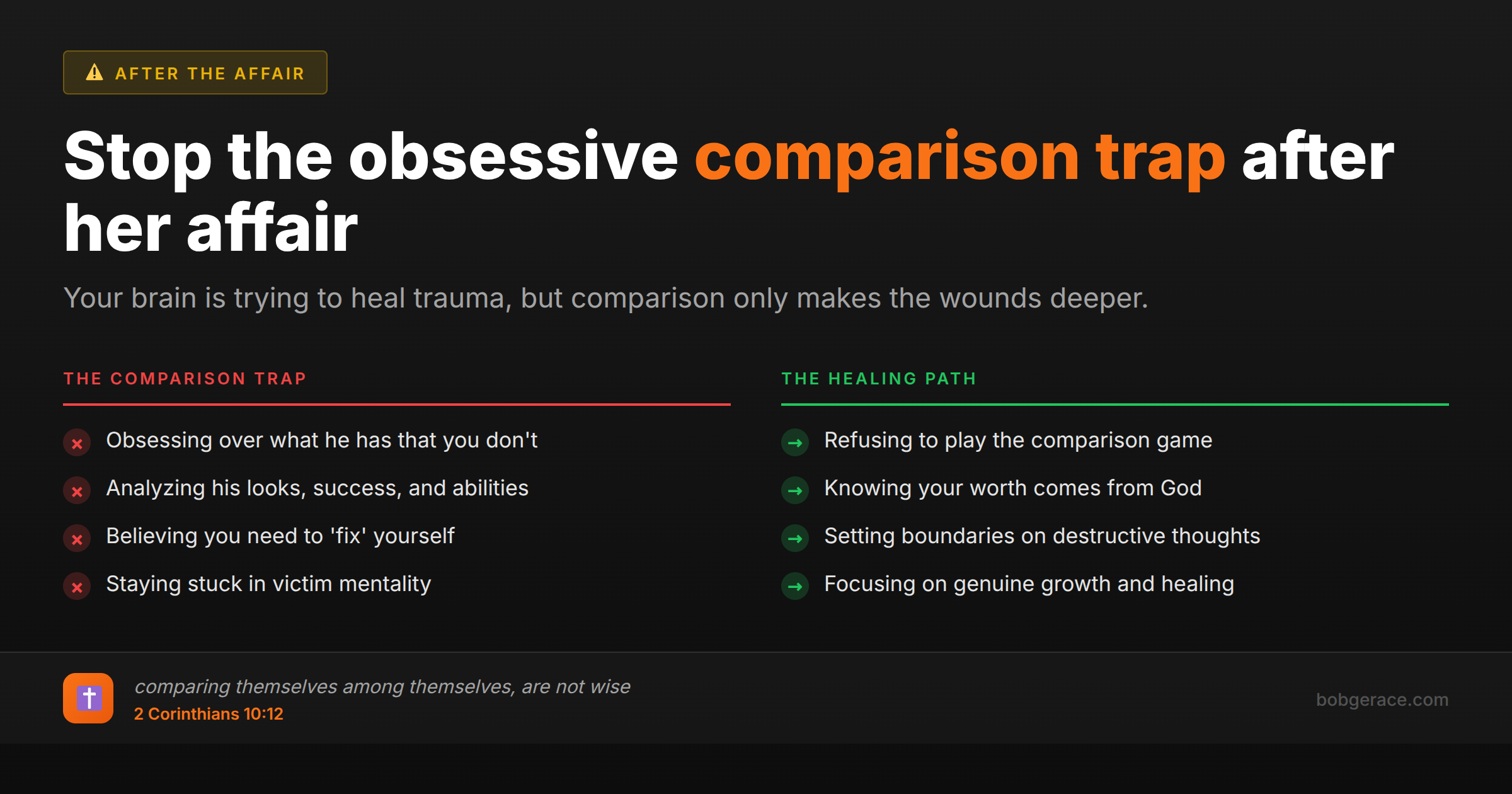
You compare yourself obsessively because your brain is trying to make sense of a devastating blow to your identity and worth. When your wife chose another man, even temporarily, it triggered every insecurity you've ever had about not being enough. Your mind desperately searches for explanations by analyzing what he has that you don't - his looks, success, personality, or abilities. This comparison trap is actually a trauma response. Your brain believes that if it can figure out why she chose him, it can somehow prevent future pain or help you "fix" yourself. But obsessive comparison only deepens your wounds and keeps you stuck in a victim mentality instead of focusing on genuine healing and growth.
The Full Picture
Let me be straight with you - this obsessive comparison is normal, but it's also destroying you from the inside out. Every man I've worked with after an affair goes through this mental torture chamber where they dissect every possible way the other man might be "better."
Here's what's really happening in your brain: When your wife had an affair, it didn't just break your marriage - it shattered your fundamental beliefs about yourself. You're not just dealing with betrayal; you're dealing with what psychologists call "comparative devaluation." Your mind has convinced itself that her choice was a direct referendum on your worth as a man.
The obsession serves a twisted psychological purpose. It gives you the illusion of control in a situation where you felt completely powerless. If you can figure out what made him more attractive, your brain believes you can either become that or prevent it from happening again. But this is a lie that keeps you trapped.
The comparison trap has three deadly components:
1. Magnification - You blow up his positive qualities while minimizing your own 2. Mind reading - You assume you know why she was attracted to him 3. Future projection - You believe understanding this will protect you from future hurt
Here's the brutal truth: Her affair wasn't a careful analysis of your deficiencies versus his strengths. Affairs happen in moments of weakness, emotional emptiness, and poor decision-making. She didn't create a spreadsheet comparing you two. She made a series of terrible choices that led to betraying her vows.
The real damage happens when you make his temporary appeal more significant than your permanent value. You're comparing your behind-the-scenes reality with his highlight reel in her mind during a fantasy period. That's not just unfair - it's completely unrealistic.
Your worth isn't determined by comparison to another man, especially not one who participated in destroying a marriage. You're fighting a rigged game where you've already decided you're the loser before you even start.
What's Really Happening
From a clinical perspective, obsessive comparison after infidelity represents a complex trauma response involving several psychological mechanisms. When a spouse discovers an affair, they experience what we call "assumptive world violation" - their basic beliefs about themselves, their relationship, and their safety in the world are shattered.
The comparison obsession serves as a maladaptive coping strategy. Your brain is attempting to regain a sense of control and predictability by analyzing the "threat" - the other man. This hypervigilance is similar to what we see in other trauma responses, where the mind becomes fixated on perceived dangers or inadequacies.
Three key psychological processes drive this obsession:
Cognitive rumination creates endless mental loops where you replay scenarios and analyze differences. This actually strengthens neural pathways associated with negative self-perception, making the obsession stronger over time.
Social comparison theory explains why we naturally evaluate ourselves relative to others, but trauma amplifies this process. You're not just comparing - you're using comparison as evidence in a case you're building against yourself.
Attachment injury triggers primitive fears of abandonment and inadequacy. The obsession becomes an attempt to understand how to be "worthy" of //blog.bobgerace.com/christian-marriage-service-transform-resentment-love/:love and faithfulness.
The neurological reality is that obsessive thoughts create actual changes in brain chemistry, releasing stress hormones that reinforce the cycle. Each comparison episode literally rewires your brain for more comparison and self-doubt.
Recovery requires understanding that these comparisons are trauma symptoms, not accurate assessments of reality. The goal isn't to win imaginary competitions with the affair partner, but to heal the underlying wounds that make comparison feel necessary for survival.
Breaking free requires redirecting that analytical energy toward understanding your own values, needs, and growth areas - independent of any other person. This shift from external validation to internal worth is essential for genuine healing.
What Scripture Says
God's Word speaks directly to this struggle with comparison and identity. Scripture makes it clear that your worth isn't determined by how you measure up to another man, but by how God sees you.
"For we dare not make ourselves of the number, or compare ourselves with some that commend themselves: but they measuring themselves by themselves, and comparing themselves among themselves, are not wise." (2 Corinthians 10:12) Paul warns us that comparison itself is foolishness. When you measure yourself against the other man, you're using a broken standard instead of God's perfect measure.
"I praise you because I am fearfully and wonderfully made; your works are wonderful, I know that full well." (Psalm 139:14) Your identity was established by God before this affair ever happened. The other man's temporary appeal doesn't diminish how God crafted you with intention and purpose.
"But when they measure themselves by themselves and compare themselves with themselves, they are not wise." (2 Corinthians 10:12 NIV) God calls comparison unwise because it takes your eyes off His truth about who you are. The affair wasn't God's assessment of your worth - it was sin disrupting His design for marriage.
"Am I now trying to win the approval of human beings, or of God? Or am I trying to please people? If I were still trying to please people, I would not be a servant of Christ." (Galatians 1:10) Your desperate need to understand why she chose him reveals you're still seeking human approval rather than resting in God's approval of you.
"The simple believe anything, but the prudent give thought to their steps." (Proverbs 14:15) Don't simply believe the lies that obsessive comparison whispers. Think carefully about whether these mental comparisons are leading you toward truth and healing or deeper into deception and pain.
"Above all else, guard your heart, for everything you do flows from it." (Proverbs 4:23) Obsessive comparison is failing to guard your heart. Instead of protecting your mind with God's truth about your identity, you're allowing toxic thoughts to poison your perspective.
God's design for your identity has nothing to do with being better than another man. It has everything to do with becoming the man He created you to be.
What To Do Right Now
-
1
Stop feeding the beast - When comparison thoughts start, immediately say "I refuse to play this game" and redirect your attention to something productive for 5 minutes
-
2
Write your non-negotiable truths - List 10 unchangeable facts about your worth that existed before the affair and remain true now, including your relationship with God
-
3
Set a comparison timer - Allow yourself 10 minutes daily to think about this, then say "time's up" and move on to prevent endless mental loops
-
4
Focus on your growth - Identify three areas where you want to improve as a man, completely separate from him or her opinion
-
5
Practice thought replacement - Every time you think about him, immediately pray for your wife's heart and your marriage's healing instead
-
6
Get an accountability partner - Tell a trusted friend or counselor when obsessive comparison starts so they can help redirect your thinking
Related Questions
- How do I compete with the affair partner?
- He's not even as good as me — why him?
- Why does she prefer him to me?
- What is 'comparison injury' and how do I manage it?
- Why is competing with the fantasy impossible?
- What does the other man represent that I don't?
- Was I not enough for her?
- I can't control my anger
- What does my body need right now?
Also find Bob on
Subscribe for weekly videos on Christian marriage.
Your marriage isn't a comparison problem
A coach who knows your actual story can help you stop spinning on 'why him' and start working on what rebuilds you. You don't have to figure this out alone.
Talk to Bob →